To follow-up on last week’s cast, here I am discussing the finer points of what I’ve learned about tabletop role playing games, and what I mean to do about it:
Faster prep
Faster play
Faster narrative escalation
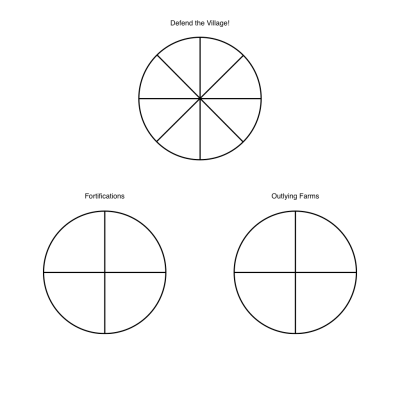
I talk about “clocks” at one point. These are those:
In the battles that take hours, dozens of dice are brought to bear. Me, a nerd, thought of only one thing:
What can we do to streamline the game?
Here’s what I found:
The Game Right Now
Stats
Warhammer 40K is a game of tiny model soldiers and monsters. A group of models is a “unit”, which is what acts on the battlefield.
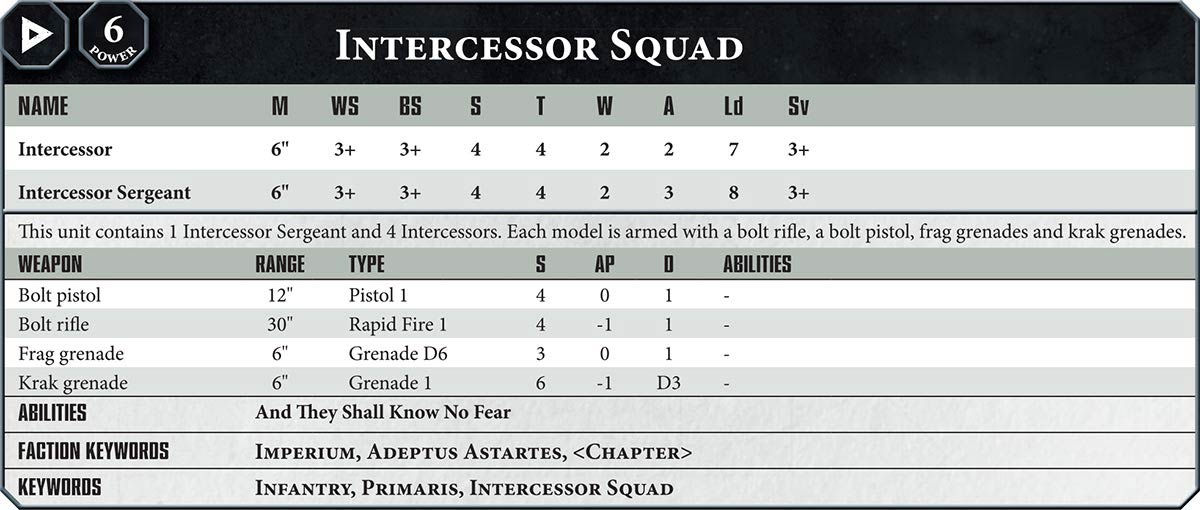
A unit has these stats:
Name – easily distinguishes what you’re talking about.
Power – the level of the unit. Counts towards how large an army comprised of units may be.
Movement (M) – how far a unit may move on the board in a normal turn.
Weapon Skill (WS) – chance of hitting a target in melee combat. (Really, “Melee Skill”.)
Ballistic Skill (BS) – chance of hitting a target by shooting at it.
Strength (S) – how hard a unit hits in melee.
Toughness (T) – how difficult it is for an attack to do damage to the unit.
Wounds – health points per model; 0 is the death of the model.
Attacks (A) – how many melee attacks the model may make.
Leadership (Ld) – how likely a unit is going to keep fighting after taking losses. (Losing models in a unit can cause the rest of the models to ‘flee’, AKA die.)
Save (Sv) – what a player must roll to not have their models die when attacked.
Units also have special abilities and weapons. While weapons have Range, Armor Piercing (makes it harder for a target to Save), Strength (in melee, use this or the unit’s Strength, whichever is higher), Damage, and a special effects, these are self-evident in what they might do.
Turns
A single player turn is defined by phases:
Movement – if a unit can move, it may do so.
Psychic – special to only certain units in the game. Like shooting, but with your mind.
Shooting – ranged units fire.
Charge – units can move again. If they do, they get shot at.
Fight – all units close enough to enemy units use their melee weapons.
Morale – for any unit that lost models in the turn, they roll against their Leadership. Failure here can collapse the rest of the unit. (Heard you liked taking losses, so here are some losses for your losses.)
Shooting and Fight are the dice-heavy portions of the game and will be our focus here.
Let’s look at the similarities of the Shooting and Fight in how they make models die.
Both phases start by using Ballistic and Weapon Skill (respectively) multiplied by the number of Attacks that can be made in the form of numbers of dice. A success here is when set A of dice roll equal to or greater than the Skill, becoming subset B.
Next, an attacking player must check the Strength of their attacks against the Toughness of the target. What subset B needs to be or greater to changes when Strength is the same or different to the Toughness. Subset B will become subset C.
Finally, the player owning the target units will roll for their Save. The number of dice in subset C is how many dice must be rolled, their face value needing to be equal to or greater than the Save of the target. The number of dice that fall below this value are the number of models to apply the Damage of the attack to the model’s Wound (or “taking a Wound”).
TLDR; An attacker must see if they hit, then see if they harm a target. The target gets a chance to save themselves. If not, models take Wounds.
Clear so far?
My Turn
Looks like we have some formulas to crunch, starting with combining the attacking player’s “did I hit” and “did I harm” rolls.
The Attacker
We’ll ignore the differences between Shooting and Fight phases, instead focusing on only the hit/harm cycle.
For that, the hit roll is determined by the chance of Skill passing a value roll times the number of Attacks.
To Hit = chance Skill * Attack
Easy.
To harm, it gets tricky. We ought to compare the Strength stat of the attacker to the Toughness of the target.
To Harm = (Variable, given Strength compared to Toughness)
This marriage of stats means we can’t have one nice roll for the attacker as it changes every time they pick a different target.
Let’s get a divorce.
If we only consider the Strength of the attacker, the Strength ought to also be considered as a chance roll. Say, for a five Strength, it’s two (five or greater, six) divided by six (six-sided die D6), or 33%.
We’ll need to do something with chance Strength. How about combining it to Skill and Attack?
For that, we can put the passing chance of Skill and Strength together, forming a percentage. This percentage will be low because we’re multiplying percentages, so take 100% minus the low chance we got, thereby betting Let Attack be the number of dice to roll:
To Hit and Harm = 100% – (chance Skill * chance Strength), per #D6, # from Attack
We’re forgetting the Armor Piercing stat of some weapons. Originally, this would apply to the Save roll of the target. Since we’re trying to divorce the stats of two different units as much as possible, Armor Piercing should apply to the hit-and-harm combination roll:
Single Hit and Harm Roll = ((100% – (chance Skill * chance Strength)) * 6) + Armor Piercing
If a unit can roll dice greater than or equal to the value from the formula above, the attacker has successfully struck.
How does this work? Take an Intercessor Squad, armed with a Bolt Rifle, as example:
One model in the unit is going to fire at a target. Thus, it’s chance of success for a single die (ignoring that it could make multiple attacks) is:
Success >= (6/6 – (4/6 * 3/6) * 6) – 1
>= (1 – (.333)) * 6) – 1
>= (.667 * 6) – 1
>= 4 – 1 >= 3
This example shows we have a 67% chance to succeed on any roll. People like succeeding, so this high chance is perfect for an attacker’s immersion when they get to keep dice on the table. No problem there!
We see how what would normally be multiple rolls of dice distills into a single roll per attack for either ranged or melee combat. Time savings, huzzah!
The Target
We have to keep our target from dying. From the previous section, Toughness is on its lonesome. We also took care of the Save vs. Armor Piercing. Thus, pairing Toughness with Save, we get something like:
Get to Live >= (100% – (chance Toughness * chance Save)) * 6, per successful attacker die
Any failure here will cost Wounds from the Damage of the attack.
Using the Intercessor Squad above and for a single successful die, we get:
Get to Live >= (6/6 – (3/6 * 4/6)) * 6
= (1 – (.333)) * 6
>= .667 * 6 >= 4
If we don’t get a four on our dice, our own Intercessors will die. Sad day 😥
Still a good day, though, since we can provide a base stat to our unit on what it must roll to survive being attacked!
So we’re looking at a 3+ to attack and a 4+ to live. The numbers boil down to a 33% chance of Wounding a model (66.7% chance of a successful attack roll multiplied by a 50% chance to fail a saving roll).
But again, only two rolls are needed to determine an outcome from end to end, compared to three previously, and with a lot less mental math of comparing attackers to targets.
So Where Do We Go From Here?
I have a confession…
I didn’t playtest this system.
It’s a shame, I know. You know. Playtesting would be the next step. This could be done with Excel simulations, seeing what the typical outcome of this system is compared to the actual game.
There’s a concern already that we aren’t removing enough models, the chance of Wounding being a little low. That, and how can we leverage the Power of a unit? Can it be added to rolls or the difference between attacker and target be applied? I don’t know yet. Merely, it wouldn’t make a lot of sense for a tiny bug (yes, these are in the game) to survive being stomped on by a giant robot.
Doing research for this post, I also found fun numbers and percentages when using a D20 (20-sided dice). The result made calculating roll value requirements a lot easier when different weapons were applied to different units. An article here could be forthcoming with a proper investigation.
Finally, consolidating the stats of a few units is in order. That’d allow for a few examples of simpler, streamlined play.
That’s it! What have you done to improve games in your life? I hope this mod is an inspiration to look at things through a lens of “how can this be made into something new, maybe better?” Cheers for now!
Just the other day I was introduced to the role-playing game The Orc and the Pie. Written by Monte Cook of Dungeons & Dragons fame, it’s the world’s most popular and shortest-yet-technically-complete RPG adventure game. The only things a player knows is that:
You see an orc with a pie.
The room is 10 feet by 10 feet.
The rest is up to the imagination of the player with guidance from the Game Master (GM).
Pretty cool, eh? Simple, straight to the point, and offers creative freedom.
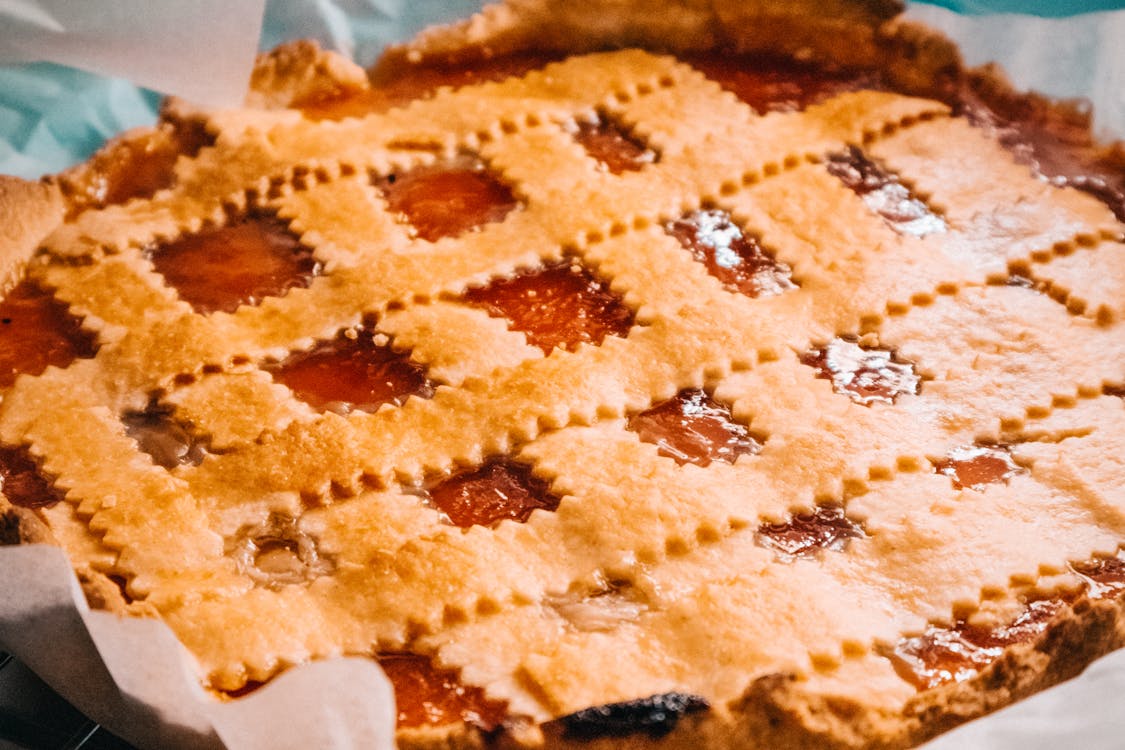
Let’s take that freedom and run. (Oh, and look at pie ~)
Looking at The Orc and the Pie, we see the following elements of the game world:
Potential Obstacle: The orc.
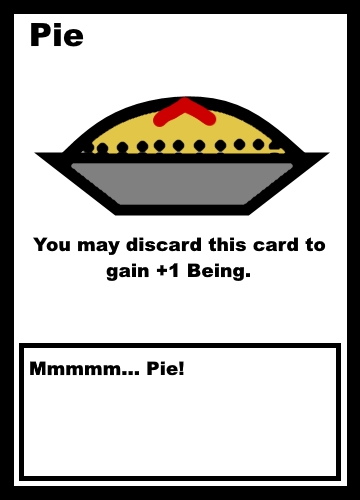
Object: The pie.
Context: The 10×10 room.
The Potential Obstacle is an implied conflict. There’s nothing in the scenario that indicates that the orc will do anything. Maybe it’s a coward, maybe it wants to sell the players the pie, maybe it’s minding its own business.
Our Object is also the implied goal. The players should want pie and acquire it in any way they deem fit.
The Context is merely a setting for the space. It could be a moon, the bottom of the ocean, or nowhere specific – everything ‘just is’.
Going Further
Ignoring the players for now, we can boil the game world down.
First, let’s toss out Context. A setting is interchangeable and largely only a consequence of how players might exist and act in relation to other characters / objects.
Next, I thought the RPG might be about the player, a goal (the Object), and some conflict (our orc) of getting that goal. However, the conflict between the player and a goal is merely a chance of failure of attaining the goal. The goal itself is a player want, whatever that ought to be.
Nixing Context and consolidating the Object and Potential, we’re left with:
Want: Whatever the player seeks to objectively say they’ve succeeded.
Chance: However likely the player gets what they want. The fairest chance is 50% to get it, 50% to not.
Gone Too Far
At this high-level view of The Orc and the Pie (and all RPGs for that matter [heck, even just games!]), we have the following synopsis:
Something is wanted.
The chance of getting what is wanted is 50%.
Our distillation of the game has been chopped up to a coin toss. “I want heads, which has a 50% chance of happening.”
Kinda lame.
Coming Back
It seems The Orc and the Pie has hit the formula of world creation pretty precisely. However, ‘world’ as environmental Context is not necessary. We can rely on players to develop their own Context.
But Potential Obstacle and Object? We need these. Chance and Want respectively are their ghosts, such that a chance to succeed in overcoming any Potential Obstacle exists and an Object can be implied to be the Want of the players.
Let’s keep our Potential Obstacle (orc) and Want (pie). How do players engage with these things?
The Players
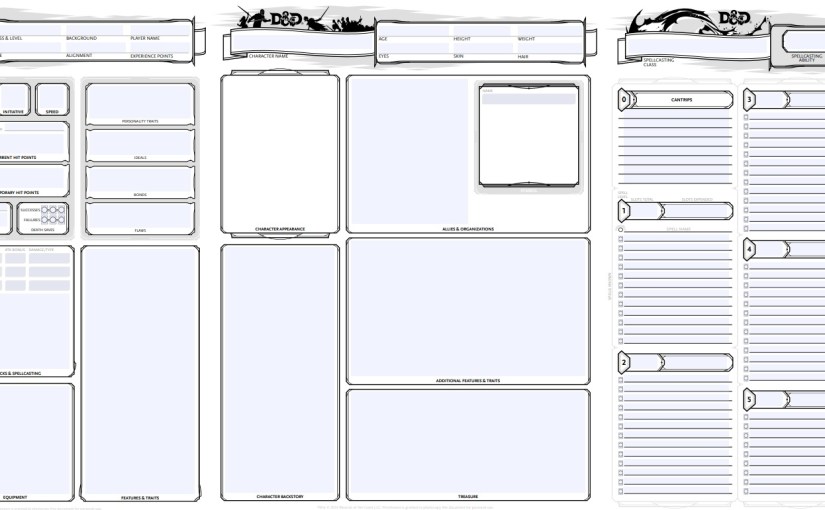
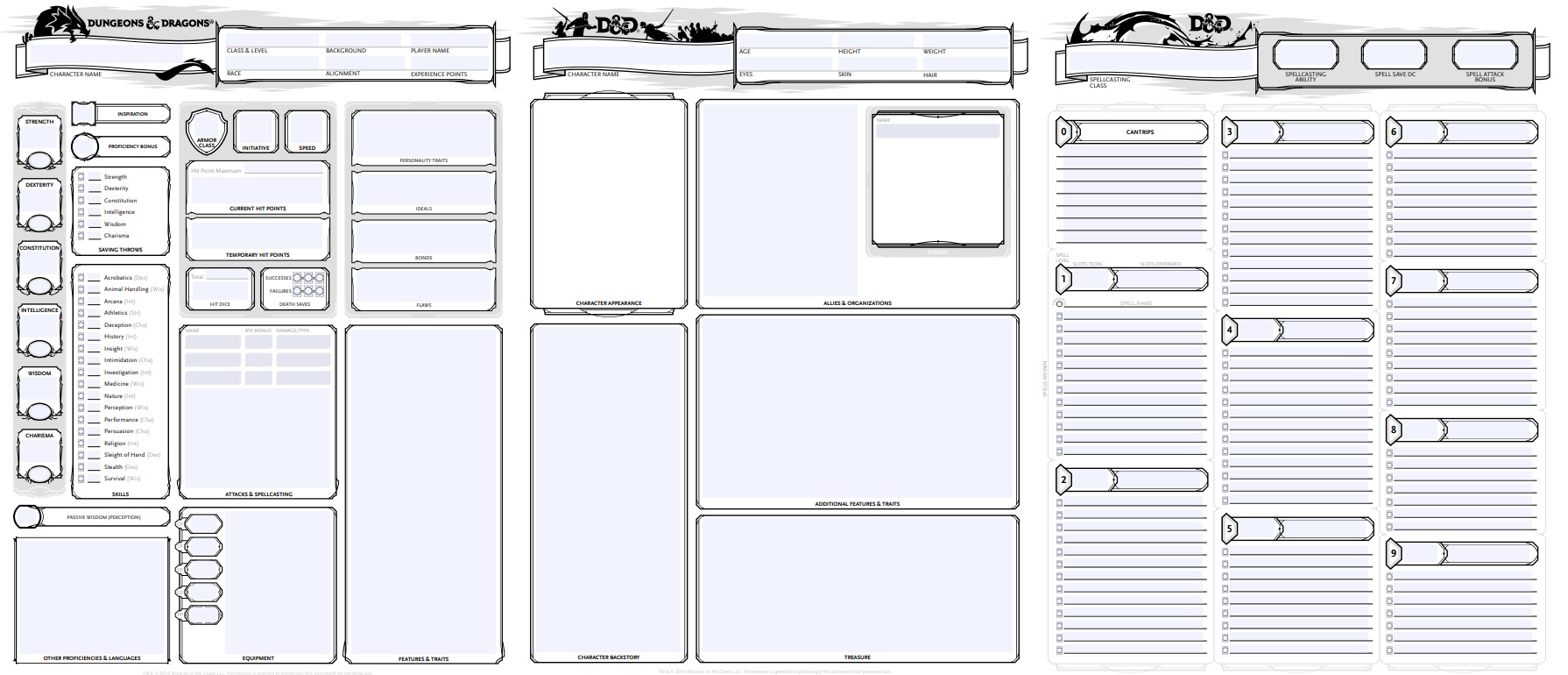
We’re missing our live-action cast for the role-play. In D&D for which The Orc and the Pie was made for, players sit in front of something like this:
Click the link above to see the full thing and spend a good 15 minutes just reading the section titles. We have, in no specific nor complete order: Class, Name, Alignment, Strength, Strength (again, but different), Ideals, Flaws, Equipment with “PP” (???), Wisdom, Wisdom again (passive this time), and a whole lot more.
That’s just from the first sheet of 3. And this isn’t the only kind of sheet there is! We have Adventure League, starters, D&D Beyond(not my character), and a metric boat-load of homebrew sheets for the myriad RPGs there are in existence.
But what in the world does all this have to do with pie and an orc?
Getting That Pie
Since simplicity is key, let’s get after as few things that’ll do as much as possible. Back to the burner to boil down the essence of player character…
Any character enacting on the physical world has physical attributes. We could divide this into something like Strength, Speed, and Sustainment (“constitution”, “endurance”, whatever; SSS seems like a cool acronym), but for simplicity’s sake, Brawn will be our trait for a brute-force approach to getting pie.
Since we’re not forgoing clever problem solving or thinking about how to get pie, Brain is our second trait. With book smarts and objective study of the world, Brain affects how a character can come up with a solution, notice things, or out-quiz an orc (or pie!) on trivia.
Lastly, Being. This is our health point / resource / whatever might get the players to care about failure. Maybe it’s ego. When a player character fails an action of Brain or Brawn, or when something succeeds against the player (with negative intention, like an attacking orc), their Being decreases. When a player character has no Being, they stop rolling dice or playing cards. They’re done (at least for awhile).
Shall we go farther? If we break B3 down, we have a single attribute, Chance, that dictates how likely a player is to accomplish whatever they attempt. The value of Chance would be how many coins need to be flipped to success to guarantee overall success.
Chance could have a spot in a very minimal setting. It serves as a nice tracker of ‘status’ (leveling, character health, etc.). The more a player succeeds, the higher Chance they have to continue to succeed! As they fail, those failures cascade into spectacular foibles great for storytelling.
Is Chance too simple? I’d say that depends. What kind of game is being played? If it’s aiming for a modicum of role-play, the B3 system is the way to go. Are you a fast, strong, dexterous character? Or more of the quick witted, perceptive variety?
The Orc and the Pie is a splendid basis for finding out what role-playing games are, what games can be on a fundamental level before they become too simplistic.
The game world of an RPG is easily set up. We have a (implied) want, chances to attain that want, character traits to alter those chances, and a clear end state for player and non-player characters, divorced from but ready to serve player goals.
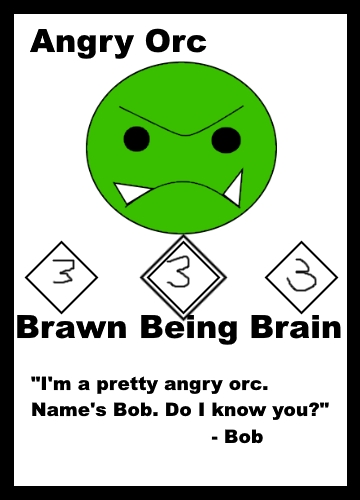
Bob, not so bad.Your dreams and desires incarnate.
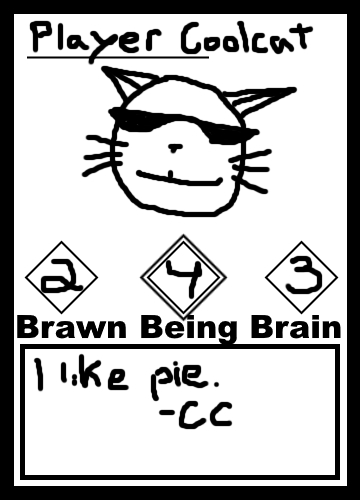
Speaking of players, with a D6, we can fill in our own player character:
Player #1
These numbers could be what a person has to role for success (a D6 roll greater than 8-# [“7” so a number of 6 would at least have a chance of failure with a roll of 1]), the number of dice to role to succeed (#D6), the number we have to roll under, or whatever. Lower numbers are bad.
An example of gameplay could end up being:
Coolcat: “I shove Bob to get to the Pie.”
Coolcat rolls a 1, failing the action for their Brawn, instead falling into Bob.
Bob reacts, rolling a 5, a success for Bob’s Brawn.
Bob pushes Coolcat away.
Coolcat falls over, losing a point in Being.
Bob: “What the heck. You’re getting me pretty angry.”
Coolcat chooses to use their Brain to negotiate with Bob.
Coolcat rolls a 6 off their Brain, a critical success!
Coolcat: “Look, Bob, whose name I know because I read your card, I’m sorry. A tasty-looking Pie is over there. Want to share it?”
Bob: “Ah, apologies accepted! Sorry about shoving you so hard. Why sure, let’s split this delicious Pie!”
Bob and Coolcat both get Pie – Scenario complete!
Players are more difficult to cater to because they are people. People are difficult. However, with Brawn and Brain and Being, Potential Obstacles and implied Wants, playing RPGs doesn’t have to be.
The same goes for designing RPGs. In Part 2 of The Orc and the Pie, I’ll take a look at adding onto and into the game’s systems.

 – health points per model; 0 is the death of the model.

 Jimmy Chattin