Thinking About Trivial Conflict

After seeing Avengers: Endgame and a pivotal episode of Game of Thrones last week, I come away awestruck by the scope of the conflicts.

One deals with half of all beings in the universe (the universe) dying; the other, a seemingly unkillable king of the dead wages war against the living in a hellish blizzard.

It makes superheroes punching each other (Avengers) or bickering about who owns which castle (GoT) just seem… So trivial.

Let’s also take a look at a few other hugely-grossing conflicts:

Yet, our personal stories are still about nations at war, gangsters and the law, the fly in our soup.

We know the vastness that lays before us in the future. With this prescience that extends from the outcome of our own lives to the outcome of our world and species, what are we doing with what is objectively trivial conflict?

It’s called into question my fascination with big space battles and urban tank fights. These are seemingly trivial.

What is there to do?

I don’t know how to handle a shift in focus on the macro-level, but maybe I can adapt to my own predispositions. It can’t be helped who I am, but I can help what I do in my story creation.

From now on I’ll endeavor to set the stakes before I set the conflict. No more senseless violence – if conflict must be acted on, it must be after all nonviolent approaches have been investigated. Never should conflict be glorified. May a person or force in writing do something barbaric, there will be severe, long-lasting, terrible consequences for all involved. A motive will be considered petty if it’s anything less than meaningful to the entirety of a person’s life. And if I can, at the end, despite any suffering caused or endured, there’ll be evidence that it was worth it, that the universe is one step closer to saving itself from entropy.

I can do something about setting the cultural gaze a little higher, a little farther. If I may, I’d beg you to do the same.
Case Study: Iterative Design

Sometimes I get inspired and sometimes that inspiration needs some work.

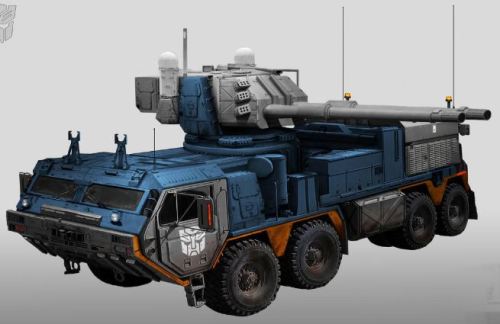
That’s what happened here when I saw part of Theo Stylianides’s AutoBots, Scattershot:

AutoBots-Scattershot.JPG
Scattershot from AutoBots by Theo Stylianides

The thought that come to mind: “Cool! Put a 5-inch naval gun on a truck! Suppress tanks with rapid fire, stability, and elevation, not to mention artillery support and modular design.”

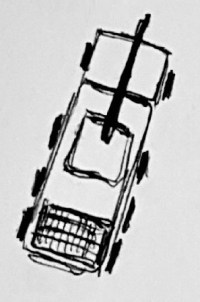
The way I think is in pictures. Names? I ‘see’ it written. Someone says ‘cat’? Fuzzy cat face that is probably no feline I’ve ever seen. Truck with a cannon? A drawing:

Sketches-Original-Long.jpg

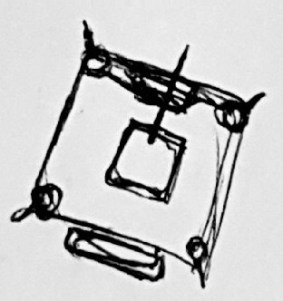
Looking at this, we need to consider street fighting and firing the cannon perpendicular to the axis of the truck. If that cannon fires, the truck will tip over or at least be rocked mightily.

So what can we do? Start simply: Make it so all sides are equal, that the cannon’s force in any direction is supported by the vehicle.

Sketches-Original-Square.jpg

That’s more like it!

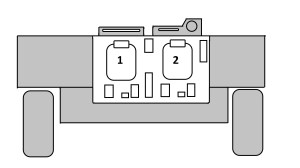
Though exposed, the cannon’s firing and reloading mechanisms are automated (see earlier in the video above for how that is done). We can stick a binocular camera set on it and seat the driver and gunner within the vehicle’s hull here.

SketchCrewCab-Clean.jpg

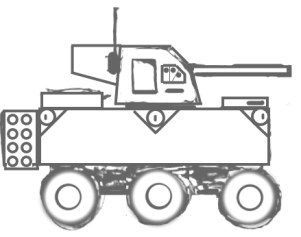
We’ll give it six-wheel drive for the streets and rubble present in urban fighting. On the back is a rack for additional ammo, fuel, or whatever we want. Ammunition is kept under the turret between the crew cabin and the engine at the rear of the vehicle. (A heavy engine’s weight can be made up for with thicker front armor to protect personnel.)

Objectively, this vehicle is pretty big as a target. Point-defense smoke for enemy sensors, lasers for missiles and ablative armor for kinetic rounds should do it. Let’s finally add a remote antipersonnel turret (yes, the lasers could selectively cook baddies too, but what do we do if it’s cloudy?):

Sketches-Side2.jpg

Viola! We have a truck with a naval-grade, rapid-fire, ready-to-be-modularized cannon!

This shows how I value function over form despite function being inspired visually. Have a problem? Change or add to the design to fix it, regardless of aesthetic.

As a happy accident, the weapon platform can join a small, personal fleet of ground fighting vehicles that fit a sci-fi ‘block’ theme:

Sketches-Lineup2.jpg

Thanks for getting this far. How do you get inspired? What do you do when that inspiration hits roadblocks? I’m always looking for ways to improve my problem-solving ability!

Competition Is for Chumps

Hear me out.

While some people think competition is well worth the punishment, there’s a case to be made that competition is for chumps.

Competition is stress. The body and mind typically fails under stress. Soul and faith is tested. Relationships degrade and IQ drops. In short, competition kills.

Woman Holding Her Head
Stress from Pexels.com

Doesn’t that mean those that can deal with and survive stress are better? The fittest? The opposite – those that survive competition either overpowered the opposition with minimal cost or were so weakened they are consumed by another overpowering force. Competition is only for those already fit above and beyond their competitors; anything else is destruction.

Something as small-scale as an argument between colleagues (a competition of who’s correct) is detrimental. What happens if you win an argument? You lose, having possibly damaged the relationship between you and the other. What if you lose? You lose, ego bruised, stature likely downgraded in the sight of the colleague, and you run the risk of public humiliation. Competition gave you nothing despite you ‘surviving’.

Remember the Cold War from 30 years ago? A sense of competition that couldn’t be helped during World War 2 bled over into the years after. During that time, the world saw the greatest increase of weapons production ever.

Men in Black and Red Cade Hats and Military Uniform
Russian soldiers from Pexels.com

From the display between the US and Soviet Russia, at best, we have a destabilized Middle East, a proliferation of nuclear weapons, and ongoing tensions. It could have been worse. The Cold War nearly got “hot” multiple times (Korean War, Sputnik, Vietnam War, Cuban Missile Crisis, any number of James Bond films), the consequences of which would have been the end of human civilization.

Why did we approach our own extinction? Competition. Capitalism vs. Communism. East vs. West. My army is bigger than your army.

So what do you do if faced with competition?

As mentioned, one must end it quickly by being absolutely overpowering by at least a magnitude (eg a competition of 1 requires you to be a 10). This can happen by letting other competitors go at it until you swoop in to take what’s left. However, whatever is being competed over will suffer (think of a football), leaving you with less, requires patience, and in no way guarantees success (there could be a magnitude 10 still left compared to your 1).

You can still win, though. When faced with competition, decline to compete.

Here’s a few ways how:

Kick Chess Piece Standing
Chess pieces from Pexels.com

Back Down, Rise Up

Backing down can be deemed as a weakness. This is only the pride of the moment getting in the way of any goal, or at the foundation, survival.

Say a person wants to take the lead on a project that you could also easily lead. You could use your skills or position already as a leader to squash their ambition. Or, you could let them take the lead so long as there’s no obvious threat to you. Do the latter.

With the other person as leader, they will do one of two things. First, they might prove themselves a fine and capable person, improving the situation for both yourself and others. If the first option fails, they will fail, taking the fall in your stead, no matter the reason. Should the second event come, it allows you to rise up to take charge again, hopefully also having a large amount of work done. Additionally, with a bit of compassion, you can improve the relationship with the person who tried and failed, but only because you didn’t butt heads in competition!

Secure Your Niches

It goes back to that “order of magnitude” thing. Leave where there is competition to secure where this is none (10 to 0!). That’s a niche.

Should you be so lucky as to be a first mover you gain momentum over any incoming competitors to your niche. It doesn’t prevent you from being displaced (there were Ubers before Uber), but it makes it a lot harder to be uprooted and still allows you to find more niches in the future.

On a global scale, a country could dominate any number of areas: tourism, ecology, education, shipping, infrastructure, computer science, production, military, diplomacy, art, writing, population, language, service, etc! The people of a country suffers when that country tries its best that’s only as good as some other country’s worst. Such is competition.

Grayscale Photography of Human Skull
Skull from Pexels.com

Takeaway

Competition is detrimental to you, others, and your goals. Even an order of magnitude advantage over other competitors only goes so far.

If something really must happen that involves competition, I encourage you to check your expectations.

Otherwise, consider letting others take the charge for you. Or better yet, compete against nothing after discovering your own niche.

History is full of competition. I’d like to see anything but the most dire cases not also causing suffering. From others’ examples, I’ll decline most all competition because “[…] doing the same thing over and over again and expecting different results” is for chumps.

Lasers + Shields = Boom in Dune

Warning: There is going to be math later. (I’ll try to make this deduction as fun as possible!) To business –

Immovable, Unstoppable

In Frank Herbert’s Dune, there exists protection that cannot be penetrated in the form of shields. Shields are immovable, covering everything from people to planets. This led to the end of ranged warfare as we would know it in Dune‘s universe.

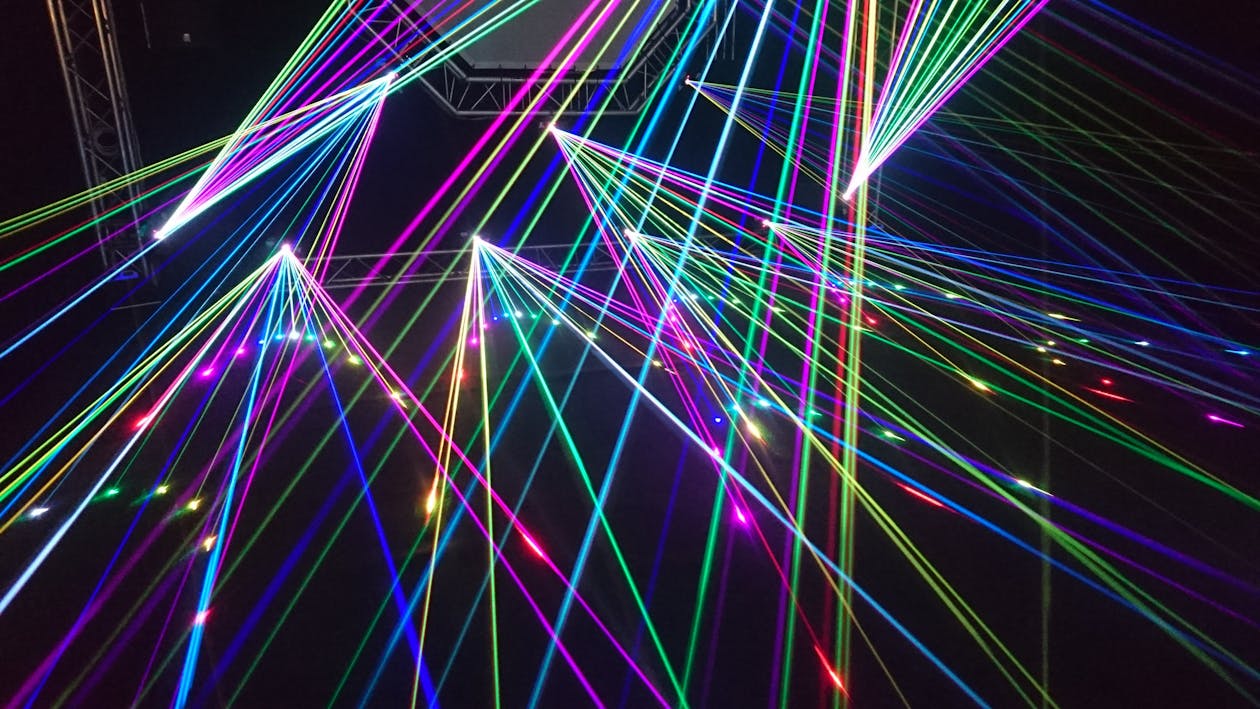
There also exists “lasers” (let’s call them “phasers” for now) when fighting at a distance is called for. Phasers can cut through anything and might be considered as an unstoppable force.

Assorted-color Laser Lights
Lasers from Pexels.com

When shields and phasers interact – that is, when the immovable meets the unstoppable – a huge explosion results:

A lasgun-shield explosion was a dangerous variable, could be more powerful than atomics […]
– Dune

Hearing this, I got to thinking. What kind of explosion are we talking about?

To find out, let’s first define our terms:

  1. Phaser – We’re going to consider this as equivalent to the Star Trek phaser. Those tools were also able to cut through anything and more, dissolving entire mountains in the early pistol-size variant.
  2. Shield – Here we assume that to stop any force, there must be an equal and opposite force. In the case of a phaser, we assume its disintegrating ray would be sent directly back along the line of the ray. Anything hitting the shield would disintegrate itself.
  3. Atomic – A nuclear weapon. For our purposes, assume 15 kilotons of explosive power (this was the power of the first atomic bomb in history).

Here comes the math…

So we shoot our phaser at a shield. At the speed of light, the shield deflects the beam back at us. Our ray hits and dissolves the matter in our phaser. All that matter has to go somewhere, right? With E=MC^2 (energy equals mass multiplied by the speed of light squared), we know that:

  • Energy (in Joules) = ?
  • C-speed of light squared = 9 x 10^16 meters^2 / seconds^2
  • Mass of a phaser = .340194 kilograms (assuming 12 ounces)

Therefore:

  • .340194 kilograms x 9 x 10^16 meters^2 / seconds^2
  • = 3.061746 x 10^16 Joules

A kiloton (measured in the mass of TNT-equivalent) is 4.18 x 10^12 Joules. We can cancel a few things out:

  • 3.061746 x 10^16 ÷ 4.18 x 10^12
  • = 3.061746 x 10^4 ÷ 4.18
  • = 30617.46 ÷ 4.18
  • = 7324.7512 kilotons

The energy held inside the matter of our handheld phaser is approximately 7324.7512 kilotons. To put that into perspective, that’s more that 488 atomic bombs.

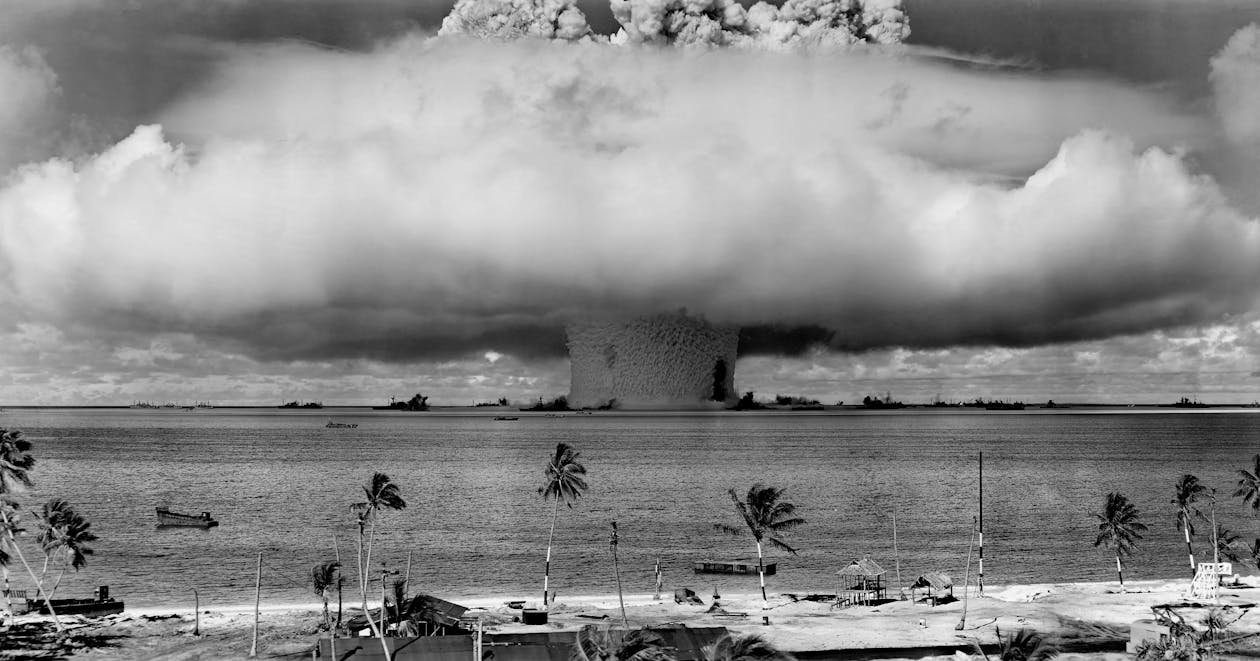
Grayscale Photo of Explosion on the Beach
Atomic explosion from Pexels.com

Let’s assume a 0.03% efficiency in converting mass into energy (equivalent to modern atomic weapons; not the most efficient conversion we can implement). That’s still some 15 atomic bombs going off. In your hand.

Little wonder the characters in Dune wouldn’t bring a gun to a knife fight.

Silver Butter Knife
Knife from Pexels.com

Record Your Good Days

These kinds of days are rare, few and far between.

Today (Sunday, April 28th, 2019) has been a Good Day.

However, what makes it “good”? That can vary from person to person.

For me, it’s a sense more than contentment. Might it be happiness?

(Well, if so, that’s a let down to think a majority of days aren’t “happy”. But must we be bursting at the gills with unconstrained joy 24/7? Probably best not to be that jovial. Sounds tiring.)

Regardless of the sensation, I like it. I’m sure you’ve felt the same at some points in life. Maybe even this week!

So how do we get this good feeling to come calling again?

To do that, what makes up these “good days” ought to be looked at factually but in broad strokes. Let’s take my day today as an example:

  • 5:30 AM wake-up; protein powder and coconut-oil + baking-chocolate drink.
  • 7 AM arrival at event site; provide support + hang out with strangers and teammates for event.
  • Take pre-competition cocktail (beetroot and maca powder, whole wheat spaghetti w/ peanut butter and oil, vitamins)
  • 8:30 AM first-in-line competitors at event.
  • I excel / don’t fail at event; team doesn’t fail at event.
  • Casually hang out / watch other teams / work out.
  • Learn we (the team) have won event; get medals.
  • Casually post online.
  • Shower + eat pancakes.
  • 40 minutes editing a story.
  • 20 minutes laundry.
  • 15 minutes watching comedy (laughing).
  • 20 minutes meditation.
  • 1 hour of edits.
  • 15 minutes light exercise.
  • Another hour of edits.
  • Make mac’n’cheese + frozen peas + egg. (It’s binge day on the 6-on, 1-off schedule!)
  • 20 minutes of writing in the journal (summarize dice game idea and decide between writing this post and playing video games).
  • Writing this post! (17 minutes in by this bullet.)

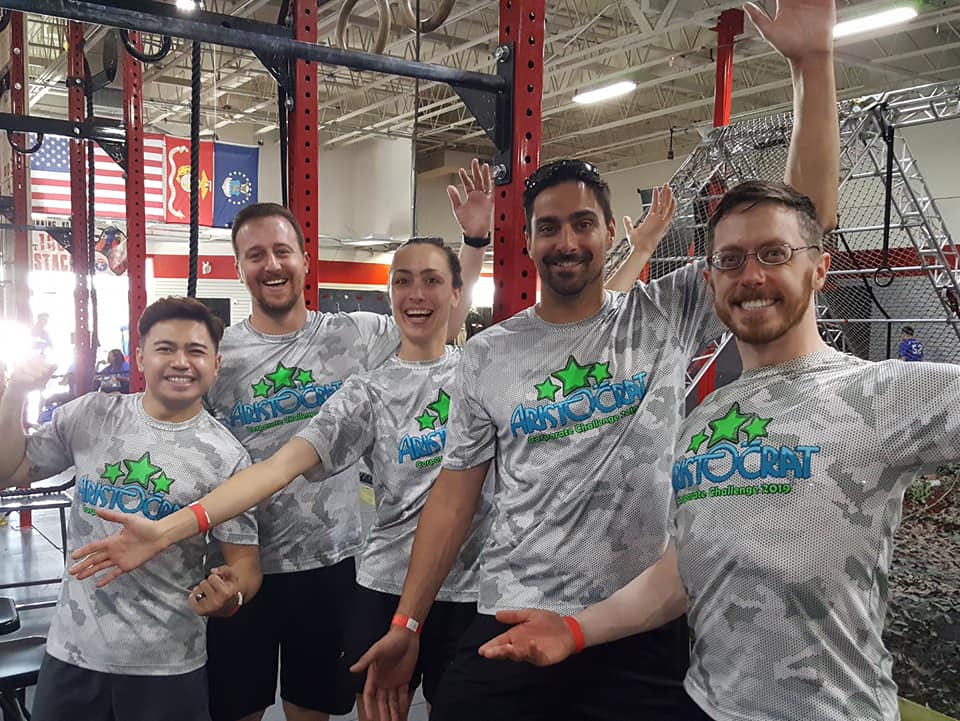
CorporateNinja2019
First-Place Ninjas of Las Vegas, B Division, 2019

My feelings are that I’ve done some cool stuff with cool people today while also saving time for myself for rest and accomplishment. That story is in good shape, I have a blog post incoming, and there is still time I might watch a cool movie or play a nifty video game!

Some generalities of today: Excellent weather (high of ~90 F, low wind), meeting people for a time, early-morning physical accomplishments, later-day personal project accomplishments, naps, and a touch of carb-rich foods.

What about other days?

Not all days have felt this good. Relatively few, in fact. The last time I recorded a really good day was April 13th. I’ve only thought to record a few similar times – these days still show some themes:

  • Great weather.
  • Physical accomplishment in the early morning w/ a team.
  • Casually watching people in a park do physical activity.
  • Socialize w/ strangers while also escaping to be on my own.
  • Casual physical activity.
  • Some generally-bad-for-you food w/ others.
  • Watch a good movie (Watchmen).
  • Laugh.

These are days to cherish. They don’t have the same specifics between them, nor do they need to. To get joy consistently / reliably is a work in progress.

A great outcome of taking note of these days and feelings is that I now have things to aim for, things to plan into my future. Certainly, this feeds into my analytical nature, these eyes for detail and pattern recognition.

If I plan on being happy, that comes with effort. It only could occur because 1) I’m aware and not afraid of my own feelings, 2) I wrote down and recognize what worked before, and 3) I forgave myself of backing off of various responsibilities (ie hanging out, video games, chores [this floor won’t vacuum itself…]).

Now I’m equipped for better days ahead. What to look for, what to say “yes” to, what to protect. If a record of the “good days” was absent, where would I be?

Without knowing the themes of your good feelings, where are you?