BITS – Starcraft

This is Jimmy.

Jim Raynor

Greetings! Taking a break from heavier topics to write something light: A game!

Not just any game, but a roleplaying game set in Activision Blizzard’s Starcraft universe driven by my very own BITS engine. (Of course to note: I own no stake in the Starcraft IP owned solely by Activision Blizzard, nor to I may any claim on the IP. The following is personally for education and publicly for entertainment purposes only.)

This came to me over the course of two afternoon hours, cleaned up and expanded here for you! As a modest, very prototype design of a famous IP, it ought to serve to highlight how to bring a real-time computer strategy game to the role-playing world.

Tough talk, Jimmy, but I don’t think you have what it takes to be a killer.

Kerrigan, Queen of Blades

Who the Characters Are

Awaken, my child, and embrace the glory that is your birthright. Know that I am the Overmind, the eternal will of the Swarm, and that you have been created to serve me.

Overmind

Players take on the roles of the units available to a faction in Starcraft: the haughty Protoss, the ravenous Zerg, or the troubled Terrans.

Any character is a standard unit in the game that then may play alongside GM-controlled hero characters. “Standard” means the player starts in an early tier unit, someone not the weakest (unless compensated accordingly), but certainly leaving room for growth.

Starting units come in tiers. Within the tier roles, each character comes with or chooses their own gear and specialties. Not all factions start in the same tiers. A shortlist of examples:

    • Terrans – Either a regular human or a robot.
      • Tier 0 – Space Construction Vehicle (SCV) operator, equipped with an exo-suit that is really bad at combat, but can breakdown structures, repair machines, and build anything anywhere given enough time and materiel.
      • Tier 1 – Marine, armed with powerful rifle and powered armor, though is unable to pilot vehicles.
    • Zerg – A spawned monster of leathery wings or chitinous hide.
      • Tier 0 – Zergling, a nasty creature of teeth and claws that travels with other Zerglings due to their minor stature.
      • Tier 1 – A slithering Hydralisk, armed with massive scythes and spewed barbs, but is a slow target.
    • Protoss – Either a psychically attuned alien or their AI servants.
      • Tier 1 – Zealot, the frontline warrior armed with energy fields and two psychically-powered forearm blades.
      • Tier 2 – Dragoon assault walker pilot, trapped inside a metal shell bearing a massive photon cannon.

There are gives-and-takes for each selection: Slow but powerful, restricted in capability but excelling in what can be done, etc. Choosing both opens and closes options to get things done while on missions.

What Characters Do

I do this for Aiur.

Zeratul

Players take their characters on missions, either as one-offs or as part of a larger campaign with the consequences of previous actions influencing future contexts. Every mission has a single environment the characters operate in with a clear goal.

Different obstacles prevent accomplishing the mission goal. They range from sneaky sabotage to ruthless assault to cautious evacuation to stalwart defense against armies. How these things get accomplished is up to the players and what their characters are capable of doing.

A character can do things in relation to what tier they are. To execute an action that has a moderate amount of difficulty, a player must role at or above the difficulty level with two six-sided dice. The player then may add the applicable BITS value of their character to the action.

An example:

    • A Terran Marine character wants to shoot a Zergling before the ‘ling can get close enough to attack. The Zergling is Tier 0 which equals a difficulty of 7+ to do anything against them. The Marine must roll 7 or above. To help the Marine, they may add their BITS value of Interaction 1 (this value applies to shooting actions) to the roll.
    • The Marine rolls a 4. Even with 1 added, the Marine fails their action. The Zergling is now close enough to attack the Marine with sharp claws. The Marine is Tier 1, so the ‘ling requires a roll of 9+. The Zergling has a Body BITS of 2 that they can add to their physical action. Rolling a 7, the ‘ling adds 2, barely getting the 9 needed to carve into the Marine’s armor.

How and Why to Improve Characters

You must construct additional pylons.

Advisor

Characters ‘level-up’ when they try to do things and fail but survive. When a level-up happens, between missions, a player may choose any number of upgrades for their character that improve how the character operates. Players may also choose to re-equip their character into a new specialty.

Upgrades allow characters to succeed more often and survive at the cost of failing less, therefore slowing down how many upgrades are gained. Characters also receive rewards for accomplishing their missions. Better gear, more allies, stashes of materials, or other tactical or strategic advantage become available for use.

Any upgrade from the Starcraft video games can be used, though customization is encouraged. Example:

    • A Terran Marine doesn’t have the ability to lay mines in Starcraft, but in this roleplaying game, they may come to carry one on their back every mission.
    • A Zergling can use in-game upgrades to become faster (Metabolic Boost), jump higher (Raptor Strain), and attack multiple times at once (Adrenal Glands).
    • A Zealot can improve their recharging shield, but might also customize themselves to shoot psychic blasts or hover off the ground. 

With better gear, players may expand from their starting roles into more advanced roles and tiers. A Terran moves from combat armor to driving a powerful Siege Tank or flying a nimble Wraith Fighter. A Protoss warrior studies to become a Corsair or a hyper-powerful Archon. Zerg evolve into bat-like, acid-spitting Mutalisks or vile, contagious Defilers. These and more are the outcomes for courageous players.

Four Example Missions

I hunger for battle…

Fenix

Players choose characters and gear together. For ease of play, they all pick from the same faction. There are few decisions to be made in selecting a character at the beginning (name, gender, role, gear), so they begin the first mission right away.

Mission 1: Escape the Base

Nuclear launch detected.

Adjutant

The GM details the environment, what has happened up the the present moment, and what is happening. The GM does this at the start of every mission.

The characters must escape a base that is being attacked and overrun. There are multiple routes out of the base (aircraft, ground transports), but also non-player characters (NPCs) that could help as well as communications equipment that could call for help.

Tier 0 enemies are everywhere with a few Tier 1 challenges. Whichever route the players choose, a Tier 2 ‘boss’ must be overcome for the characters to escape. A Tier 4 ‘super’ enemy destroys the base behind the characters.

After the mission, the players take note of what they took from the base and any upgrades they have available.

Mission 2: Steal the Keys

I have returned.

Dragoon

The characters are stranded unless they get the encryption keys to a spaceship. The keys are kept in a well-guarded base that doesn’t know the characters are nearby.

There are multiple routes into and through the base, as well as different styles of play available: Sneak through the base to avoid Tier 0 and 1 patrols, direct assault at the front gate, cause a distraction outside the base, or disguise as part of the base’s inhabitants.

Whichever rout the players choose, they must escape the base with the keys.

After the mission, a player decides to change their character role based off of what happened in the mission.

Mission 3: To the Victor

(harse growl)

Kerrigan, Queen of Blades

The characters must secure a spaceship for themselves. The spaceship is on a space station. The characters are already on the station when an enemy raiding party attacks.

Battles happen throughout the station. There are multiple ways to get to the spaceship: Fight anyone encountered, run through any firefights, or sneak through the conflict. Extra rewards are on the station but are also where the heaviest enemy presence is.

Whichever route the players choose, they must make it to a spaceship and fly away.

A player character died during the mission. That player then chooses a new character to join the surviving characters, coming up with a plausible reason why that character is joining.

Mission 4: Space Race

Carrier has arrived.

Carrier

The characters must use their spaceship to defeat other spaceships to save evacuees from the invasion started in the first mission. NPCs are available to help with their own space fighters and ships, but need the direction of the characters.

Players may choose to fly fighters, operate spaceship cannons, coordinate friendly spaceships, board the enemy, or fight off boarders.

Whichever route the players choose, Tier 3 and 4 enemies are frequent. Before the mission succeeds, an enemy hero must be overcome as a final ‘boss.’

After the mission, players upgrade their characters. The NPCs who have joined as allies and rewards collected help the players decide what their next mission will be.

Tiers

Power overwhelming!

Archon

A partial list of units in their tiers per faction. BITS stats are given more or less in proportion to the tier of the unit.

TerranZergProtoss
T0:SCV, CivilianDrone, ZerglingObserver, Interceptor
T1:Marine, MedicHydralisk, ScourgeProbe, Zealot
T2:Vulture, GoliathMutalisk, QueenDragoon, Corsair
T3:Frigate, Siege TankOverlord, GuardianScout, Templar
T4:Battlecruiser, GhostUltralisk, DefilerArchon, Carrier
Heroes:General DukeBrood CerebrateFleet Arbiter
Sample Unit Tiers

The tiers ought to be altered to better reflect the “technology trees”

Dev Notes

We sense a soul in search of answers.

Arbiter

Actions have abstract ranges of effect. Some actions require a minimum distance, but all cap at a maximum distance. The types of distance include Melee (hand-to-hand), Close (line-of-sight shooting), Long (sniping), and Far (indirect). Other games present systems of abstract distances that can be adapted here.

The quantity of effect an action has is by default 1 for accomplishing the action. 1 additional quantity is added for each number rolled above the minimum challenge required for the action to succeed. Some equipment or actions have a higher default quantity (e.g. a Siege Tank would have more effect in shooting than a Marine’s rifle). Some actions are lower (e.g. a human fighting with only their un-augmented body is 0).

To iron-out absurdities such as a Marine (Tier 1) shooting down a Battlecruiser (Tier 4), a unit may only interact with one and only one tier above that unit or below. Two or more tiers above a unit’s tier cannot be interacted with in a harmful manner by that unit. If an action affects a tier above, the action is at disadvantage (i.e. the highest die in a roll changes to be the lowest die). If an action affects a tier below, the action is at advantage (i.e. the lowest die in a roll changes to be the highest die).

There are more high-tier Protoss units than Terran, but Protoss are fewer in number. There are more Zerg units than Terran, but Zerg are lower tier.

Terran (2 units)Zerg (4 units)Protoss (1 unit)
T0:10%30%10%
T1:30%30%20%
T2:30%20%40%
T3:20%10%20%
T4:10%10%10%
Frequency of Tiers and Units (the math isn’t balanced [yet])

The merging is complete.

Archon

And there it is! My brainstorm that leveraged inspiration when inspiration hit.

I hope you like it! This would be a prototype if played. With the BITS ruleset and the prebuilt Starcraft universe, a game could be played, and that’s what really matters!

What have you been playing? Care to give this a shot? The ruleset here will get you well on your way to enjoying your own space adventure! Cheers!

Avatar RPG Inspiration

I’ve gotten around to watching the shows Avatar: The Last Airbender (ATLA) and Avatar: The Legend of Korra (great shows, btw). Along the way, I’ve taken notes on recurring themes and opportunities to bring ATLA to the tabletop.

This post is less than a full game – for those, try out Avatar-inspired titles like Legend of the Elements (Powered by the Apocalypse narrative game) and The Last of the Lacers (D&D game). The following are the elements (see what I did there? 😁) I’m concerned with for making ATLA into a streamlined RPG.

Themes

ATLA is consistent with a set of ‘rules for the world’ which make it ‘kid friendly’, though these can begin to be stripped away for a harsher feel depending on game genre.

  1. No one kills another. (It’s only an option for the biggest, baddest evil villain.)
  2. People live for over a hundred years.
  3. Gravity is really low, so falls, jumps, and throws are very impressive.
  4. Injuries reduce capability until a person is unconscious, not dead.
  5. There is the Spirit World and the Material World.
  6. There are four Elements (Air☁, Water🌊, Earth🌎, Fire🔥) with a subset and super-power each.
  7. A person is either born able to Bend (magically control) one of the four Elements or not. (Cataclysmic events or powers can give or remove Bending ability.)
  8. Animals are intelligent and a companion is common.

Got it? Cool! Onto mechanics…

Mechanics

Very similar to BITS, two six-sided dice (2d6) roll at or above a target number, that number representing the threat of an individual or otherwise the difficulty of enacting a character’s will on the world.

To aid rolls, the applicable stat number gets added to the value.

Stats

A simple set of stats represent the collective ability of any action a character may take.

  1. Martial
    1. For fighting and physical exertion, getting your way manually. This includes the name of a preferred weapon that, when used, gives a bonus to the action or outcome.
  2. Influence
    1. For leading and convincing others, getting your way without violence. This includes the name(s) of a companion, human or animal, that gives a bonus when they are also interacting in a social situation.
  3. Training
    1. For when doing a life’s work. This uses a specific name of a specialty which in turn has lists of actions that could be taken for a bonus.

Training may be Bending, Soldiering, Crafting, Performing, Wandering, Administrating, or other professions a character could spend their time at. However, if not choosing Bending, other boons are given to the character, eg another weapon they are practiced with.

Other stats keep a character in the game and add color to their life:

  1. Nation
    1. Where the character comes from. This is also the default Element the character may Bend, though for role-play another Element may be Bent if it’s specified that a parent is from another Nation.
  2. Endurance
    1. How much more the character can take. Any detriment to Stress adds conditions that impede the character’s actions before they are ultimately rendered unconscious or otherwise lost.
  3. Confidences
    1. The things the character is proud of. Some advantage may apply when doing such things.
  4. Failings
    1. The things a character should be ashamed of. Some disadvantage may apply when doing such things.

Goals

Stat advancements are the first goal since they improve the odds of accomplishing other things in the game.

The goals in fiction are ultimately up to the type of game being played. The primary goal must be shared by all players, but each player may have additional goals for themselves that give reward such as stat advancement or other mechanical boon.

Some group goal ideas:

  1. Stop the Fire Lord from conquering the world.
  2. Resurrect the Avatar.
  3. Unite the Material and Spirit worlds.
  4. Find an item of power to bring balance to the Nations.

Bending

The “magic” of the game offers great robustness in how diverse a character may become as they Train. Whether used as a utility, brought to bear in offense, or as a matter of healing, Bending can do about all. Each Element also has a magical Elemental animal.

AirEarthFireWater
ExamplesSoftening falls,
pushing objects away,
flying.
Raising the ground,
throwing rocks,
carving stone.
Creating fire,
throwing fireballs,
immolating.
Freezing,
spraying,
using water to manipulate objects.
Subgroup BendingCloud BendingSand BendingLight BendingSwamp Bending
Advanced BendingGravity BendingMetal or Lava BendingLightning BendingBlood Bending
Healing PowerSicknessBonesBleedingFlesh
AnimalSky BisonBadger MolesDragons(none)

No matter the Bending Element, a true master-level character may Bend with only their minds. Hands-free magic!

The god-tier forms of Bending usually lie with the Avatar, the incarnation and agent of the cosmos to keep balance in all things. Walking the Spirit world, telepresence, removing Bending ability, using all Elements at once, achieving a temporary state of extreme ability, and transforming into a hulking colossus of energy are a few examples.

Non-Bending

Not to be outdone by Benders, normal folks have their own gifts too. In advanced Trainings, a non-Bender has access to a lot:

  1. Acrobatics to dodge attacks, run on water and walls, and scale heights.
  2. Chi blocking or assassination to immediately disable the limbs or whole body of an opponent.
  3. Medicine to care for any ill or injury.
  4. Weapon skills to duel with and defend against any foe.
  5. Engineering to create machines and tools matching or exceeding a Bender’s ability.
  6. Brilliance to outthink any situation and foretell things to come.

Bending gives a natural edge that some non-Benders have overcome with study and dedication.

Closing

As a world, ATLA is rich with potential. Keeping things simple, the above outline establishes a solid way to create a purely ATLA game experience. Surprised this wasn’t a post about BITS?

I may come back here someday to create a game from this, though if you beat me to it, let me know 😉 Cheers for now!

BITS – The Spells 🧙🏻‍♂️

Spells, magics, powers, tech abilities – whatever you want to call it, powerful, spooky actions by players in BITS need rules. Healing, harming … that and more BITS takes care of 😁 Just in time for Halloween! 🦇

What Spells Are

As the title has it, spells are unseen phenomena that allow a player to do marvelous and dangerous things. Electricity and technology are as much a kind of magic as what is practiced by fantastical druids and warlocks. BITS being a generalized game design ruleset, the same principles apply to any form of ability a player could have!

Spell Effects

The specific effects of spells or how the effects get conveyed rely on the setting or genre of the game. There are nonetheless traits that reoccur in any spell system, each with intuitive exchange of cost-to-do and effect-of-doing:

  • Switch a location for another.
    • eg teleportation, telepathy
  • Morph what’s in a location.
    • eg alter colors and sizes
  • Bring into or remove from a location.
    • eg conjuration, removing some or all of what’s in a location
  • Act in a location.
    • eg mind control, telekinesis

Some spells do little more than move objects around, but what happens when the effect itself needs to be taken into account?

BITS gives spells the effect of being “magical.” However, for many games, increased granularity is required for a more tactical game feel.

To bring tactics to a BITS game, there are only two other kinds of spell effect:

  • 2Ps
    • “Power” and “Pyro” are the first branches out from basic “magical” kinds of spells. Power is for anything purely magical or electrical, Pyro for (what else) fire or heat-addition and heat-removal 🔥❄

      Sure, one or two additional kinds of effect may be added here or the Ps themselves may be renamed, but they must conform to the theme of the game. (Cellular, Laser, and Software for a game in modern times, anyone?)
  • Dungeons and Dragons-Like
    • D&D kinds of games are the bucket added to the end of the BITS spell toolbox, but this doesn’t mean a game can go off the rails with the kinds of spells they bring to the fore.

      After severe study, even D&D seems to overdo the eight schools of magic it uses, leading to balance issues where schools like Evocation objectively better perform some other schools.

      A better look is a maximum number of different things a player can track (hint: it’s seven). To improve the D&D issue, a modest proposal of six kinds (and never more) of spells for any kind of fantasy game:
      • Divinity – Blessing and cursing targets.
      • Temperature – Heating and cooling targets.
      • Form – Making something from nothing and morphing targets.
      • Life – Decaying and rejuvenating targets.
      • Mind – Knowing what targets know and bestowing ideas.
      • Sensorium – Altering the senses and using illusions.
    • Those previous six are themed for D&D high fantasy, but what about other genres? BITS handles those to, focusing on the “4” theme that repeats throughout BITS. On offering are example sets including: Space, Time, Gravity, Power; Solids, Liquids, Gases, Plasmas; Animalism, Potions, Meteoromancy, Shamanism; Create, Cease, Control, Change; etc.

Spell Systems

There are more ways to convey the awesome power of spells as there are writers of magic systems. Thus, to pick a system of spells for your game, BITS offers some guidance:

  • Take the D&D Approach
    • Dungeons and Dragons is the best known roleplaying game ever. How the game does magic is it restricts a player’s use of a spell to the kind of “magic school” the spell is, and both the difficulty of the spell and number of spells based on player character experience. Further, there are a finite number of spells premade to choose from that a player has to decide on before an adventure, a daunting task as there are hundreds of spells 😱BITS mitigates this option paralysis by doing two things: removing the excessive limits, and paring down spells from systems like D&D (BITS has a 120-spell collection taking the best from D&D and balancing out what were previously “must have” spells in D&D).

      There are still limits with this approach any game designer must choose to include or forego: Only magical players or game equipment may cast spells, and, players may only use spells from the kinds of magic they understand. Other than that, a player can use any level of spell difficulty! Though, nothing terribly bad is guaranteed to happen if a player foils up casting a spell…
  • Slim Approach
    • Which brings us to a slimmer, more deadly approach! Following the influence of old-school revival (OSR) games, there is at most a page or two of succinct spells that speak to the theme of the game.

      Further, when players critically fail to cast these otherwise resource-free, ranged, and power spells, BITS requires the spell to target the casting player and any effect turned negative towards the player. That heal spell now hurts, that fireball explodes around the player, the airstrike you called in is on your location. BITS achieves balance here by keeping the game succinct and spell use deadly.
  • Freeform
    • What if players are especially imaginative? There are no walls barring magical ability? Is the game Harry Potter themed? BITS solves that too. In a freeform system, a table guide for spell effect and the difficulty of the spell exists to aid not just impromptu game systems, but also for GMs and players who want to introduce their own material to the game.

      Spells range in difficulty from 0 to 4 (from a required roll of 5 to a roll of 13). That 0 to 4 corresponds tightly with the effect of the spell, its range, and its radius of effect.

Default for BITS Spells

As mentioned before, what spells end up in the game depends on the kind of game being gone for. A bucket of spells? A tight selection? A creative ocean of spell possibilities? Regardless, BITS focuses on a set of realities to keep spells both balanced and powerful in any game.

First, the difficulty of a spell roll is the difficulty of the spell, not the threat of what the spell targets. Melee fighters and arrow-shooting rangers have to meet or beat the difficulty of harming a target, but a spell thrower merely needs to account for the spell they cast, leaving them free to focus on their role as magical support.

Second, spells will target and harm the caster if the caster critically fails their roll. The same effect, but opposite of intent.

If this self-destruction is too harsh, BITS has the optional rule to allow casters to choose between accepting the negative themselves, or destroying what equipment they carry to completely negate the spell. (Just be careful of naked adventures running around with sacrificed clothing!)

Third and lastly, spells are what I call “runaway”. Like a train without a conductor, when a spell is cast, it keeps going until it’s finished. Plenty of spells are instantaneous (zap ⚡), but some last the lifetime of a target or until some special rule of the spell is met. Runaway spells lessens the bookkeeping of tracking multiple spells in the game world while freeing up magical players to otherwise continue acting instead of babysitting some effect.

And that’s spell use in BITS! Thank you for getting this far, reader 😁 If you haven’t yet or need a reminder, checkout BITS’s core mechanic, the equipment, and the role of the GM.

Tomorrow is Halloween 🎃 Next week is the US national election 🙃 After all that, look forward to when I review October’s goals and we look ahead to November. Stay safe! Vote! Cheers ~

BITS – The Equipment

There’s been the intro, the core mechanic, and the GM guide to BITS. Let’s talk now about how players use tools to interact with the game!

Defining Terms

Equipment is anything the player’s character uses to aid their adventures. These things are just that: things (objects, items, stuff, etc.), each with a common set of properties that describe how the equipment helps with possibly additional explanation as to special, specific rules for the item.

The most common properties include a base damage or an armor value, a physical range of use, a weight or other abstract carrying value, a money value (which may be derived from other properties), and name that implies common use (we all know what a “shovel” is, right? 😶).

Lastly, after diligent study of what makes-up the tools in games, equipment falls into four categories:

    1. Wielded Equipment
    2. Worn Equipment
    3. Whatever
    4. Trinkets

About Equipment

Wielded equipment is anything held in one, two, or more hands depending on how the game means to accommodate weight or carry capacity. This type of equipment is what typically has the “base damage” (BD) property, which is the bare minimum of hurt the equipment will do to a target if successfully used. In the case of shields, though, the “armor value” property exists instead.

Armor value (AV) mostly stays on worn equipment which by its namesake stays on a character’s body. AV reduces any damage from damage passively should an action to hurt the wearer  get through successfully.

Both BD and AV may be reduced over time depending on the game experience intended. This then introduces repair (at a cost) and exchanging BD and AV values to negate or ensure actions. Thus, an economy of equipment is born!

But I digress…

“Whatever” is any equipment that is the miscellaneous, well, whatever that a character would be expected to bring with them on adventures. Fantasy examples include torches, bedrolls, rations, rope, and things specific to a character’s role or background, such as lockpicks for a thief or a war horn for a soldier.

Whatever is abstracted into a value of how much is brought along by a character. When the situation needs a tool, a character can take from that resource pool to get one of the item. Needless to say, this saves a lot when it comes to bookkeeping and tedious minutia when playing.

Trinkets are special things from a character’s past. These are equipment that take none of a character’s carrying capacity and are merely conversation starters that allow players to pursue different aspects of role-play with their characters. Mysterious rings, stained handkerchiefs, and even a ruddy deck of playing cards give the imagination a running head start. (And who knows? Players will always come up with more than the game designer, so a clever player may find a context to put their trinket to work!)

Ranges

Range is a finicky thing that changes based on how tactical or how abstract a game is meant to be. BITS gives tools to go either way.

A middle-ground example of the abstract and concrete is the approximation of distances like so (directly taken from the 201021 version of BITS):

Self – ~1 meter. Reach without a step.
Wagon – ~5 meters. Reach with one or two strides.
Room – ~10 meters. A road with two lanes and shoulders.
Half-line – ~50 meters. The height of a normal tower.
Field – ~100 meters. The length an arrow travels from a normal bow.
Peak – ~500 meters. When a hill becomes a mountain and a normal skyscraper height.
Horizon – ~1000 meters. Maximum visible length when on a road in wilderness.
League – ~5000 meters. Distance walked in an hour and maximum visibility on completely flat water.
Mountaintop – ~10000 meters. Mountains are not higher.

This is probably too specific – that’s why BITS is still a WIP 😂

Anywho, hand-to-hand encounters default to a wagon, or ~5 meters, away which is also the distance traveled in a single unit of movement. Therefore, positioning is preserved and other actions may roll directly into combat ⚔

There is a strict segregation between hand-to-hand and at-a-distance equipment (ie bows, crossbows, and slings). Equipment that may attack from afar first uses ammunition which is drawn from the character’s whatever, but only on critical failures. Balancing whether to keep shooting or to retreat comes because ranged equipment has disadvantage when there are opponents in hand-to-hand range while also being improvised equipment when dueling mono-a-mono.

Improvisation and Degrees of Success

Sometimes what you have is all you have to solve the problem in front of you. Thus, improvised equipment must be accommodated for.

Be it a suit made of rope acting as armor or a broken bottle in a bar, the reassigned devices work far less effectively than their purpose-built cousins. Armor value sits at 1 and is heavy while base damage is 0 (at most, 1) if using degrees of success.

Speaking of, degrees of success (DoS) offer a varying level of effectiveness with any action, and when it comes to equipment, that’s the damage caused.

DoS is how much higher a roll is than the roll needed to be. A pass of 7 but a roll of 10 has 3 DoS. This value gets added to the damage applied to the target, ensuring that an unarmored character with a shiv can still find a chink in a fully suited and shielded knight!

Other Stuff

There’s a lot to consider and accommodate for as it comes to equipment:

How do I throw my axe? Do I have a bonus or advantage if it’s a throwing axe?

So how does weight, or as you call it, “carry”, work?

Do spears also default to the same range as other HTH gear?

What about all this junk I want to bring along?

Ad infinitum…

These are important considerations which have been incorporated into the BITS designer’s guide. To really get into the meat of it all would require a whole new post for edge cases that rely primarily on the game experience sought by the designer.

However, if you have a specific question on your mind, of course it may be answered! 😃 Reach out (not with your longsword, please) to help shore up BITS, saving other designers the same wonder!

Next week will be how spells and magics apply to BITS! Stay tuned and stay healthy. Cheers ~

BITS – An Introduction

You’ve seen me talk a lot about BITS, an original rule set for tabletop role-playing games (RPGs). It’s about time you got some more insight to it!

BITS, or Body-Interaction-Thought System, came about first when a colleague and knowledgeable friend mentioned how cumbersome the classic Dungeons and Dragons type of old-school RPG systems were.

I sat on this problem for awhile, pondering ways to automate and streamline the work of the world building, dice juggling, and stat monitoring. Nothing really “worked”…

Until I noticed that the universe of Warhammer 40K was made purely of the elements of Muscle, Machine, and Mind 🤯

Looking at other RPG systems, I saw the 3Ms everywhere. All game systems divide into physical ability and performance, manual dexterity and know-how, and mental strength and intelligence.

For reasons I care to let you read or listen about, the 3Ms became the 4Ms, “Maybe” joining the ranks and becoming a dump section for anything narrative in a game.

I tried 4Ms for a few more things, but I couldn’t get Maybe to always feel “correct”, but I sure as heck wasn’t going to give up Muscle, Machine, and Mind!

What resulted was BITS. Body relates better to physical performance, Interaction better for manual work and social charisma, and Mind handling magic and intelligence. And in these things, any attributes or stats in any game can be put 😎

Further, I discovered a common theme of ‘4’ showing up in games, where every number could be normalized on a 0 to 4 scale. Thus, any single BITS value is rated 0 to 4 on a linear growth curve (0 to 1 is short, 3 to 4 is long), meaning any fictional creature in a game has at maximum a total of 12 for their values, while any single value is at most 4. (Great for balancing and restricting the dreaded Power Creep!)

BITS uses 2 6-sided dice (2d6) for every roll to see if a fictional creature succeeds at what it wants to do. The expectation is to keep things simple – 2d6 are easy to add together, they are the most common dice type, and having everyone roll only 2 dice for everything is elegantly simple (checkout the probability curve that games such as the famous Powered by the Apocalypse system uses).

When rolling, the “additions” to the roll are kept in a very exclusive list:

  • Add a single BITS value (or none, in the case of pure Luck rolls), 0 to 4.
  • Add 1 for any other creature that spends valuable time helping your creature act.

“Maybe” hasn’t gone away completely, either. The current test-case conversion of D&D into BITS has “Luck”, a fallback for whenever a roll needs to happen that doesn’t seem to fit into the Body-Interaction-Thought set, or is an event that a player would have no chance to react to. It means no values are added to the roll.

But what does a person need to roll to succeed?

“Threat” is the WIP term for the success threshold. Every creature and environmental obstacle has a threat which corresponds with their total BITS value (if a creature) or difficulty (hazards). Any action against this creature or hazard must roll (with additions) at or over the threat. (Easy, ya?)

Scaling threat has been a major undertaking with BITS and may not be done yet, so it goes for now as follows:

  • Roll a 5 for easy actions.
  • 7 for moderate.
  • 9 for hard.
  • etc.

Players max out at 13 threat. Simple!

The rolls may be altered (rerolling for dis-/advantage) or may lead to automatic successes/failures (doubles over/under threat).

Regardless, how effective the action is deals with how much over threat a roll is. Using damage from a weapon as an example, weapons only have a low base damage X from 1 to 4. However, for every degree of success over threat, that’s extra damage to add! No extra rolling for damage, no variable dice for damage, and a counterbalance of using tools and picking fights!

If you take damage, you must have health! Or, as it is in BITS, “wounds”, which you add any damage to (reduced by an armor value). Once you reach your maximum number of wounds, well, 💀💀💀

I aim to have wounds traceable with 6-sided dice for easy counting, so maximum wounds have been necessarily low… I will need more playtesting later-/post-pandemic to understand the implications of that, but you get the drift – everything is to be easier, simpler, and more accessible 😉

When your creature acts is also streamlined. Everyone rolls, adding their highest BITS value. The highest final number goes first, but then if the result is even or odd, that changes the direction of the turn order (to the player’s left or right). If it’s the Game Moderator’s (GM) turn, they take a turn for every creature not controlled by a player.

The GM does more than moderate – they arbitrate, describe, listen, and help ensure the quality of the game. They’re also the player I aim to develop the most automation tools for 😁

Together, the GM and other players take on adventures meant to be self-contained missions that offer opportunities to pursue other adventures. The players gain XP for trying more difficult adventures, which increases their BITS values, which leads to getting more treasure in the adventure, which allows better equipment to be bought, which allows more difficult (and epic!) adventures to be undertaken, which gives more XP. #Cycles

And that’s a quick and dirty introduction to BITS! I have grand expectations for this theme-agnostic system, but am taking humble steps to make sure the foundations are solid before releasing the full set.

After reading all that, what are your thoughts? Any glaring holes in this design? How would you improve it?

Share your impressions and let me know if you’d like to be an alpha-reader. (Don’t worry – the system is split into short, topical guides.)

Take care of your own goals in September! Look forward to more design talk of BITS in the following weeks 😃 Cheers ~

Improvised Role-playing Game

It follows this month’s goals that I invest in both making games and in family. This week, I did both!

This post has lessons for being a Game Moderator, or GM (referred to in the massively popular role-playing game Dungeons & Dragons as DM) and impromptu game-playing. However, I want make special note of just how much fun my sister, her partner, and I had with nothing more than two dice, a prompt, and our imaginations 😁

Try the following yourself sometime and have a great day! 👍

Mechanics

2d6. Or, two six-sided dice, are what’s rolled. Only the GM rolls dice when the outcome is uncertain or the attempt could be dangerous.

3-5-7-9-11 difficulty. Difficulty starts at 3 for very easy (this should hardly, ie never, be used; the player should just be able to do it), 5 for easy, 7 for moderate (the default if no difficulty specified), 9 for hard, and 11 for very hard. The GM bases the difficulty off of the game’s context, the player’s ability, and the action or actions trying to be done.

Roll at or above to succeed. Meet or above the difficulty to do the things intended.

Critically succeed or fail. When the 2d6 both have the same face value (eg 2-2, 5-5), consider that a critical. It’s a success or failure if the total value of the 2d6 is above or below the difficulty, having especially positive or especially negative consequences.

Have the option to reroll the lowest die for great context. If in the game story a player does something unexpected, has the high ground, or takes advantage in the game’s story in any other way, give that player the option to reroll the lowest die.

Playing

Two to six players, one being GM. You need a handful of players (two to six-ish), one being the GM. Players work together to clarify and act in the game’s story. The GM describes the environment and outcomes, rolls dice, presents obstacles, answers other players’ questions, and asks what the players are doing (this buys the players time to think of their next actions).

Non-GM players are themselves in the game. To judge how well they might do something, the players are asked about their past experiences and current abilities when such things might help them accomplish what they want.

Let the details reveal themselves. Whether defining a player’s character or the game world, let the specifics be asked for when they’re needed. This saves time and trivia. Want to know where the exits in a room are? Ask if there are any. Need to know if a player is strong enough to lift something? Ask for their experience and past examples of doing similar.

Let the very likely happen. If something is very easy, or if it involves nothing but the character themselves, those in the game story do it without needing to roll the dice. This goes for having certain items and being knowledgeable about certain things that the player would very likely have or know.

Talk it out. Again, as a player, ask for details and talk among yourselves. If unsure what intentions are, what something looks like, where things are, or how actions would be carried out, ask and talk it out. As a GM, you also don’t need to describe absolutely everything, either; ask players for how they commit their successes, where they were before, and what they’ve done previously.

Give a prompt. The GM can start the game off with the famous The Orc and the Pie game prompt from Monte Cook: “You see an orc with a pie. The room is 10 feet by 10 feet” and “what are you doing?” Regardless of prompt, it should have implicit or explicit obstacles to get around and goals to attain in a place.

Optional

Players roll their own dice. This though seems to slow things down. One person rolling (the GM) and reviewing the values is faster, especially since the GM determines the difficulty and any additions or advantage the players have. (That, and you need more dice!)

Players are someone else. Depending on the game wanting to be played, players can be lousy pirates 🦜 superior ninjas 🐱‍👤 bug squashing space marines 👾 or anything in between, original or taken from a popular story world. Being generic as possible helps here, but the bare minimum is that all players are familiar with trope.

Add or subtract from rolls. A roll may be given +1, +2, or -1, -2 for the abilities of the player in the context of the game world, such as being weak (usually a negative) or comparatively large (usually a positive). This was tried for awhile, but arithmetic usually slowed things down, it being better to give harder or easier difficulty instead.

Roll for who goes first. This is commonly called “initiative”, which determines which characters act first. When playing, I did this for the first conflict, yet that was over very quickly. As the game went on, we skipped initiative, instead giving each player and fictional character near-enough equal time in the spotlight to try something, moving on to other characters once they were done.

Have you done something similar? I want to know! The improvised game played was something I want to do again. Heck, I may (after the current pandemic passes) carry dice with me at all times just for the possible opportunities 😃

Cast 13 – Quick Table Top Role Playing Game – 2

Download for the road. (15m 13s)

Coming hot off last week’s post, here is the second half of the Quick TTRPG (name pending; any suggestions?).

Today we’re getting after the role of the Game Moderator, some general rules for everyone, and background to the system.

Download the action-oriented sheet here.

And here’s the roleplay sheet.

The sheets will be appearing soon! In the meantime, let me know if these suckers print properly – not all printers were created the same 😑

Lots happening towards this month’s goals – looking forward to sharing more news with you in future posts 😁 Enjoy the game! Cheers.


Cast 12 – Quick Table Top Role Playing Game – 1

Download for the road. (15m 2s)

When’s the last time you played a tabletop role playing game? A TTRPG? 🤔

How much time did it take to play? How much time did it take to prepare? Do you know? What did the dungeon master do to start the game? Did you feel left out? Did you feel it was slow?

When did you pull out your phone? 🤳🏻

Games can take awhile. long while. 😱

After listening to the concerns of my friends who regularly play and hundreds of hours studying what makes role playing games both fun and terrible, I’ve come up with something quick, simple:

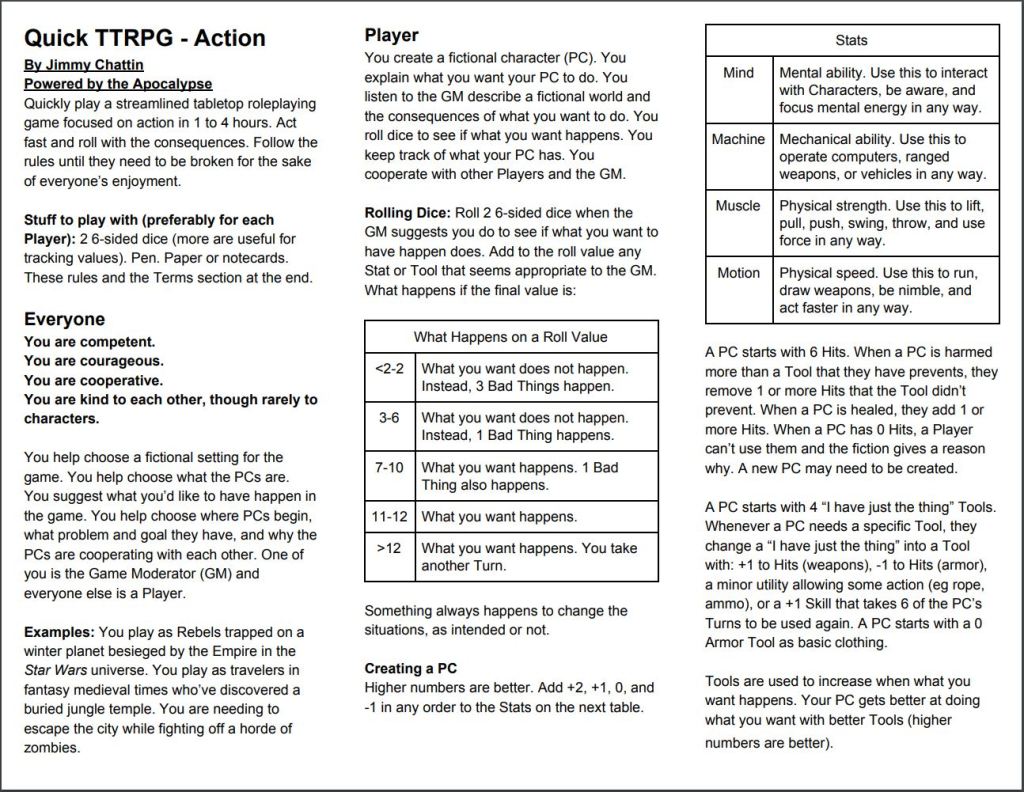
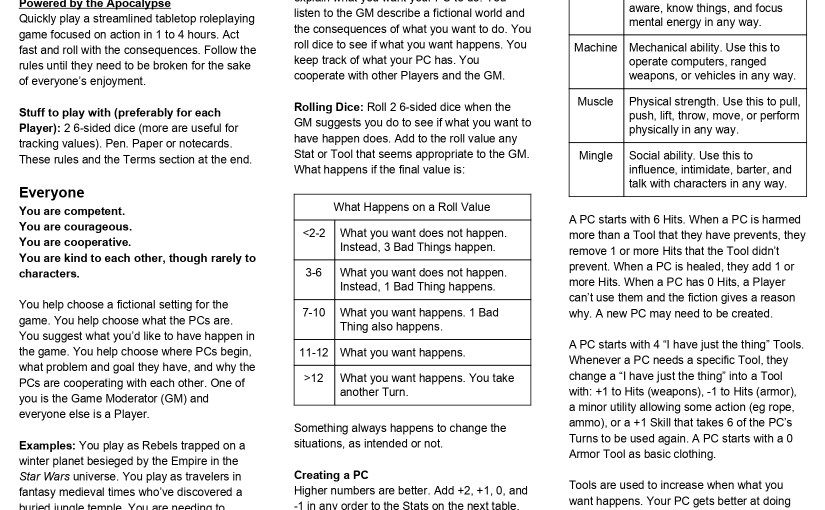
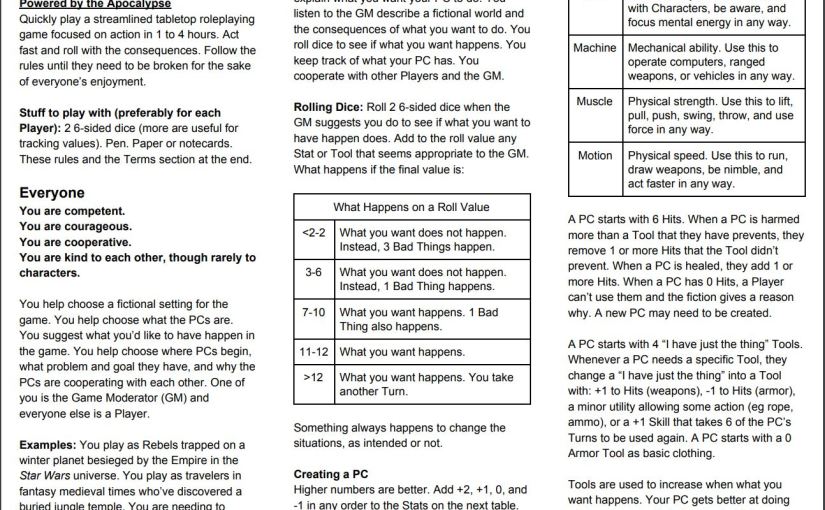
QuickTTRPGPreview
Preview of the Quick TTRPG ruleset.

Meant to be printed front to back on a single page, the Quick TTRPG means to accommodate for two styles of play (Action, Role Play), the roles of every participant (Player, Game Moderator), dice rules (two six-sided), stats (4M System), and the tools used in a game.

Further resources include random tables for both game setup, character creation, treasure, missions, and the Bad Things that happen.

And now, the second half of the review is up! Check it out for some freebies.

I look forward to your thoughts  – please give the casts a listen and the ruleset a glance. Send me your comments to assist in making better games 🙂

Cast 02 – RPG Systems

Download for the road. (11m 38s)

To follow-up on last week’s cast, here I am discussing the finer points of what I’ve learned about tabletop role playing games, and what I mean to do about it:

  • Faster prep
  • Faster play
  • Faster narrative escalation

I talk about “clocks” at one point. These are those:

Image of narrative clocks from Kevin Whitaker.