Quarterly Goals – September 2019

The last quarter had some drifting in my focus towards game design and software development and away from writing. It was so impactful, I was thinking of taking a quarter off to see what I naturally drew myself to doing. That train of thought was thrown out posthaste – there’s so much exciting stuff to do, why skip out on what should be some easy accomplishments for myself?

We’re going to split this next quarter into three buckets with three criteria each. Check ’em out:

My Goals Due September 2019

  1. All About Writing
    1. I will produce 1 outline a month. Likely more will be generated, though extra time will be given so I don’t get off track like I did on the in-hiatus Shallow Seas novel. Let’s count an outline as at least 5 pages.
    2. I will rewrite a fanfic so it’s not a fanfic, but something I can really own. People are inspired all the time by others. My They’re Aboard is one such case, though with a bit of tweaking and world-building, it ought to stand well on its own.
    3. I will keep up this blog. That’s going to be things such as a larger post exploring the need for gratuitous weaponry in science fiction and shorter updates on works in process.
  2. Game Time
    1. I will investigate the problems faced by Game / Dungeon Masters (DMs). This all spawned from when I heard someone lament that no one in a Role Playing Game (RPG) wanted to have the responsibility of DMing. I hope to provide some solutions to that, like:
    2. A RPG card-based system to ease campaign setup and running. I’m using Magic the Gathering cards at the moment. They’re surprisingly useful, though more work is needed for items, traps, locations, time of day, distances, weather, etc. I’ve high hopes for this one.

      Person Holding Brown Card
      Man holding card about rules from Pexels.com
    3. I will get a tabletop RPG into a prototype state. Between players acting as tank commanders w/ crew, players being the leaders of space fleets and worlds, or a study of this game The Orc and the Pie, someone somewhere should be able to play something (sometime).
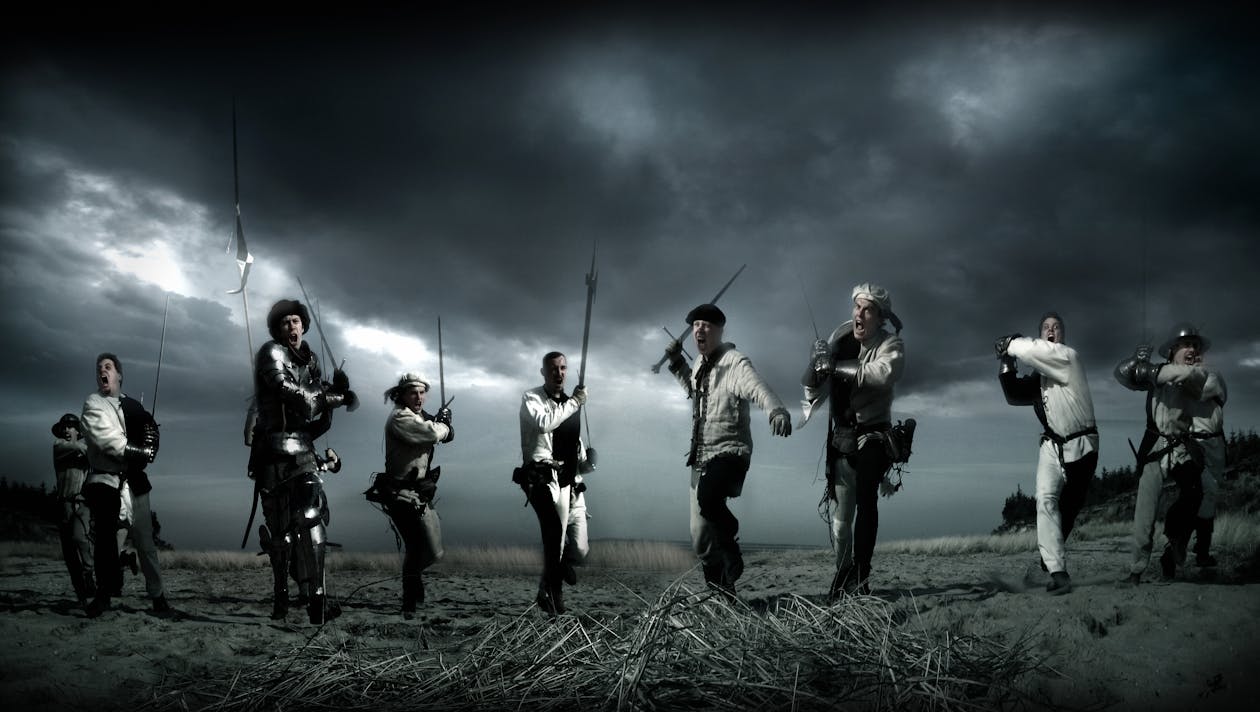
      Man's Holding Swords Clip Art
      Role players from Pexels.com
  3. Evolving My Work
    1. I will study coding on LeetCode. It was suggested to hit-up 50 questions each of the easy, medium, and hard categories. I trust this person’s advice, so I gotta get on it!
    2. I will read two work-related books (with notes!) every month. Despite the list possibly changing, I can look forward to:
      1. The Effective Executive
      2. Tribe of Mentors
      3. Changing on the Job
      4. The 21 Indispensable Qualities of a Leader
      5. The Design of Everyday Things
      6. Linchpin: Are you Indispensable?

        Book title from Amazon.com
    3. I’ve another, but it’s private. JimmyChattin.com may take a hit in contributions if this comes to pass.

That’s it for now. Depending on what comes, I’ll flip the table on all of this. As Captain Barbossa would put it, these are “more what you’d call guidelines than actual rules”. In the meantime, here’s to a successful quarter!

19SQ3.jpg
Phone lockscreen source image from Pablo Olivera

BONUS

Checking the Toggl (my favorite time tracker) analytics for the last 17 months as it comes to time spent on goals, the numbers are very humbling. (Spoiler: I don’t spend enough time pursuing my goals.)

Last year, I spent an average of 33.6 hours per month on goals (2019 at least is 37.5 hours per month!). In the 17 months I’m referencing, we are at about 35.55 hours a month, or 105 per quarter.

It has taken me about 17 hours to come up with an outline (any draft would be a conservative 500 words per hour). That’s 51 hours out of our 105. 54 left to go.

The blog has, on average, taken 2.5 hours per post. If I keep with 2 posts per week for 12 weeks, that’s 60 hours… Let’s aim more for half that at 30!

Down to 24 hours.

Edits for stories tend to be about 22 hours split between 2 unequal stories. Assuming the They’re Aboard rewrite has more than my typical editing required, let’s assume 22 to be a generous cushion for the changes.

The games will be… problematic. It’s been awhile since I’ve fully designed tabletop games (checkout my mods!). We can say that 8 hours is the most I’ve spent on designs this year in a month, so let’s assume 8 per month, 3 months, for 24 hours total.

Everything else gets wrapped up in my normal studies (LeetCode) or reading.

Ouch. We have -22 hours left over at the end of the quarter if we’re diligent, not counting the quarterly review and next quarter planning. These might be called “stretch goals” 🙂 Whatever the case, time’s ticking!

Round Black Analog Table Alarm Clock
Clock and coffee from Pexels.com

Quarterly Goals Recap – June 2019

Read the original post here.

Out of four goals, how did we do?

  1. Finish the Draft of Shallow Seas
    1. Failed. Didn’t even touch it. There’s a lot wrong with this almost-draft of my first novel-length work. So much so, and myself still evolving leaps and bounds as a fiction writer, it’s best to put Shallow Seas to rest for now. Maybe after pushing out a few more stories, we can revisit the world of Shallow Seas.
  2. Finish Edits on Two Outstanding Stories
    1. Won. Unblinking Skitarii (a Warhammer 40K fan fiction) and They’re Aboard (also fanfic) are done! Done done! In the near future, these two short stories will be posted. They’re Aboard is also the planned subject of one of my goals for September 2019 – keep an eye out!
  3. Create Lists for Life
    1. Won. I’ll spare you these for their private and very personal nature. This will be a true win if I can live by these guiding bullet points to have a more fulfilled life!
  4. Create and Sustain JimmyChattin.com
    1. Won. WordPress made it really easy to get started and to keep up posts. It was on me to find something(s) to talk about. Getting 11 (now 12) posts out, 3 pages published, and plans for more, this is a definite win.

75% success! It’s been a fantastic last three months. Despite a loss of friends and coworkers, more friends have been made and I’m more secure in just about everything.

Success Text
Success from Pexels.com

Life is good. Let’s see what happens in the next quarter.

May’s Hiatus

Try as I might, a quality post couldn’t be finished for today. Don’t only trust me when I say it’s for a good reason!

Other than next quarter’s goals, I’m taking the rest of May off of blog posting to work on both some big articles and short story writing. These are planned for mid-June, though that totally depends on how much the content balloons.

White and Red Balloons
Balloons from Pexels.com

Here’s a preview:

  • Simplified Dungeon / Game Master session generation.
  • Involving the DM / GM as a ‘god’ needing player ‘belief’ to exist so the DM / GM can bestow boons on the players.
  • A tabletop space-empire RPG.
  • A tabletop tank-squadron RPG.
  • Studies of why gratuitous weaponry is viable in many fictions.
  • New thoughts on story structure.
  • A treatise on converting fan fiction into fiction eligible to be sold.
  • Numerous short story fictions currently in editing.
  • Trying out Twine.
  • Many story outlines, including:
    • The story of Aladdin and his magic demon lamp meets Night on Bald Mountain.
    • Magical Cthulhu teens uncovering the truth of their powers.
    • The last demon on Earth trying to make sense of what happened to get them there.
    • Rapture as the last option for a Heaven losing a war to Hell and a single soul’s discovery of what lies at the bottom of all existence.
    • How the survivors deal with all the suns in the galaxy going out in a span of years.
    • After conquering the lands of death, the queen of horror seeks mythical shores, home to a thing called “life”.
    • More! (Or maybe I’ll screenplay my own Season 8 of Game of Thrones 🙂 )

Am I reaching? Yes. Will I have things to show for it? Yep! Might it be fun? Surely.

Person's Hand in Shallow Photo
Reaching hand from Pexels.com

Thanks for your patience. Check my Twitter @JimmyChattin regularly for updates!

Software Worker’s Dichotomy

Other the years of working in the software industry, I’ve seen a trend towards dichotomy. (This is speculation, mind you.) The theme is that programming folks being hired and kept are starting to fall into two role buckets:

  1. Architect – the person responsible for how all the parts fit together, knowing advanced software engineering concepts, SME on programming languages, and keeping an entire piece of software in their head.
    1. Benefits: Experienced, able to handle abstract problems and make decisions, can have vision, knows how to optimize programs while coding.
    2. Cons: Not enough people like this, rarely seen together with other Architects, detached from day-to-day processes, superiority complexes possible.

      Person Holding Gray Pen Sitting Near Laptop
      Architect from Pexels.com
  2. Code Monkey (CM) – the person told what to do and often how to do it; implementer of code on a line-by-line basis without understanding of how the program ought to work.
    1. Benefits: Cheap, plentiful.
    2. Cons: Unable to grasp conceptual discussions, cannot make meaningful decisions, likely to create more problems of correction for Architects if not given explicit instruction.

      Grayscale Photography of Three Wise Monkey Figurines
      Monkeys from Pexels.com

Hear me out for what I’ve seen.

Let’s start in the 2000’s. From those learning to program along with myself, most had no grasp of the conceptual aspects of code (ie, they were Code Monkeys). They were many. Me, new and naive, could work my way out of a paper bag given enough time, but that’s that; far from Architect, but driven beyond the role of CM and surrounded by them.

Entering banking security, I created new systems from scratch, monitored their performance, and communicated the soul of the work to others. I was an Architect. But I also worked with other Architects (experts at the company), making new projects difficult to integrate.

Following up with healthcare work, I had the privilege to see Architects and CMs working together. Architects needed awe from the CMs because they were never wrong; when they were, things got expensive, dangerous, and people were reprimanded. The company I worked for also desired not Architects but CMs, many of them for cheap. To get the recruitment numbers, fresh college grads and foreign visas were required in astonishing numbers. (At least a strategy of making CMs into Architect-like persons continues to contribute to the long-term success of the company.)

For Microsoft, I got to be an Architect again! My insight provided solutions to numerous business cases, be they quarterly goals or daily challenges. This largely worked because I could move fast, deliver apps without butting heads with others, and created documentation such that persons in need could CM their way to a solution on their own for common issues. The rest of development wasn’t so lucky; this is where I saw Architects wielding CMs full-bore in the dichotomy trend.

Later in the gambling industry, I did the kinds of work done for Microsoft at a new company. I was half Architect being self-managed; half of my time was as a CM, maintaining and expanding the work of others from before me. Though, as my responsibilities grew and shifted, I get a front-row seat (too close for comfort?) to the Architect / Code Monkey trend and all its conflicts:

  • Multiple Architects cannot agree on solutions.
  • Architects abandon daily processes.
  • CMs usually cause more work for the Architects in code reviews.
  • CMs require constant check-in to ensure the right work is being done, or will reaffirm any course of action to the point of stagnation.
C++ Screengrab
Code from Pexels.com

Now, there’s bleed between Architects and Code Monkey’s still. As mentioned, I used to both Architect and Code the solutions to problems. Architects and CMs I know typically still code or make design decisions on their own.

But their numbers are few and they are dwindling.

Am I correct in these observations? Really only time will tell. Meanwhile, the software industry I grew up with is shifting in my sight. Instead of agile cooperation between peers who are all on the same level, Architects compete against each other in a rat-race of expanding technologies while Code Monkeys exist as replaceable cogs. It’s George Orwell‘s 1984 worker dichotomy of the Party and the proles.

I hope to be wrong.

Thinking About Trivial Conflict

After seeing Avengers: Endgame and a pivotal episode of Game of Thrones last week, I come away awestruck by the scope of the conflicts.

One deals with half of all beings in the universe (the universe) dying; the other, a seemingly unkillable king of the dead wages war against the living in a hellish blizzard.

It makes superheroes punching each other (Avengers) or bickering about who owns which castle (GoT) just seem… So trivial.

Let’s also take a look at a few other hugely-grossing conflicts:

Yet, our personal stories are still about nations at war, gangsters and the law, the fly in our soup.

We know the vastness that lays before us in the future. With this prescience that extends from the outcome of our own lives to the outcome of our world and species, what are we doing with what is objectively trivial conflict?

It’s called into question my fascination with big space battles and urban tank fights. These are seemingly trivial.

What is there to do?

I don’t know how to handle a shift in focus on the macro-level, but maybe I can adapt to my own predispositions. It can’t be helped who I am, but I can help what I do in my story creation.

From now on I’ll endeavor to set the stakes before I set the conflict. No more senseless violence – if conflict must be acted on, it must be after all nonviolent approaches have been investigated. Never should conflict be glorified. May a person or force in writing do something barbaric, there will be severe, long-lasting, terrible consequences for all involved. A motive will be considered petty if it’s anything less than meaningful to the entirety of a person’s life. And if I can, at the end, despite any suffering caused or endured, there’ll be evidence that it was worth it, that the universe is one step closer to saving itself from entropy.

I can do something about setting the cultural gaze a little higher, a little farther. If I may, I’d beg you to do the same.

Case Study: Iterative Design

Sometimes I get inspired and sometimes that inspiration needs some work.

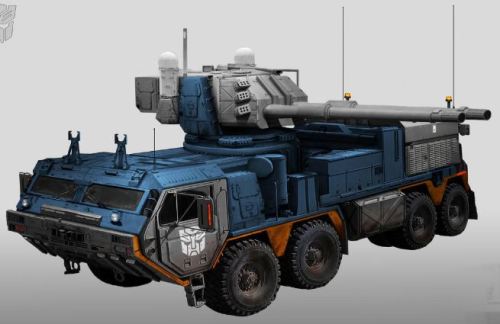
That’s what happened here when I saw part of Theo Stylianides’s AutoBots, Scattershot:

AutoBots-Scattershot.JPG
Scattershot from AutoBots by Theo Stylianides

The thought that come to mind: “Cool! Put a 5-inch naval gun on a truck! Suppress tanks with rapid fire, stability, and elevation, not to mention artillery support and modular design.”

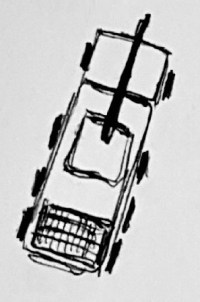
The way I think is in pictures. Names? I ‘see’ it written. Someone says ‘cat’? Fuzzy cat face that is probably no feline I’ve ever seen. Truck with a cannon? A drawing:

Sketches-Original-Long.jpg

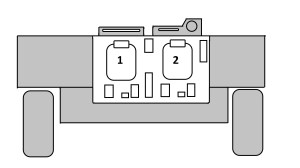
Looking at this, we need to consider street fighting and firing the cannon perpendicular to the axis of the truck. If that cannon fires, the truck will tip over or at least be rocked mightily.

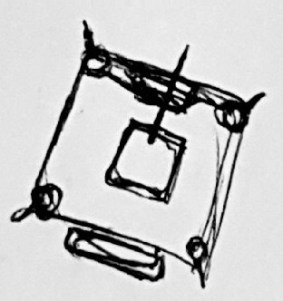
So what can we do? Start simply: Make it so all sides are equal, that the cannon’s force in any direction is supported by the vehicle.

Sketches-Original-Square.jpg

That’s more like it!

Though exposed, the cannon’s firing and reloading mechanisms are automated (see earlier in the video above for how that is done). We can stick a binocular camera set on it and seat the driver and gunner within the vehicle’s hull here.

SketchCrewCab-Clean.jpg

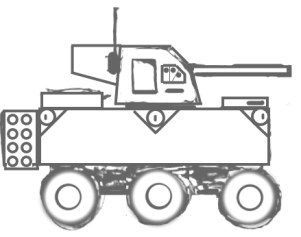
We’ll give it six-wheel drive for the streets and rubble present in urban fighting. On the back is a rack for additional ammo, fuel, or whatever we want. Ammunition is kept under the turret between the crew cabin and the engine at the rear of the vehicle. (A heavy engine’s weight can be made up for with thicker front armor to protect personnel.)

Objectively, this vehicle is pretty big as a target. Point-defense smoke for enemy sensors, lasers for missiles and ablative armor for kinetic rounds should do it. Let’s finally add a remote antipersonnel turret (yes, the lasers could selectively cook baddies too, but what do we do if it’s cloudy?):

Sketches-Side2.jpg

Viola! We have a truck with a naval-grade, rapid-fire, ready-to-be-modularized cannon!

This shows how I value function over form despite function being inspired visually. Have a problem? Change or add to the design to fix it, regardless of aesthetic.

As a happy accident, the weapon platform can join a small, personal fleet of ground fighting vehicles that fit a sci-fi ‘block’ theme:

Sketches-Lineup2.jpg

Thanks for getting this far. How do you get inspired? What do you do when that inspiration hits roadblocks? I’m always looking for ways to improve my problem-solving ability!

Competition Is for Chumps

Hear me out.

While some people think competition is well worth the punishment, there’s a case to be made that competition is for chumps.

Competition is stress. The body and mind typically fails under stress. Soul and faith is tested. Relationships degrade and IQ drops. In short, competition kills.

Woman Holding Her Head
Stress from Pexels.com

Doesn’t that mean those that can deal with and survive stress are better? The fittest? The opposite – those that survive competition either overpowered the opposition with minimal cost or were so weakened they are consumed by another overpowering force. Competition is only for those already fit above and beyond their competitors; anything else is destruction.

Something as small-scale as an argument between colleagues (a competition of who’s correct) is detrimental. What happens if you win an argument? You lose, having possibly damaged the relationship between you and the other. What if you lose? You lose, ego bruised, stature likely downgraded in the sight of the colleague, and you run the risk of public humiliation. Competition gave you nothing despite you ‘surviving’.

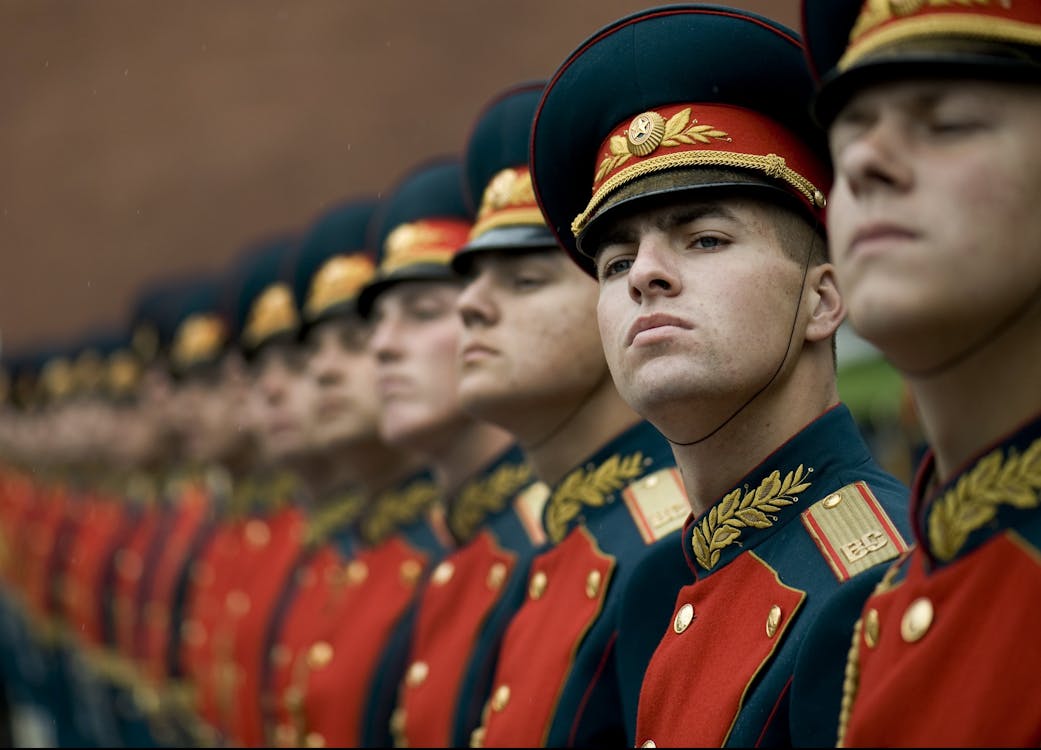
Remember the Cold War from 30 years ago? A sense of competition that couldn’t be helped during World War 2 bled over into the years after. During that time, the world saw the greatest increase of weapons production ever.

Men in Black and Red Cade Hats and Military Uniform
Russian soldiers from Pexels.com

From the display between the US and Soviet Russia, at best, we have a destabilized Middle East, a proliferation of nuclear weapons, and ongoing tensions. It could have been worse. The Cold War nearly got “hot” multiple times (Korean War, Sputnik, Vietnam War, Cuban Missile Crisis, any number of James Bond films), the consequences of which would have been the end of human civilization.

Why did we approach our own extinction? Competition. Capitalism vs. Communism. East vs. West. My army is bigger than your army.

So what do you do if faced with competition?

As mentioned, one must end it quickly by being absolutely overpowering by at least a magnitude (eg a competition of 1 requires you to be a 10). This can happen by letting other competitors go at it until you swoop in to take what’s left. However, whatever is being competed over will suffer (think of a football), leaving you with less, requires patience, and in no way guarantees success (there could be a magnitude 10 still left compared to your 1).

You can still win, though. When faced with competition, decline to compete.

Here’s a few ways how:

Kick Chess Piece Standing
Chess pieces from Pexels.com

Back Down, Rise Up

Backing down can be deemed as a weakness. This is only the pride of the moment getting in the way of any goal, or at the foundation, survival.

Say a person wants to take the lead on a project that you could also easily lead. You could use your skills or position already as a leader to squash their ambition. Or, you could let them take the lead so long as there’s no obvious threat to you. Do the latter.

With the other person as leader, they will do one of two things. First, they might prove themselves a fine and capable person, improving the situation for both yourself and others. If the first option fails, they will fail, taking the fall in your stead, no matter the reason. Should the second event come, it allows you to rise up to take charge again, hopefully also having a large amount of work done. Additionally, with a bit of compassion, you can improve the relationship with the person who tried and failed, but only because you didn’t butt heads in competition!

Secure Your Niches

It goes back to that “order of magnitude” thing. Leave where there is competition to secure where this is none (10 to 0!). That’s a niche.

Should you be so lucky as to be a first mover you gain momentum over any incoming competitors to your niche. It doesn’t prevent you from being displaced (there were Ubers before Uber), but it makes it a lot harder to be uprooted and still allows you to find more niches in the future.

On a global scale, a country could dominate any number of areas: tourism, ecology, education, shipping, infrastructure, computer science, production, military, diplomacy, art, writing, population, language, service, etc! The people of a country suffers when that country tries its best that’s only as good as some other country’s worst. Such is competition.

Grayscale Photography of Human Skull
Skull from Pexels.com

Takeaway

Competition is detrimental to you, others, and your goals. Even an order of magnitude advantage over other competitors only goes so far.

If something really must happen that involves competition, I encourage you to check your expectations.

Otherwise, consider letting others take the charge for you. Or better yet, compete against nothing after discovering your own niche.

History is full of competition. I’d like to see anything but the most dire cases not also causing suffering. From others’ examples, I’ll decline most all competition because “[…] doing the same thing over and over again and expecting different results” is for chumps.

Lasers + Shields = Boom in Dune

Warning: There is going to be math later. (I’ll try to make this deduction as fun as possible!) To business –

Immovable, Unstoppable

In Frank Herbert’s Dune, there exists protection that cannot be penetrated in the form of shields. Shields are immovable, covering everything from people to planets. This led to the end of ranged warfare as we would know it in Dune‘s universe.

There also exists “lasers” (let’s call them “phasers” for now) when fighting at a distance is called for. Phasers can cut through anything and might be considered as an unstoppable force.

Assorted-color Laser Lights
Lasers from Pexels.com

When shields and phasers interact – that is, when the immovable meets the unstoppable – a huge explosion results:

A lasgun-shield explosion was a dangerous variable, could be more powerful than atomics […]
– Dune

Hearing this, I got to thinking. What kind of explosion are we talking about?

To find out, let’s first define our terms:

  1. Phaser – We’re going to consider this as equivalent to the Star Trek phaser. Those tools were also able to cut through anything and more, dissolving entire mountains in the early pistol-size variant.
  2. Shield – Here we assume that to stop any force, there must be an equal and opposite force. In the case of a phaser, we assume its disintegrating ray would be sent directly back along the line of the ray. Anything hitting the shield would disintegrate itself.
  3. Atomic – A nuclear weapon. For our purposes, assume 15 kilotons of explosive power (this was the power of the first atomic bomb in history).

Here comes the math…

So we shoot our phaser at a shield. At the speed of light, the shield deflects the beam back at us. Our ray hits and dissolves the matter in our phaser. All that matter has to go somewhere, right? With E=MC^2 (energy equals mass multiplied by the speed of light squared), we know that:

  • Energy (in Joules) = ?
  • C-speed of light squared = 9 x 10^16 meters^2 / seconds^2
  • Mass of a phaser = .340194 kilograms (assuming 12 ounces)

Therefore:

  • .340194 kilograms x 9 x 10^16 meters^2 / seconds^2
  • = 3.061746 x 10^16 Joules

A kiloton (measured in the mass of TNT-equivalent) is 4.18 x 10^12 Joules. We can cancel a few things out:

  • 3.061746 x 10^16 ÷ 4.18 x 10^12
  • = 3.061746 x 10^4 ÷ 4.18
  • = 30617.46 ÷ 4.18
  • = 7324.7512 kilotons

The energy held inside the matter of our handheld phaser is approximately 7324.7512 kilotons. To put that into perspective, that’s more that 488 atomic bombs.

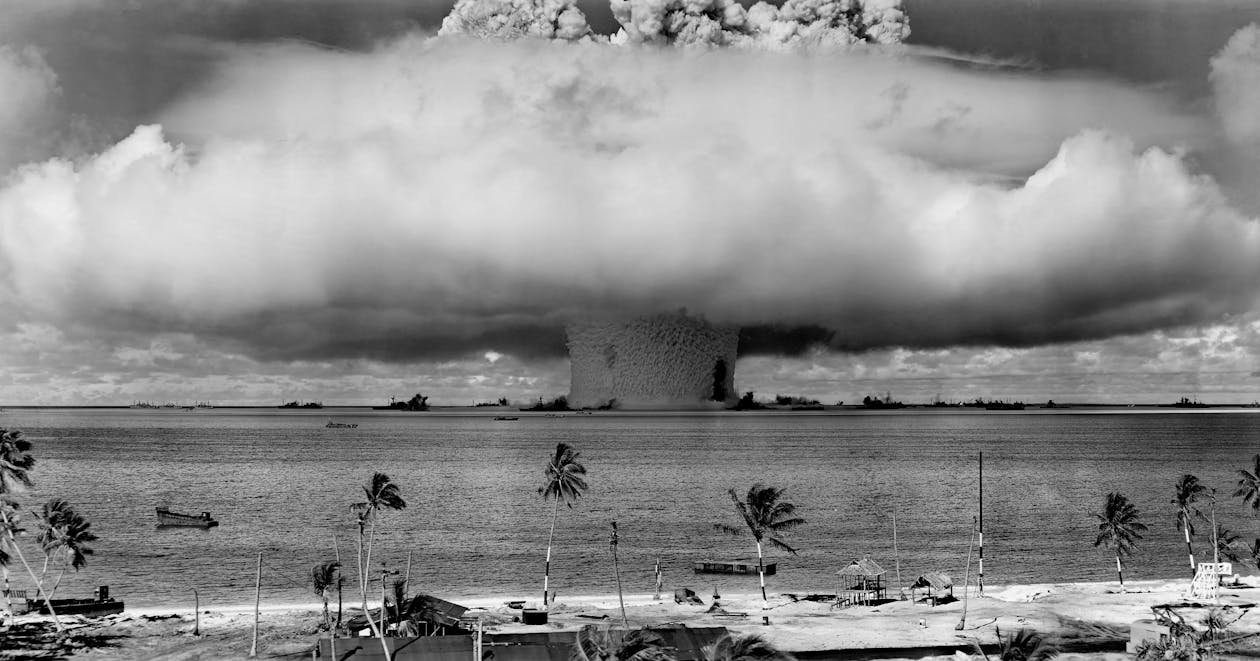
Grayscale Photo of Explosion on the Beach
Atomic explosion from Pexels.com

Let’s assume a 0.03% efficiency in converting mass into energy (equivalent to modern atomic weapons; not the most efficient conversion we can implement). That’s still some 15 atomic bombs going off. In your hand.

Little wonder the characters in Dune wouldn’t bring a gun to a knife fight.

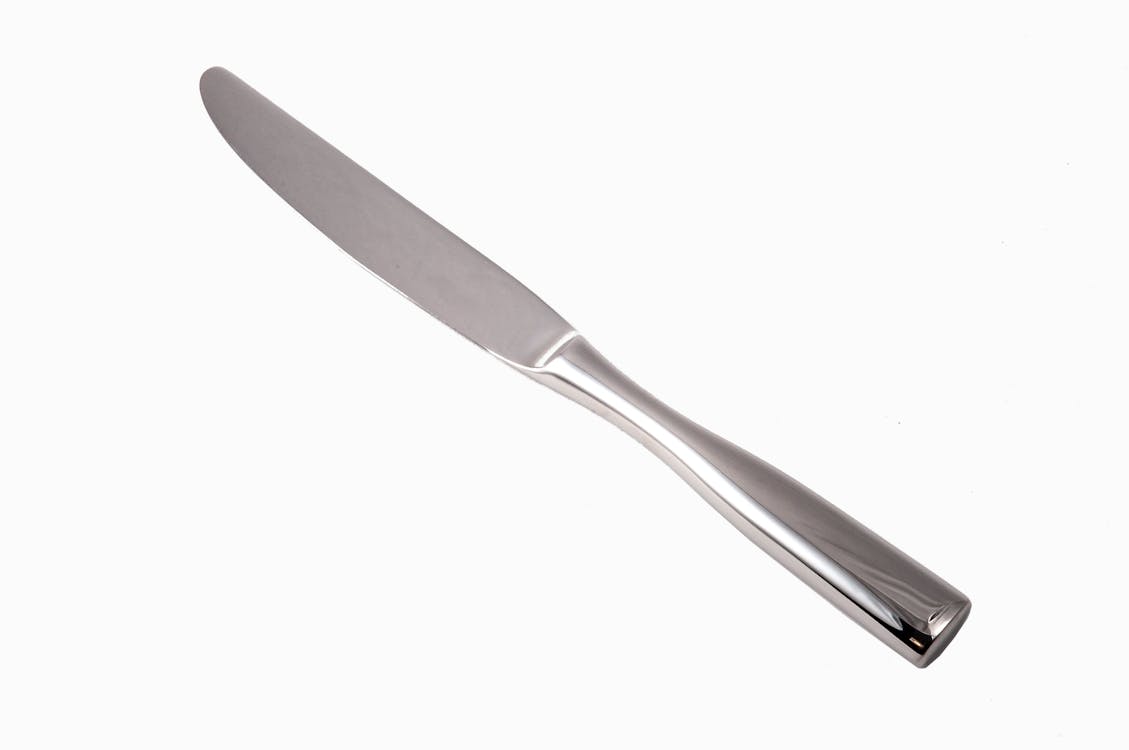
Silver Butter Knife
Knife from Pexels.com

Sleeping God

Six months to Halloween. Let’s get creepy:

Our trumpets blow unceasingly to keep the Eternal at bay.

It has been a million millennia. More. The records are wasted now, burned long ago to fuel the forges for our Instruments. Always our Instruments.

Yet I will take this luxury here, secretly, to write with valuable resources my thoughts. Even mindfulness is a crime for the energetic glucose it consumes. I would choose to burn it for my own peace rather than in the embers of our legacy.

The constellations have been going dark. We’ve mined the worlds, conscripted their populations, drained our suns. A darkness unlike anything before creeps in at the edges of the universe. It is not just a physical shroud over creation, but also a shadow to the pits of our minds. So long as the sound from the Instruments trumpet through the void, all is as it must be.

At least the light is strong in our young, artificially birthed sun, but that is it. When machines harvest the last energy of this last star, all existence will be cast into the black. We continue to play. Nothing else is left to us, the few huddled now in the final system whose bellows bring forth song from the Instruments.

Philosophers of myth wrote on the outcome of these end times, the apocalypse revealed sometime when the universe was naive, ignorant to the nothingness that awaits all at the end of the Divine Dream. If only we’d never known why the Instruments were needed, or at least had lacked the cleverness to construct such things, our foreparents might have died long ago, sparing us now our toil.

No-one can really know what will become of us. As the last horns blow no more, the god that forsook us will toss all that has been to oblivion.

Many have taken the Way Out. Their bodies lie forgotten in dead spirals that once were galaxies. We’ve brought uncounted burial sites close to cater to this existential ritual, though their corpses aren’t enough for the forges, for the Instruments to sound. Only so much ash anymore.

The dead may have been right, to choose their own end, rather than be cast to the fires in their trillions to play the Instruments. Always we must service the Instruments. Even death will be denied us, the living. Either we are alive and labor, or we become part of the fire and the Instruments. Thus is all our need for fuel.

Now, we persist. Our awareness damns us. Still, the Choir races here in this place of ending don’t stop. An old, obsolete word from ages past, “hope”, wouldn’t fit a description of our efforts. For as long as we can, we will play. There is nowhere to go. There is nothing to do otherwise. Only few like I who have read the stories as their pages were shoveled into the fires understand there has ever been anything else.

Solutions have been calculated, dreamed, prophesied, and all ultimately failed. “Hope” has eluded the most titanic means available of the brightest minds over eons of unknowable work. There is no person nor thing deigned to survive the flames. Not the remnants of our best, not even their histories. Not the least this author.

We keep the god-thing asleep in its Divine Dream. The Instruments either play and we continue, or they are silent, and we cease. Until quiet finally wakes the Eternal, we will all be used to keep up the charade of this dreamscape. Forever and ever it shall be.

My writing time ends. How many seconds has it cost the universe in fuel? Time lost for us to wonder moments more at it all? These questions must go unanswered. This note and I travel to the forges.

Here’s the prompt that sparked this little piece:

“The universe is just God dreaming. When he wakes the universe vanishes. Every species in the universe has united to forestall the inevitable.”

u/Punsterglover

Record Your Good Days

These kinds of days are rare, few and far between.

Today (Sunday, April 28th, 2019) has been a Good Day.

However, what makes it “good”? That can vary from person to person.

For me, it’s a sense more than contentment. Might it be happiness?

(Well, if so, that’s a let down to think a majority of days aren’t “happy”. But must we be bursting at the gills with unconstrained joy 24/7? Probably best not to be that jovial. Sounds tiring.)

Regardless of the sensation, I like it. I’m sure you’ve felt the same at some points in life. Maybe even this week!

So how do we get this good feeling to come calling again?

To do that, what makes up these “good days” ought to be looked at factually but in broad strokes. Let’s take my day today as an example:

  • 5:30 AM wake-up; protein powder and coconut-oil + baking-chocolate drink.
  • 7 AM arrival at event site; provide support + hang out with strangers and teammates for event.
  • Take pre-competition cocktail (beetroot and maca powder, whole wheat spaghetti w/ peanut butter and oil, vitamins)
  • 8:30 AM first-in-line competitors at event.
  • I excel / don’t fail at event; team doesn’t fail at event.
  • Casually hang out / watch other teams / work out.
  • Learn we (the team) have won event; get medals.
  • Casually post online.
  • Shower + eat pancakes.
  • 40 minutes editing a story.
  • 20 minutes laundry.
  • 15 minutes watching comedy (laughing).
  • 20 minutes meditation.
  • 1 hour of edits.
  • 15 minutes light exercise.
  • Another hour of edits.
  • Make mac’n’cheese + frozen peas + egg. (It’s binge day on the 6-on, 1-off schedule!)
  • 20 minutes of writing in the journal (summarize dice game idea and decide between writing this post and playing video games).
  • Writing this post! (17 minutes in by this bullet.)

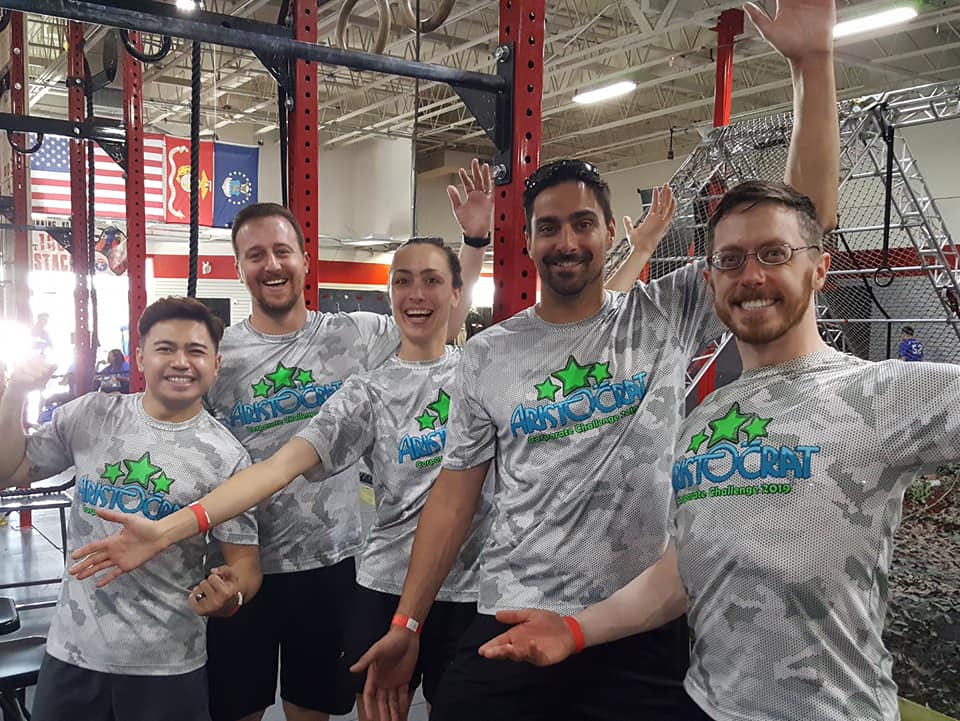
CorporateNinja2019
First-Place Ninjas of Las Vegas, B Division, 2019

My feelings are that I’ve done some cool stuff with cool people today while also saving time for myself for rest and accomplishment. That story is in good shape, I have a blog post incoming, and there is still time I might watch a cool movie or play a nifty video game!

Some generalities of today: Excellent weather (high of ~90 F, low wind), meeting people for a time, early-morning physical accomplishments, later-day personal project accomplishments, naps, and a touch of carb-rich foods.

What about other days?

Not all days have felt this good. Relatively few, in fact. The last time I recorded a really good day was April 13th. I’ve only thought to record a few similar times – these days still show some themes:

  • Great weather.
  • Physical accomplishment in the early morning w/ a team.
  • Casually watching people in a park do physical activity.
  • Socialize w/ strangers while also escaping to be on my own.
  • Casual physical activity.
  • Some generally-bad-for-you food w/ others.
  • Watch a good movie (Watchmen).
  • Laugh.

These are days to cherish. They don’t have the same specifics between them, nor do they need to. To get joy consistently / reliably is a work in progress.

A great outcome of taking note of these days and feelings is that I now have things to aim for, things to plan into my future. Certainly, this feeds into my analytical nature, these eyes for detail and pattern recognition.

If I plan on being happy, that comes with effort. It only could occur because 1) I’m aware and not afraid of my own feelings, 2) I wrote down and recognize what worked before, and 3) I forgave myself of backing off of various responsibilities (ie hanging out, video games, chores [this floor won’t vacuum itself…]).

Now I’m equipped for better days ahead. What to look for, what to say “yes” to, what to protect. If a record of the “good days” was absent, where would I be?

Without knowing the themes of your good feelings, where are you?