2d6. My go-to: roll two six-sided dice. Again, I as the game guide (aka game- or dungeon-master) roll the dice when dice need rolling.
5-7-9 difficulty. Whenever the players need to do something, it’s either easy, medium, or hard, and the sum of the dice must be at or above the difficulty to succeed. At most a roll gets a +1 or a +2 if the player is especially good at something, or the lowest die becomes the same value as the highest die if there is contextual advantage (the opposite applying if there’s disadvantage).
Always going. The fictional world doesn’t stop just because a player is making a decision. If not fast enough, fictional characters and contexts advance to force player decisiveness.
Play
Player one. I enjoyed this latest game with only one player. The gameplay was superb, thereby undermining the held belief that multiple players are required for a roleplaying game to blast off.
Self as character. The player existed as a character in the game world. Their motivations and self-reported abilities where their own, the dice deciding how well they fulfilled their sought-after actions.
Orc and pie. The classic mini-beginning to a roleplaying game, the player started in a stark-white, narrow room or hall facing an orc holding a pie, the orc not too enthused the player is there. Everything else in the world is made on the fly!
“What are you doing?” After describing a scene or the action of some imaginary character, this question is the modus operandi to keep the focus on the player. It is the player action that ultimately decides what happens, no matter the fiction being thought up around them.
Probably happens. Rolling dice slows things down. To keep things feeling ‘hot’, most things a player ought be able to do without resistance. Only when there is some sort of challenge to an action occurring do dice get rolled.
Talk it out. Ask for intentions and clarification. As a game guide or player, if something is unclear, get it clear. Only then will the resulting context of the game be able to be figured out and feelings saved from a misunderstanding!
Outcome
Over the course of thirty minutes, the game went from the white room with the orc to a sandy beach. A summary:
The player started in a white room with an orc at the opposite end who also held one of the best-smelling pies ever to exist. After a brief questioning of the orc, the orc leaves in a huff, followed by the player.
Outside the room is a park, and beyond that a street and warehouse buildings. The orc disappears into one, hotly pursued by the player.
The player searches for the orc, finding them in a dark storage area stacked with crates stamped with “Meat“.
A tussle gets the player captured and drug back to the front of the building, where another orc, Boss, finds out the first orc Rudolph let the player follow them in.
Alone with Boss in Boss’s office, the player makes a break for it as the Boss decides he needs to keep the meat-pie plant a secret.
Blowing past Boss, the player exits to the street where a surprised Rudolph lounges. Continuing to race away, the player is chased by two shouting orcs. An alley provides some cover, enough that the player makes their way to the opposite building side.
There lies a beach stretching out left and right across a busy highway. The player, risking a lot, proceeds to dance around the traffic and leap down an embankment to the beach.
Dashing across the sand to a lifeguard stand, no one is found. Screeches and honks let the player know that the pursuit isn’t over.
100 meters away is a second stand. Luckily there’s a speechless lifeguard there. Unluckily, Boss and Rudolph have just reached the sand.
The player explains themselves and the lifeguard locks both of them inside the hut. A radio-call later has the police on their way… In five minutes.
A pounding and breaking-down of the hut’s door lets the lifeguard surprise the first orc that storms in with an air-canister to the face. The guard is less lucky with the second orc wielding a pistol.
The player makes their escape, pushing past the distracted orc still standing (Boss) and knocking him onto the sand.
Gun cast down between them, the player and Boss face-off.
A grapple in the sand a second later has both characters with hands on the weapon, but the player’s finger is on the trigger.
BLAM. Boss’s hand is mulched! The big orc thrashes and shouts on the beach, clutching their disfigurement.
But the player takes no chances with someone who tried to kill them – BLAM.
Rudolph sees the carnage and beats it across the sand. The player fires, but misses the retreating orc as sirens begin to wail.
Dropping the weapon, the player surrenders to the police just as food arrives in the real world 🙂
–
Well, that escalated quickly 😅 Yet shouldn’t all quality stories?
Playing while waiting was an absolute joy. I look forward to future games where I might encourage players to set the scene and declare who they are. Wizard fighting a flaming monster? Survivor of the zombie apocalypse? Secret agent stealing the codes? All doable with this simple system of improvised RPGing.
Feel free to use this system yourself for your own time-killers! Improve your game-guiding skills and impress your friends 😁 Let me know how it goes, too!
Now I’m back with a new take on the game: Catastrophic dice rolls.
Context
In the game of Risk, commanders (the players) know immediately and iteratively how well their armies are doing in combat. Using dice, no more than two units at a time can be removed from either side, while the math tends towards a 1:1 loss of units on both sides (slight advantage to the attacker). Between losses, an attacker can choose to preserve their forces at any time, stopping the wanton destruction of armies.
If only real war were so charming.
After reading military histories by author Rick Atkinson, it came to my attention how quickly even the most advantageous of battles can devolve into a debacle of incredible losses before commanders and generals are aware of what’s happening. Risk hardly lives up to its namesake, as while single army groups tend towards dozens of units, only two are at risk at any time.
A Problem
Losing one or two units over and over again is, well, tedious. Dice need to be rolled, compared, units removed, and dice rolled again until someone gives up or is eliminated.
Speaking from experience, a problem with Risk is how long it takes to play. (I don’t seem to be alone in this regard.) The dice rolling and one-two unit removal certainly plays a part in exacerbating the situation.
Thereby Risk is neither very accurate historically or quick.
Let’s stab at a fix to both those problems.
Riskier Rolls
In place of capping losses at one or two units, the dice themselves offer a way to increase the variance of the battles.
Normal Risk rules have the attacker rolling up to three dice against up to two defender dice. The highest dice are compared (up to two), any others discarded. Whichever player has the lower die in each comparison loses a unit (attacker loses ties).
It first came to mind that all values might be added together then compared, the difference being applied as losses to the lower-valued player. This is bad because it involves addition and subtraction. (More mental math in games is a hard no-go.)
Math is also a problem if the difference between individual dice is used. (Say, rolls of 6 and 4 are compared; 6-4=2, or 2 units lost, but that is still too much math from the original game.)
A method without extra math, and the most satisfying of our criteria of historical accuracy and fewer, faster rolls, is this:
Compare dice normally for the rules of Risk. Remove a number of units from the lower-value-die player equal to the value of the higher-die player.
So say an attacker rolls a 6-2-1 and a defender rolls a 5-4. The dice comparisons are 6v5 and 2v4 (the attacker’s 1 is discarded). Using the risker rolls rule, the first comparison requires the defender to remove six units; the second has the attacker remove four.
With all removals of units for a roll happening at the same time, an attacker’s advantage can quickly evaporate or a defender’s line be broken in but a single roll.
With riskier rolls, units are removed at pace, battles become decided in a fraction of the time, math remains minimal, only a single rule is changed from the base game, and more accurate swings of fortune get injected into the base experience that is Risk.
I’d count that as a positive 😉
–
Riskier rolls rules! Gosh, I’m a sucker for alliteration ~
I’ve given these a swing with friends, and the feel is *French kiss*. More playing is required though, so give these rules a chance in your own games of Risk.
Let me know how your games go! Here’s to all the games you’ll enjoy ~ Cheers.
Now, let’s make a distinction between “vehicles” (generic) and the already-covered “ships” and “mechs” (specific). Yes, all vehicles/ships/mechs share the same mechanics and 0 through 4 tiers of effect, but the flexibility of including all things that allow travel carries its own nuance described below.
Tonnage and Tech
The first ways to classify how vehicles can effect BITS dice rolls is to group tiers based on vehicle tonnage or tech-level.
Tonnage would have tier 0 being below the weight of standard vehicles, such as animals and people. Each tier above is a magnitude greater in weight, 1 perhaps being cars, 2 trucks, 3 tanks, etc.
Tech tiers differentiate on the generation of machine. 0 might be a horse cart, 1 a Model T, 2 the modern car, 3 a battle tank, and 4 a next-generation jet plane.
Tonnage and tech have been covered in detail already (BITS ships and mechs, respectively), so check out these classification systems there.
Kind
Is the vehicle small? Armored? Airborne? Super-sized? Perhaps not a vehicle at all, but infantry or a building?
0 holds the place of masses of unarmored infantry or support teams. 1 has light vehicles and mechanized/mobile infantry. 2 carries the tanks and heavy armor. 3 shows off jets and helicopters. 4 rounds out with ships, titanic earth-movers, i.e. hulks that carry all the rest. Using this variation also unifies tiers of scale into one all-playable 0-to-4 set of metrics to keep track of.
Inspired by how the game Starcraftdeals with unit sizes, vehicle tiers based on the kind of vehicle offers a lot of flexibility for fictional game context and rule introduction while maintaining sensibility (such as that infantry shouldn’t shoot down capital ships, at least easily!).
Cost
For those games with a larger emphasis on economy, vehicles can be assumed to be more useful by how much they cost (ie the difficulty of attainment).
Tier levels have to maintain their magnitude differences, but adding a few zeros to the tiers allows for rapid rebalancing of vehicle use. 0 say is <$1000, 1 between that and <$100K, 2 <$1 million, 3 <$100 million, and 4 being anything $100 million or more.
For example, a Ferrari and an armored humvee would be on tier 2 (both about $300K). However, where a Ferrari is fast, agile, and sleek, a humvee has ballistic plates and space for guns and passengers, yet neither floats like a boat.
Distinctions of what a vehicle can do begs use of special rules.
Everything Else: Special Rules
There is more to vehicles than their BITS tiers. A tier 1 implies only how good a vehicle is at its function, but the “1” lacks what that function is. Special rules provide that definition and make vehicles distinct.
Rules for vehicles should be common where they can, such as does it fly in the sky, sail on water, or drive over ground, is it heavy or light or of moderate frame. Uncommon rules ought to be especially concise and attached to any description of the vehicle itself to keep unnecessary information at bay until needed.
Getting more specific can be useful on a case-by-case basis (e.g. does it glide, hover, float, push with a jet, or pull with a ram scoop when it flies), but unless called for or the vehicle is especially unique, trust that players know a horse might be ridden, a car driven, boats float, and that a helicopter doesn’t need a runway.
These examples so far have covered the travel capacities of vehicles. Here are a few more options:
How does the vehicle deflect, absorb, or otherwise neglect bullets?
How long can it go without refueling?
Does it have weapons? Which ones and where are they? Do they have firing arcs? How long will ammo hold out?
Can the vehicle explode if damaged?
How many people can it carry as passengers? Is there a safety system? Cargo?
Any special skills to operate it?
Where can this vehicle fit?
Plainly, sky’s-the-limit as it comes to the rules that could apply to a vehicle. But as a design pillar of BITS, discretion is advised. Simple rules only need to be added (and even ignored) when required with a little insight and creativity.
–
And that’s how you bring vehicles into a BITS game! No longer restricted to human-scale walking and running and fighting, gameplay can expand with planes, trains, and automobiles (or their contextual equivalents).
Someday I’ll get this into a BITS guide. Before I do, which grouping – kind, cost, tonnage, or tech – is your favorite? (I’m a “kind” guy myself ~)
As always, deeply appreciate your feedback. Cheers!
With the short details below, multiple fictional universes that have mecha will provide real examples of adapting those properties to BITS.
How Mechs Work
Mechs, like ships, have a threat tier 0 through 4 that indicates their ability to act in the world. However, while ships typically use tonnage to class battlefield dominance, mechs rely on the context of the fictional universe.
For example, a tier system that represents leaps in technological understanding may have additional benefits rather than a system that represents adding more-of-the-same technological level to the body of the mech (this is the same with ships). Specific examples of tech and tonnage are included in the next section.
When a player acts as a mech, add the mech’s tier to a 2D6 roll. When acting against a mech, roll higher than that mech’s threat tier. For example, a tier 3 mech acting against a tier 2 must roll 9 or more (threat tier 2) with 2D6 and may add 3 to the roll.
Depending on the fictional context, tiers may also show how many extra smaller actions the mech may take. These smaller actions may be either defensive or of more minor consequence, but again, it’s a decision that needs context. (I’m still ironing out the value of different kinds of actions.)
A mech otherwise behaves as any other fictional Being in BITS. (This includes the use of Body as a hull and engine, Interaction as a sensory and weapon dexterity, Thought as targeting and computation, and Specialty for whatever role the mech is fitted out to do!)
Pilots
The human component driving the giant robot, mechs may have pilots. Pilots are Beings that allow a robot to move and fight.
Some mechs may require more than one pilot (Power Rangers, Pacific Rim, etc.). Some mechs may be autonomous or controlled remotely.
Pilots may enter through a cockpit hatch, the head, the feet, or other means to control the robot. Pilots might be able to eject or transform their robot.
Whatever the case, determining if a pilot can control a mech depends on the context of the fiction.
Size
Things human-sized are of an immense scale less than the machines they operate. If conventional vehicles are considered a magnitude above human-scale, mechs are at least that if not a magnitude above the vehicle scale.
If a mech is the size of a large vehicle, it would be considered a single size class above human-scale. Any Being of human-size would have naturally be at a disadvantage against these mechs.
However, if a robot is truly giant, a human-sized Being cannot do anything against the mech that would do damage without very specialized tools (think ‘rocket launcher’ or ‘tow cable’). Being so huge, a person, without the correct equipment, taking action against a mech would at most get the mech-pilot’s attention. (The pilot then could choose to step on said offender.)
Special rules to consider are few for mechs. Mainly as flavor-adding tidbits, a fictional robot in BITS mechanically follows the rolling and resolutions as any vehicle or organic body.
But, as any BITS game expands to fit the needs of the context and no more, mechs may have special rules added on a case-by-case basis. A single mech may be able to fly or jump, there could be ejection seats for pilots, all mechs may have a fuel or heating element similar to their inventory or health status.
What does appear in mecha throughout fiction is the kind of weapons used. Such fall into four categories (excluding ‘none’, of which the robot would be unarmed except for its momentum and girth):
Missiles/Rockets (dumb or smart, things that can be shot down and go boom)
Kinetic/Ballistic (a chunk of metal traveling very fast)
Energy (lasers, fire, electricity, particles)
Melee (close-range brawling devices like blades, claws, and clubs)
Tier Examples in Fiction
Tier 0
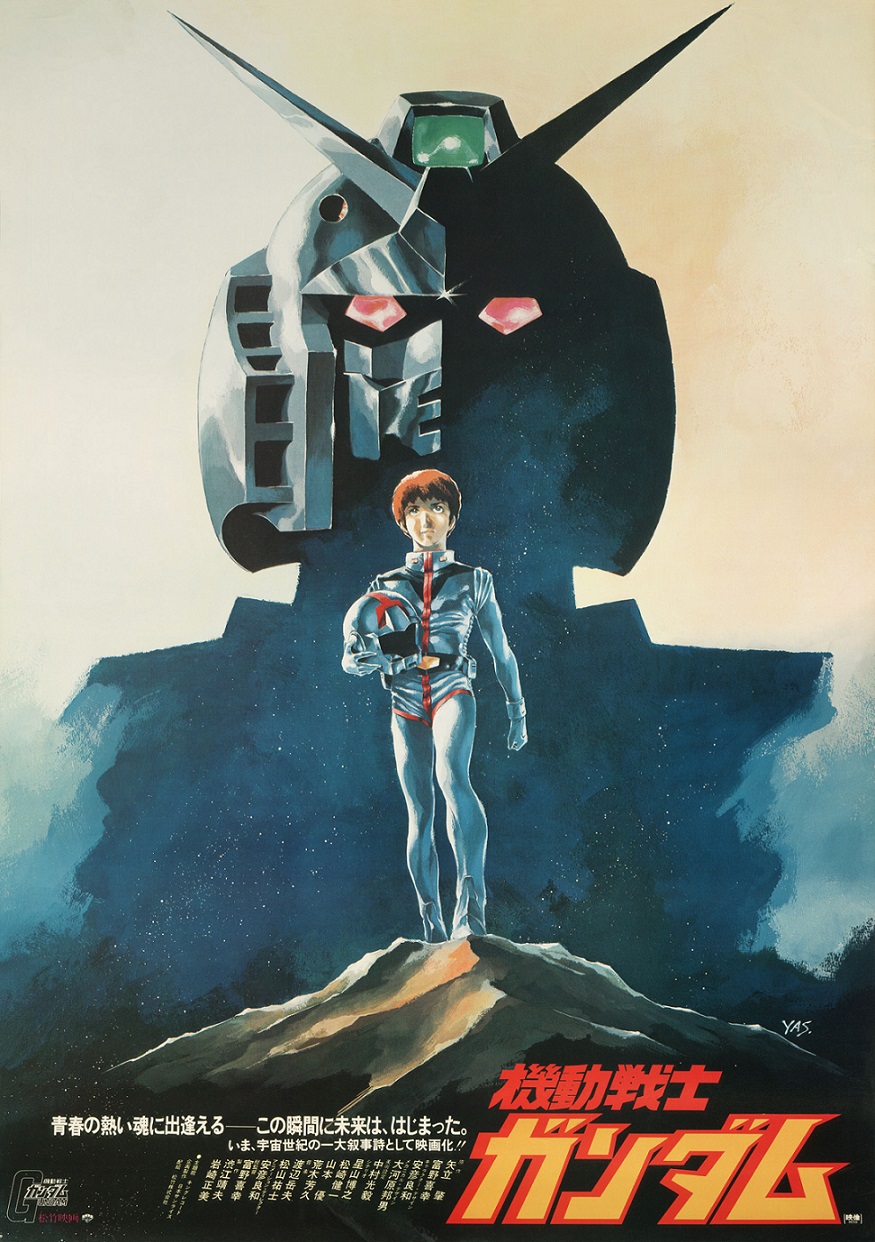
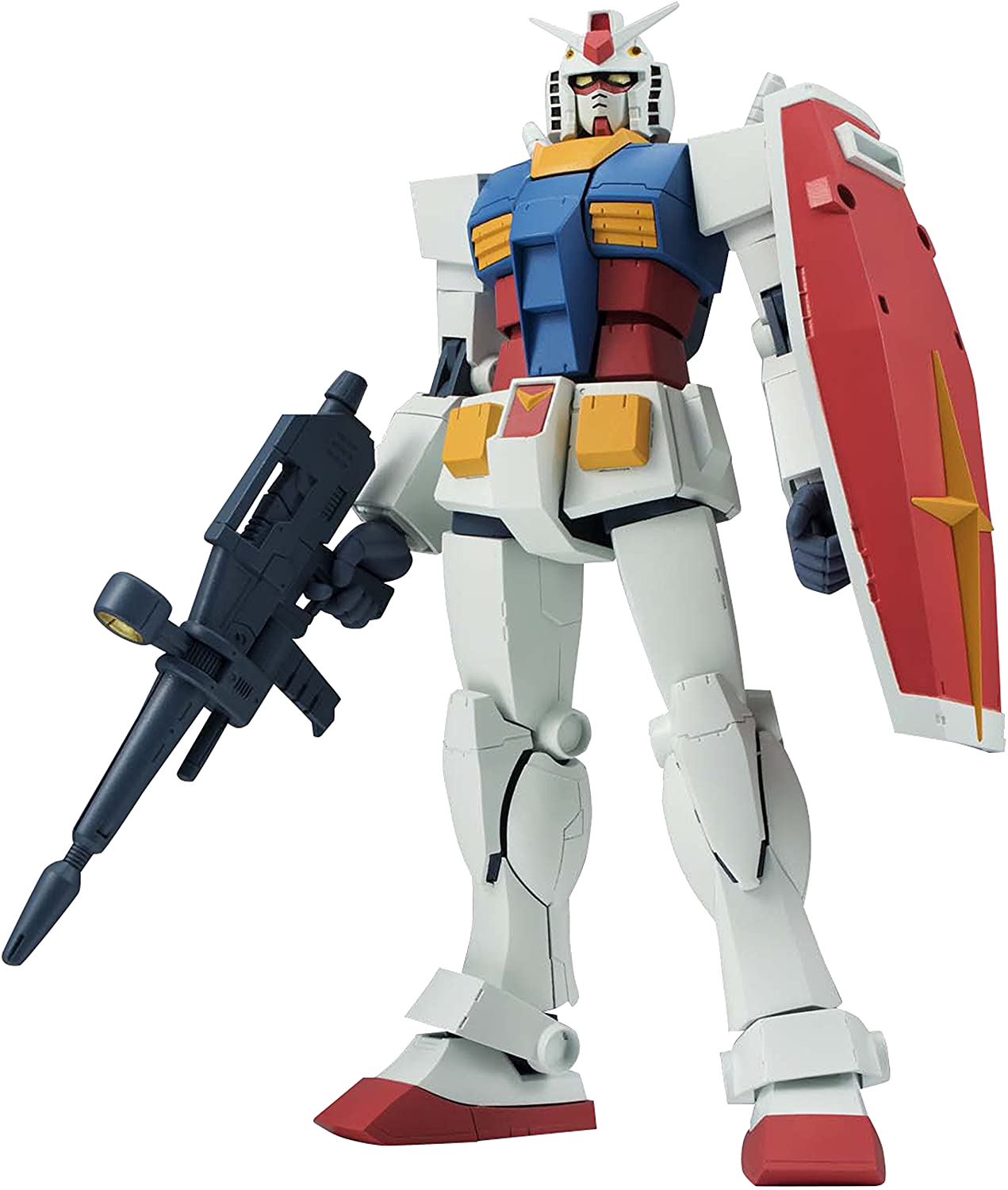
Gundam Poster
The genre-setting Mobile Suit Gundam is all about giant robots, but its recognizable tanks and jet planes are T0 through and through. They are the ‘generation previous to mech warfare.’
A universe like MechWarrior / BattleTech also has planes and tanks, which are classic T0 when compared to mechs.
In the grimdark of the Warhammer 40K setting, everything is taken to the extreme. That’s why mainstay Knight walkers would qualify as T0 when they are in fact mechs.
Tier 1
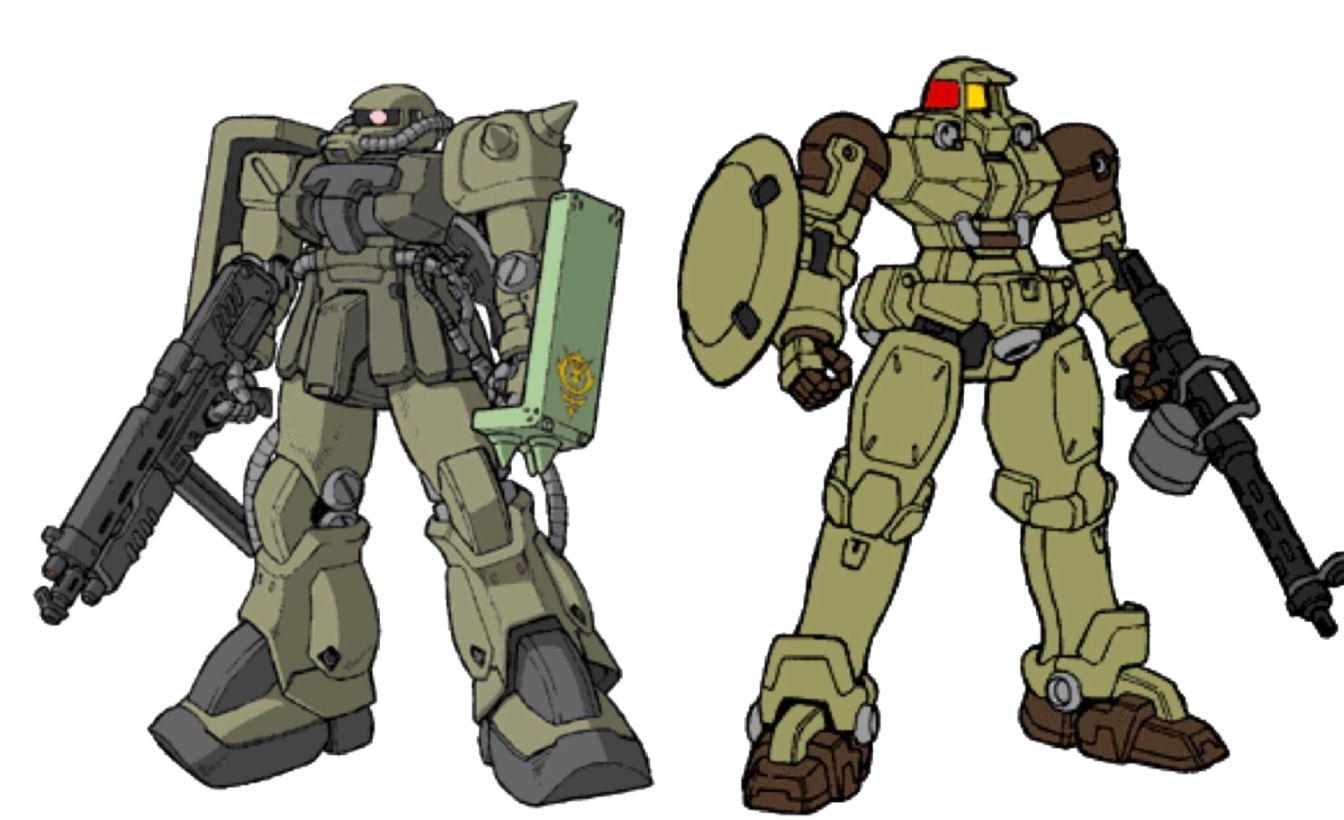
Gundam‘s many series would introduce their first generations of mecha suits here. From Leos to Zakus to Guntanks, these are the foundation that proved mechs were the next phase of military hardware.
The same respect to tonnage fits with the Warhammer 40K setting. The smallest of the mighty Titan classes, a Warhound-class Scout armed with two weapon mounts, is T1 along with super-heavy tanks (a single Titan-class weapon mount if any) and the largest of Knights (though these latter likely at a disadvantage).
When technology does not evolve, classifications of mechs relies on size and capability, as ships do.
Tier 2
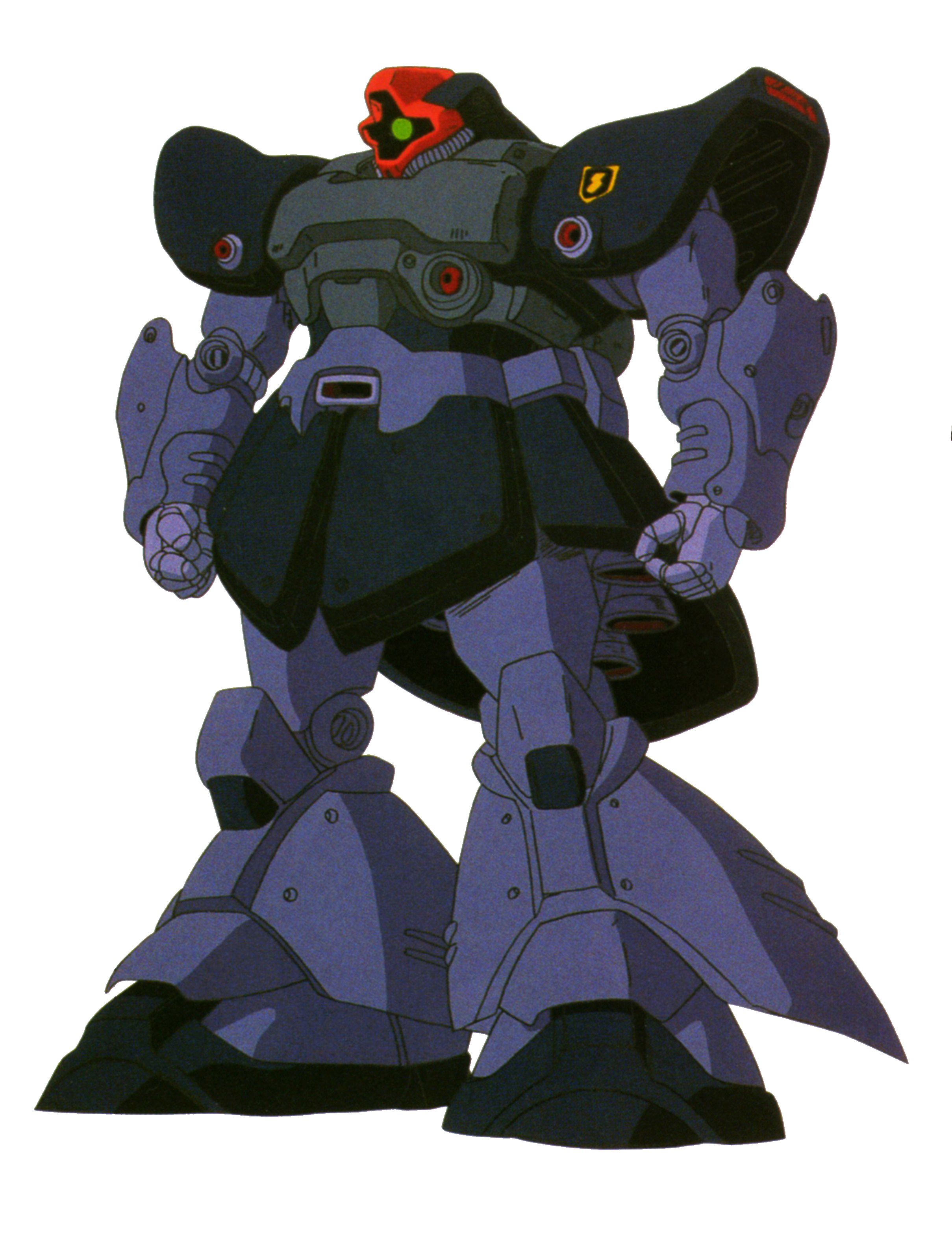
Rick Dom
Another generation of tech in the Gundam universe means GMs and Rick Doms and Dolls arrive. These can be brought down by their T0 predecessors, but it’ll be a fight!
Warhammer 40K brings to bear the middling Reaver Titan, some five-stories tall and wielding three weapons.
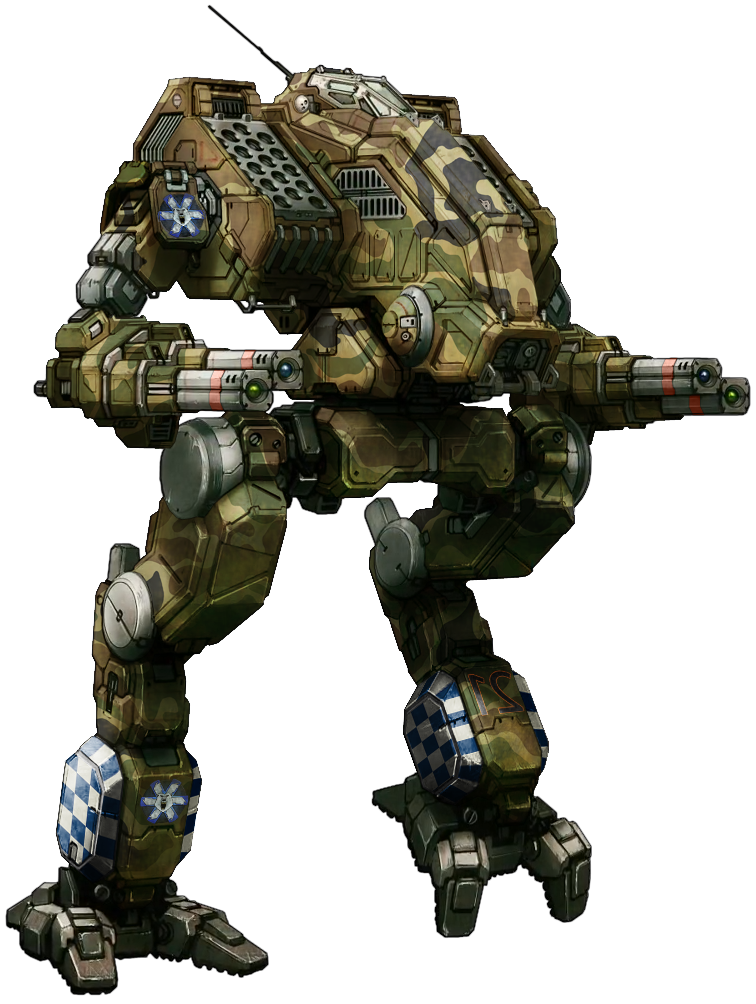
It makes sense BattleTech Heavy mechs like the Mad Dog appear here with gauss rifles and cannons.
WH40K escalates size and ability again with the Warlord Titan.
For a similar almost-fantasy example, the lesser-known Zoids franchise shows off huge bio-mechs like the Iron Kong.
Gundam
Mad Dog (aka Vulture)
Tier 4
A wrecking-tier of robots:
Gundam shows off advanced suits like Wing Zero – which destroys entire battle groups – to boss-level super-massive Mobile Armors the equivalent of multiple divisions (Big Zam, Apsaras III).
+100-ton Assault mechs in BattleTech plate the most armor, the heaviest weapons, and strike fear into any encounter. (The death’s-head Atlas being one such beast.)
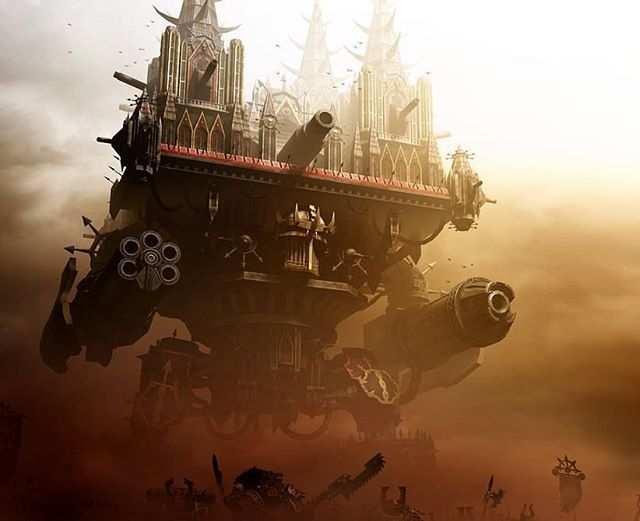
Imperators in 40K are walking fortress-cathedrals that carry a company of troops just to prevent enemies from scaling the heights of its legs.
Mech species in Zoids cap out with the gargantuan sky-borne Whale King, land-battleship Ultrasaurus, and the Godzilla-like Death Saurer.
Imperator Titan
Atlas
–
There we are – mechs for use in BITS.
These rules are easily adapted to organic monsters as well (Godzilla, Attack on Titan, etc.), and that’s the benefit of BITS: flavor the system to what’s being played, because it caters any play.
How would you improve the use of mecha in a role-playing game? What universal principles specific to mechs did I miss?
Whatever your playstyle is, have fun out there! Cheers.
When acting as a ship, add the ship’s tier to a 2D6 roll (or appropriate BITS value, if so inclined!). When acting against a ship, roll higher than that ship’s threat tier. For example, a tier 3 battleship acting against a tier 2 destroyer must roll 9 or more (threat tier 2) with 2D6 and may add 3 to the roll.
Tiers also show how many extra smaller actions the ship may take. These smaller actions may be either defensive or of more minor consequence. (I’m still ironing out the value of different kinds of actions.)
A ship may hold inside it smaller ships that are 2 threat tiers below it, and/or multiple groups of ships 3 or more tiers below. For example, a tier 3 carrier may hold 1 tier 1 corvette and/or multiple groups of tier 0 fighters.
A ship otherwise behaves as any other fictional Being in BITS. (This includes the use of Body as a hull and engine, Interaction as a sensory and communications capability, Thought as targeting and computation, and Specialty for whatever role the ship is fitted out to do!)
Tier Examples
Tier 0 fighters and boats exist only as groups when interacting with higher-tier ships. Tier 0 can be subdivided into interceptors, bombers, dropships, and others. Subdivisions of tier 0 ships are differentiated with simple rules.
For example, a Star Wars X-Wing would be a heavy fighter with critical roles against single ships automatically destroys the other ship (representing a proton torpedo exploding). A Gundam Ball is incredibly cheap, but cannot travel without a carrier though is useful for ship repair. A Chinook helicopter serving with the United States Navy is slow, but can carry supplies, a platoon of troops, or gunship weapons.
Tier 1 ships include dedicated troop carriers, freighters, and smaller warships. Individual capabilities are defined per ship, such as being able to travel between worlds or systems.
Tier 2 destroyers and cruisers can carry a boat or small fighter group to support operations. Ships called “cruisers” (Star Trek Romulan D’deridex) and “destroyers” (Star Wars Star Destroyer) are often tier 3 battleships and carriers in their abilities.
For example, a USN destroyer may have a vulcan cannon to have advantage defending against missiles and fighters while having a mine-laying helicopter. Star Trek Galor cruisers have a large forward cannon, multiple weapon arrays, and high speed, but can be taken out by swarms of fighters or beefier battleships.
Tier 3 represents the battleships, carriers, and hybrids that bring the largest hurt and the largest number of forces to play.
For example, the Imperial Japan Yamamoto battleship had defensive and offensive advantage against any other ship on the water. The Star Wars Star Destroyer could field squadrons of tier 0 TIE fighters, capture a tier 1 Tantive IV blockade runner, land an army of troops and supplies, and bring massive guns to bare. Many Star Trek variants of the Enterprise flagship were on-par with battleships, fielding multiple torpedo launchers, heavy shields and armor, and even fighters and personnel shuttles.
Tier 4 ships are awe-inspiring, all-commanding giants. For the most part unassailable, tier 4 ships get to do what they want to do until a lucky action halts their progress.
A station may hold ships that have the same threat tier or below whether constructing or docking the ship. The station may or may not have defensive or offensive means. If so, the station uses its threat tier for resolutions.
For example, a tier 0 listening post may detect ships approaching a tier 1 science station orbiting a moon. Tier 2 defense platforms may open fire and release a compliment of fighters so that a tier 3 space dock can muster battleships and carriers to fight. When all else fails, a distress signal summons reinforcements from the fleet HQ, a tier 4 mega-station.
Thought Behind Design
Inspired by shows like The Expanse and of course movies like Star Wars, I began to see patterns in how the large vehicles known as “ship” were treated in fiction (a class their own; another post later about vehicles later).
After experimenting with carriers (ships carrying smaller ships) and threat tiers, I am struck by how tightly the BITS treatment of ships above fits into naval considerations. From the real-world United States Navy, to modern space flight, to hard sci-fi in The Expanse, to the fantasies of Star Trek and Star Wars, a 0 to 4 threat tier system where some ships carry other ships seems to work really, really well!
So that’s the thought behind: Keep with the mechanics found throughout BITS, allow for all the classic naval designations, and thematically represent ships regardless of “universe” or IP they exist in.
–
Ready to play some BITS? I know I am 😁
Now to get these manuals taken care of and updated to 2021 standards!
What do you suggest for putting rulebooks together? What holes are there to sink this handling of ships? Let me know! Cheers to your gameplay ~
(A reminder: BITS is a proprietary Body-Interaction-Thought-Specialty game system for tabletop roleplaying games.)
This time, I’ve been thinking awhile on how to handle large groups. Since humans can only track about seven different things at a time, I thought it best to figure out how to make anything more than a small gathering feasible.
Solution
Members of a group have similar capabilities. Everything they do, they do together and at the same time.
Groups have a rating that indicates their size.
0 – An individual. Does not use group size. 1 – A gang or squad of ~10 or fewer individuals 2 – A company, century, or mob, ~100 3 – A demi-legion or town, ~1000 4 – An army or division, ~10k
Ratings also show how many extra actions the group may take.
When a group acts against another group, that action has advantage or disadvantage if the acted-against group is smaller or larger (respectively). For example, an individual 0 is always at a disadvantage when acting against a group 1+.
Certain actions committed by a group may have disadvantage or not be available at all. For example, a group would have disadvantage on being sneaky, or having a 10k army fit into a Manhattan apartment.
To resolve an action by or against a group, the threat tier of an individual member of the group. Different threat tiers should be grouped separately from each other.
A group has a state of health like any individual Being. However, when a group reaches 0 for their state, they break up into D6 (a dice roll of 1 to 6) of the next smallest group. That means a rating 4 10k group at 0 state breaks up into 1 to 6 rating 3 1000-member groups.
As a choice, when a group reaches 0 for state and breaks up into smaller groups, a second D6 may be rolled to give the new group a state 1 to 6 to represent the harm already taken.
Thought Behind
BITS is all about keeping things simple yet deep in what it can be used for. The system attempts to address a lot of the problems other systems run into, and handling large groups (“mobs”) has always been a sore point.
With the BITS use of groups, everything from street fights to clashing armies can happen with a solid dynamic between all engaged. Since BITS also handles social conflicts with the same mechanics as physical violence, inciting mobs or inspiring a legion can be accomplished with the group mechanics here.
It came to my attention that perhaps an individual shouldn’t be able to face down an army of 10K. But then I remembered the brutally brilliant (and violent) “Crazy 88’s” fight in Kill Bill – the player, as hero, ought to be able to have a try at beating the odds 😉
–
And that’s how BITS handles groups!
Will be sharing more BITS content over the next few weeks, including revisiting some sub-par implementations of the past.
If you’ve ideas on groups, share ’em! In the meantime, cheers to your play ~
Greetings! Taking a break from heavier topics to write something light: A game!
Not just any game, but a roleplaying game set in Activision Blizzard’s Starcraft universe driven by my very own BITS engine. (Of course to note: I own no stake in the Starcraft IP owned solely by Activision Blizzard, nor to I may any claim on the IP. The following is personally for education and publicly for entertainment purposes only.)
This came to me over the course of two afternoon hours, cleaned up and expanded here for you! As a modest, very prototype design of a famous IP, it ought to serve to highlight how to bring a real-time computer strategy game to the role-playing world.
Tough talk, Jimmy, but I don’t think you have what it takes to be a killer.
Kerrigan, Queen of Blades
Who the Characters Are
Awaken, my child, and embrace the glory that is your birthright. Know that I am the Overmind, the eternal will of the Swarm, and that you have been created to serve me.
Overmind
Players take on the roles of the units available to a faction in Starcraft: the haughty Protoss, the ravenous Zerg, or the troubled Terrans.
Any character is a standard unit in the game that then may play alongside GM-controlled hero characters. “Standard” means the player starts in an early tier unit, someone not the weakest (unless compensated accordingly), but certainly leaving room for growth.
Starting units come in tiers. Within the tier roles, each character comes with or chooses their own gear and specialties. Not all factions start in the same tiers. A shortlist of examples:
Terrans – Either a regular human or a robot.
Tier 0 – Space Construction Vehicle (SCV) operator, equipped with an exo-suit that is really bad at combat, but can breakdown structures, repair machines, and build anything anywhere given enough time and materiel.
Tier 1 – Marine, armed with powerful rifle and powered armor, though is unable to pilot vehicles.
Zerg – A spawned monster of leathery wings or chitinous hide.
Tier 0 – Zergling, a nasty creature of teeth and claws that travels with other Zerglings due to their minor stature.
Tier 1 – A slithering Hydralisk, armed with massive scythes and spewed barbs, but is a slow target.
Protoss – Either a psychically attuned alien or their AI servants.
Tier 1 – Zealot, the frontline warrior armed with energy fields and two psychically-powered forearm blades.
Tier 2 – Dragoon assault walker pilot, trapped inside a metal shell bearing a massive photon cannon.
There are gives-and-takes for each selection: Slow but powerful, restricted in capability but excelling in what can be done, etc. Choosing both opens and closes options to get things done while on missions.
What Characters Do
I do this for Aiur.
Zeratul
Players take their characters on missions, either as one-offs or as part of a larger campaign with the consequences of previous actions influencing future contexts. Every mission has a single environment the characters operate in with a clear goal.
Different obstacles prevent accomplishing the mission goal. They range from sneaky sabotage to ruthless assault to cautious evacuation to stalwart defense against armies. How these things get accomplished is up to the players and what their characters are capable of doing.
A Terran Marine character wants to shoot a Zergling before the ‘ling can get close enough to attack. The Zergling is Tier 0 which equals a difficulty of 7+ to do anything against them. The Marine must roll 7 or above. To help the Marine, they may add their BITS value of Interaction 1 (this value applies to shooting actions) to the roll.
The Marine rolls a 4. Even with 1 added, the Marine fails their action. The Zergling is now close enough to attack the Marine with sharp claws. The Marine is Tier 1, so the ‘ling requires a roll of 9+. The Zergling has a Body BITS of 2 that they can add to their physical action. Rolling a 7, the ‘ling adds 2, barely getting the 9 needed to carve into the Marine’s armor.
How and Why to Improve Characters
You must construct additional pylons.
Advisor
Characters ‘level-up’ when they try to do things and fail but survive. When a level-up happens, between missions, a player may choose any number of upgrades for their character that improve how the character operates. Players may also choose to re-equip their character into a new specialty.
Upgrades allow characters to succeed more often and survive at the cost of failing less, therefore slowing down how many upgrades are gained. Characters also receive rewards for accomplishing their missions. Better gear, more allies, stashes of materials, or other tactical or strategic advantage become available for use.
Any upgrade from the Starcraft video games can be used, though customization is encouraged. Example:
A Terran Marine doesn’t have the ability to lay mines in Starcraft, but in this roleplaying game, they may come to carry one on their back every mission.
A Zergling can use in-game upgrades to become faster (Metabolic Boost), jump higher (Raptor Strain), and attack multiple times at once (Adrenal Glands).
With better gear, players may expand from their starting roles into more advanced roles and tiers. A Terran moves from combat armor to driving a powerful Siege Tank or flying a nimble Wraith Fighter. A Protoss warrior studies to become a Corsair or a hyper-powerful Archon. Zerg evolve into bat-like, acid-spitting Mutalisks or vile, contagious Defilers. These and more are the outcomes for courageous players.
Four Example Missions
I hunger for battle…
Fenix
Players choose characters and gear together. For ease of play, they all pick from the same faction. There are few decisions to be made in selecting a character at the beginning (name, gender, role, gear), so they begin the first mission right away.
Mission 1: Escape the Base
Nuclear launch detected.
Adjutant
The GM details the environment, what has happened up the the present moment, and what is happening. The GM does this at the start of every mission.
The characters must escape a base that is being attacked and overrun. There are multiple routes out of the base (aircraft, ground transports), but also non-player characters (NPCs) that could help as well as communications equipment that could call for help.
Tier 0 enemies are everywhere with a few Tier 1 challenges. Whichever route the players choose, a Tier 2 ‘boss’ must be overcome for the characters to escape. A Tier 4 ‘super’ enemy destroys the base behind the characters.
After the mission, the players take note of what they took from the base and any upgrades they have available.
Mission 2: Steal the Keys
I have returned.
Dragoon
The characters are stranded unless they get the encryption keys to a spaceship. The keys are kept in a well-guarded base that doesn’t know the characters are nearby.
There are multiple routes into and through the base, as well as different styles of play available: Sneak through the base to avoid Tier 0 and 1 patrols, direct assault at the front gate, cause a distraction outside the base, or disguise as part of the base’s inhabitants.
Whichever rout the players choose, they must escape the base with the keys.
After the mission, a player decides to change their character role based off of what happened in the mission.
Mission 3: To the Victor
(harse growl)
Kerrigan, Queen of Blades
The characters must secure a spaceship for themselves. The spaceship is on a space station. The characters are already on the station when an enemy raiding party attacks.
Battles happen throughout the station. There are multiple ways to get to the spaceship: Fight anyone encountered, run through any firefights, or sneak through the conflict. Extra rewards are on the station but are also where the heaviest enemy presence is.
Whichever route the players choose, they must make it to a spaceship and fly away.
A player character died during the mission. That player then chooses a new character to join the surviving characters, coming up with a plausible reason why that character is joining.
Mission 4: Space Race
Carrier has arrived.
Carrier
The characters must use their spaceship to defeat other spaceships to save evacuees from the invasion started in the first mission. NPCs are available to help with their own space fighters and ships, but need the direction of the characters.
Players may choose to fly fighters, operate spaceship cannons, coordinate friendly spaceships, board the enemy, or fight off boarders.
Whichever route the players choose, Tier 3 and 4 enemies are frequent. Before the mission succeeds, an enemy hero must be overcome as a final ‘boss.’
After the mission, players upgrade their characters. The NPCs who have joined as allies and rewards collected help the players decide what their next mission will be.
Tiers
Power overwhelming!
Archon
A partial list of units in their tiers per faction. BITS stats are given more or less in proportion to the tier of the unit.
Terran
Zerg
Protoss
T0:
SCV, Civilian
Drone, Zergling
Observer, Interceptor
T1:
Marine, Medic
Hydralisk, Scourge
Probe, Zealot
T2:
Vulture, Goliath
Mutalisk, Queen
Dragoon, Corsair
T3:
Frigate, Siege Tank
Overlord, Guardian
Scout, Templar
T4:
Battlecruiser, Ghost
Ultralisk, Defiler
Archon, Carrier
Heroes:
General Duke
Brood Cerebrate
Fleet Arbiter
Sample Unit Tiers
The tiers ought to be altered to better reflect the “technology trees”
Dev Notes
We sense a soul in search of answers.
Arbiter
Actions have abstract ranges of effect. Some actions require a minimum distance, but all cap at a maximum distance. The types of distance include Melee (hand-to-hand), Close (line-of-sight shooting), Long (sniping), and Far (indirect). Other games present systems of abstract distances that can be adapted here.
The quantity of effect an action has is by default 1 for accomplishing the action. 1 additional quantity is added for each number rolled above the minimum challenge required for the action to succeed. Some equipment or actions have a higher default quantity (e.g. a Siege Tank would have more effect in shooting than a Marine’s rifle). Some actions are lower (e.g. a human fighting with only their un-augmented body is 0).
To iron-out absurdities such as a Marine (Tier 1) shooting down a Battlecruiser (Tier 4), a unit may only interact with one and only one tier above that unit or below. Two or more tiers above a unit’s tier cannot be interacted with in a harmful manner by that unit. If an action affects a tier above, the action is at disadvantage (i.e. the highest die in a roll changes to be the lowest die). If an action affects a tier below, the action is at advantage (i.e. the lowest die in a roll changes to be the highest die).
There are more high-tier Protoss units than Terran, but Protoss are fewer in number. There are more Zerg units than Terran, but Zerg are lower tier.
Terran (2 units)
Zerg (4 units)
Protoss (1 unit)
T0:
10%
30%
10%
T1:
30%
30%
20%
T2:
30%
20%
40%
T3:
20%
10%
20%
T4:
10%
10%
10%
Frequency of Tiers and Units (the math isn’t balanced [yet])
–
The merging is complete.
Archon
And there it is! My brainstorm that leveraged inspiration when inspiration hit.
I hope you like it! This would be a prototype if played. With the BITS ruleset and the prebuilt Starcraft universe, a game could be played, and that’s what really matters!
What have you been playing? Care to give this a shot? The ruleset here will get you well on your way to enjoying your own space adventure! Cheers!
This is my attempt to boil down characters to the essentials of what needs to be known. A character sheet still needs the four sections “Self, Seem, Story, and Stuff,” but there’s more wiggle room, especially on “Self,” on what a given game IP ought to include.
(Note card-sized sections are pictured for reference.)
My joy of a game system, BITS delivers a faster pace of gameplay, simpler arithmetic, but a thorough set of possible outcomes for any action. Here I talk of the dice, the math, and other factors in resolving conflict in the system.
Back when I could upload podcasts, I outline twelve actions that remove stress and improve decision making. These are points that are recommended by the best performers and thinkers in our society which I have also tried out personally to great success 😁
I’ve come a long way in terms of knowledge and technique for making games (specifically TTRPGs), yet this first system has a special place in my heart ♥
There are a lot of disgusting, dangerous things being said to downplay or misinform about the current global pandemic.
One hit me so hard on social media it took me days to get over the audacity of it. Then I wrote a blog post in response 😉
One thing I’d add to this post: You can’t give someone lung cancer from your lung cancer condition. You can give COVID-19 to another without even knowing you have it. Therefore, this is another point that comparing COVID to other diseases as a means to render mute the concerns (and lives lost) of the pandemic is not just infantile and uninformed, it is dangerous.
I fled Las Vegas to the wilds and eventually the East Coast in May. What’s written retells my journal entries for the trip, including a very eye-opening understanding of poverty in the forgotten, decaying rural sections of America.
I wish I had this guide when I started in the professional sphere.
What’s inside is a step-by-step formula to calculating what you ought to be paid along with surefire ranges you must ask for when negotiating pay.
It’s dangerous to go about with ignorance when it comes to money. Take this insight along for the ride.
–
If you’ve missed out on these crowd-pleasers, it’s not too late! I also recommend checking out the other posts – you’ve plenty of content to gleam from.
What has been your favorite post? Which articles would you recommend I read? Let me know! Cheers to your 2020 wrap-up ~
I’ve gotten around to watching the shows Avatar: The Last Airbender (ATLA) and Avatar: The Legend of Korra (great shows, btw). Along the way, I’ve taken notes on recurring themes and opportunities to bring ATLA to the tabletop.
This post is less than a full game – for those, try out Avatar-inspired titles like Legend of the Elements (Powered by the Apocalypse narrative game) and The Last of the Lacers (D&D game). The following are the elements (see what I did there? 😁) I’m concerned with for making ATLA into a streamlined RPG.
Themes
ATLA is consistent with a set of ‘rules for the world’ which make it ‘kid friendly’, though these can begin to be stripped away for a harsher feel depending on game genre.
No one kills another. (It’s only an option for the biggest, baddest evil villain.)
People live for over a hundred years.
Gravity is really low, so falls, jumps, and throws are very impressive.
Injuries reduce capability until a person is unconscious, not dead.
There is the Spirit World and the Material World.
There are four Elements (Air☁, Water🌊, Earth🌎, Fire🔥) with a subset and super-power each.
A person is either born able to Bend (magically control) one of the four Elements or not. (Cataclysmic events or powers can give or remove Bending ability.)
Animals are intelligent and a companion is common.
Got it? Cool! Onto mechanics…
Mechanics
Very similar to BITS, two six-sided dice (2d6) roll at or above a target number, that number representing the threat of an individual or otherwise the difficulty of enacting a character’s will on the world.
To aid rolls, the applicable stat number gets added to the value.
Stats
A simple set of stats represent the collective ability of any action a character may take.
Martial
For fighting and physical exertion, getting your way manually. This includes the name of a preferred weapon that, when used, gives a bonus to the action or outcome.
Influence
For leading and convincing others, getting your way without violence. This includes the name(s) of a companion, human or animal, that gives a bonus when they are also interacting in a social situation.
Training
For when doing a life’s work. This uses a specific name of a specialty which in turn has lists of actions that could be taken for a bonus.
Training may be Bending, Soldiering, Crafting, Performing, Wandering, Administrating, or other professions a character could spend their time at. However, if not choosing Bending, other boons are given to the character, eg another weapon they are practiced with.
Other stats keep a character in the game and add color to their life:
Nation
Where the character comes from. This is also the default Element the character may Bend, though for role-play another Element may be Bent if it’s specified that a parent is from another Nation.
Endurance
How much more the character can take. Any detriment to Stress adds conditions that impede the character’s actions before they are ultimately rendered unconscious or otherwise lost.
Confidences
The things the character is proud of. Some advantage may apply when doing such things.
Failings
The things a character should be ashamed of. Some disadvantage may apply when doing such things.
Goals
Stat advancements are the first goal since they improve the odds of accomplishing other things in the game.
The goals in fiction are ultimately up to the type of game being played. The primary goal must be shared by all players, but each player may have additional goals for themselves that give reward such as stat advancement or other mechanical boon.
Some group goal ideas:
Stop the Fire Lord from conquering the world.
Resurrect the Avatar.
Unite the Material and Spirit worlds.
Find an item of power to bring balance to the Nations.
Bending
The “magic” of the game offers great robustness in how diverse a character may become as they Train. Whether used as a utility, brought to bear in offense, or as a matter of healing, Bending can do about all. Each Element also has a magical Elemental animal.
Air
Earth
Fire
Water
Examples
Softening falls, pushing objects away, flying.
Raising the ground, throwing rocks, carving stone.
Creating fire, throwing fireballs, immolating.
Freezing, spraying, using water to manipulate objects.
Subgroup Bending
Cloud Bending
Sand Bending
Light Bending
Swamp Bending
Advanced Bending
Gravity Bending
Metal or Lava Bending
Lightning Bending
Blood Bending
Healing Power
Sickness
Bones
Bleeding
Flesh
Animal
Sky Bison
Badger Moles
Dragons
(none)
No matter the Bending Element, a true master-level character may Bend with only their minds. Hands-free magic!
The god-tier forms of Bending usually lie with the Avatar, the incarnation and agent of the cosmos to keep balance in all things. Walking the Spirit world, telepresence, removing Bending ability, using all Elements at once, achieving a temporary state of extreme ability, and transforming into a hulking colossus of energy are a few examples.
Non-Bending
Not to be outdone by Benders, normal folks have their own gifts too. In advanced Trainings, a non-Bender has access to a lot:
Acrobatics to dodge attacks, run on water and walls, and scale heights.
Chi blocking or assassination to immediately disable the limbs or whole body of an opponent.
Medicine to care for any ill or injury.
Weapon skills to duel with and defend against any foe.
Engineering to create machines and tools matching or exceeding a Bender’s ability.
Brilliance to outthink any situation and foretell things to come.
Bending gives a natural edge that some non-Benders have overcome with study and dedication.
Closing
As a world, ATLA is rich with potential. Keeping things simple, the above outline establishes a solid way to create a purely ATLA game experience. Surprised this wasn’t a post about BITS?
I may come back here someday to create a game from this, though if you beat me to it, let me know 😉 Cheers for now!
Spells, magics, powers, tech abilities – whatever you want to call it, powerful, spooky actions by players in BITS need rules. Healing, harming … that and more BITS takes care of 😁 Just in time for Halloween! 🦇
What Spells Are
As the title has it, spells are unseen phenomena that allow a player to do marvelous and dangerous things. Electricity and technology are as much a kind of magic as what is practiced by fantastical druids and warlocks. BITS being a generalized game design ruleset, the same principles apply to any form of ability a player could have!
Spell Effects
The specific effects of spells or how the effects get conveyed rely on the setting or genre of the game. There are nonetheless traits that reoccur in any spell system, each with intuitive exchange of cost-to-do and effect-of-doing:
Switch a location for another.
eg teleportation, telepathy
Morph what’s in a location.
eg alter colors and sizes
Bring into or remove from a location.
eg conjuration, removing some or all of what’s in a location
Act in a location.
eg mind control, telekinesis
Some spells do little more than move objects around, but what happens when the effect itself needs to be taken into account?
BITS gives spells the effect of being “magical.” However, for many games, increased granularity is required for a more tactical game feel.
To bring tactics to a BITS game, there are only two other kinds of spell effect:
2Ps
“Power” and “Pyro” are the first branches out from basic “magical” kinds of spells. Power is for anything purely magical or electrical, Pyro for (what else) fire or heat-addition and heat-removal 🔥❄
Sure, one or two additional kinds of effect may be added here or the Ps themselves may be renamed, but they must conform to the theme of the game. (Cellular, Laser, and Software for a game in modern times, anyone?)
Dungeons and Dragons-Like
D&D kinds of games are the bucket added to the end of the BITS spell toolbox, but this doesn’t mean a game can go off the rails with the kinds of spells they bring to the fore.
After severe study, even D&D seems to overdo the eight schools of magic it uses, leading to balance issues where schools like Evocation objectively better perform some other schools.
A better look is a maximum number of different things a player can track (hint: it’s seven). To improve the D&D issue, a modest proposal of six kinds (and never more) of spells for any kind of fantasy game:
Divinity – Blessing and cursing targets.
Temperature – Heating and cooling targets.
Form – Making something from nothing and morphing targets.
Life – Decaying and rejuvenating targets.
Mind – Knowing what targets know and bestowing ideas.
Sensorium – Altering the senses and using illusions.
Those previous six are themed for D&D high fantasy, but what about other genres? BITS handles those to, focusing on the “4” theme that repeats throughout BITS. On offering are example sets including: Space, Time, Gravity, Power; Solids, Liquids, Gases, Plasmas; Animalism, Potions, Meteoromancy, Shamanism; Create, Cease, Control, Change; etc.
Spell Systems
There are more ways to convey the awesome power of spells as there are writers of magic systems. Thus, to pick a system of spells for your game, BITS offers some guidance:
Take the D&D Approach
Dungeons and Dragons is the best known roleplaying game ever. How the game does magic is it restricts a player’s use of a spell to the kind of “magic school” the spell is, and both the difficulty of the spell and number of spells based on player character experience. Further, there are a finite number of spells premade to choose from that a player has to decide on before an adventure, a daunting task as there are hundreds of spells 😱BITS mitigates this option paralysis by doing two things: removing the excessive limits, and paring down spells from systems like D&D (BITS has a 120-spell collection taking the best from D&D and balancing out what were previously “must have” spells in D&D).
There are still limits with this approach any game designer must choose to include or forego: Only magical players or game equipment may cast spells, and, players may only use spells from the kinds of magic they understand. Other than that, a player can use any level of spell difficulty! Though, nothing terribly bad is guaranteed to happen if a player foils up casting a spell…
Slim Approach
Which brings us to a slimmer, more deadly approach! Following the influence of old-school revival (OSR) games, there is at most a page or two of succinct spells that speak to the theme of the game.
Further, when players critically fail to cast these otherwise resource-free, ranged, and power spells, BITS requires the spell to target the casting player and any effect turned negative towards the player. That heal spell now hurts, that fireball explodes around the player, the airstrike you called in is on your location. BITS achieves balance here by keeping the game succinct and spell use deadly.
Freeform
What if players are especially imaginative? There are no walls barring magical ability? Is the game Harry Potter themed? BITS solves that too. In a freeform system, a table guide for spell effect and the difficulty of the spell exists to aid not just impromptu game systems, but also for GMs and players who want to introduce their own material to the game.
Spells range in difficulty from 0 to 4 (from a required roll of 5 to a roll of 13). That 0 to 4 corresponds tightly with the effect of the spell, its range, and its radius of effect.
Default for BITS Spells
As mentioned before, what spells end up in the game depends on the kind of game being gone for. A bucket of spells? A tight selection? A creative ocean of spell possibilities? Regardless, BITS focuses on a set of realities to keep spells both balanced and powerful in any game.
First, the difficulty of a spell roll is the difficulty of the spell, not the threat of what the spell targets. Melee fighters and arrow-shooting rangers have to meet or beat the difficulty of harming a target, but a spell thrower merely needs to account for the spell they cast, leaving them free to focus on their role as magical support.
Second, spells will target and harm the caster if the caster critically fails their roll. The same effect, but opposite of intent.
If this self-destruction is too harsh, BITS has the optional rule to allow casters to choose between accepting the negative themselves, or destroying what equipment they carry to completely negate the spell. (Just be careful of naked adventures running around with sacrificed clothing!)
Third and lastly, spells are what I call “runaway”. Like a train without a conductor, when a spell is cast, it keeps going until it’s finished. Plenty of spells are instantaneous (zap ⚡), but some last the lifetime of a target or until some special rule of the spell is met. Runaway spells lessens the bookkeeping of tracking multiple spells in the game world while freeing up magical players to otherwise continue acting instead of babysitting some effect.
–
And that’s spell use in BITS! Thank you for getting this far, reader 😁 If you haven’t yet or need a reminder, checkout BITS’s core mechanic, the equipment, and the role of the GM.
Tomorrow is Halloween 🎃 Next week is the US national election 🙃 After all that, look forward to when I review October’s goals and we look ahead to November. Stay safe! Vote! Cheers ~






 Jimmy Chattin