Truth: Top 10 Truisms

  1. 1. Simplify
  2. 2. Suffering Exists
  3. 3. Knowledge Is Terrible
  4. 4. Be Attractive
  5. 5. Don’t Settle, Suffice
  6. 6. Competition Is for Chumps
  7. 7. Know Better
  8. 8. Escalate
  9. 9. You Are Responsible
  10. 10. Forgive Yourself

What is Truth? We might know it by how these top truisms are us and the universe.

1. Simplify

Less is truly more. Should you need more anyway, there is some written on this.

2. Suffering Exists

Exists and is inevitable, a persistent, constant force in the universe. I have taken a deeper dive into the topic.

3. Knowledge Is Terrible

What is known cannot be unknown along with all of its consequences. Care to know more?

4. Be Attractive

Attraction is a basic law of nature where to be attractive is the only thing to be. More material outlining attraction is available.

5. Don’t Settle, Suffice

In short, have higher standards, but keep those standards in line with what’s sufficient.

It is naïve to think things cannot be better regardless of situation. To seek to be better is one of the most noble activities to improve yourself and the world. However, an obsession without end will cause more suffering that it corrects.

Wisdom arrives when you know the world and yourself enough to understand what, subjectively, is “enough.”

Achieving this is a numbers game. Be it the theory of Pareto’s Principle, the Optimal Stopping Strategy for professionals and love-seekers, or Statistical Significance, the number of trials to find what’s sufficient correlates with both knowing and achieving that “enough.”

Truth requires continuous action until higher standards are met sufficiently. For you, that means being the harshest critic of your own monstrosity, leaving nothing for anyone else to critique.

6. Competition Is for Chumps

Competition spends immense amounts of energy. The more energy one has unspent for competition, the more likely that competition will be a success. And survivorship is Good!

But a strategy of expending too much energy against others goes by another term: War of Attrition. Attrition warfare can also cascade into a Pyrrhic (a.k.a. not-worth-it) Victory. By its very nature, competition tends towards less-than zero-sum outcomes, all competitors having spent their energies against each other, not their goals.

To come away from a singular competition with less or even no energy takes away that fund available for future competitions over food, space, and mates. Thereby, a competitor may have survived the competition, but their likelihood of surviving thereafter goes down (not Good).

Be it peacocks maintaining elaborate plumage to out-gaudy other mates, male lions killing each other for pride control, or humans laboring and becoming indebted to attain status symbols that are more form-than-function, competition takes a toll.

So what is the alternative? As renown military philosopher Sun Tzu would have it, “the best strategy is the one that delivers victory without fighting.”

In competition, little is gained. Effort is largely wasted and suffering gets accumulated by all parties in true competition (consider the benefits of play, the faux competition).

Energy spent in cooperation or subtle, low-energy, indirect competition (if competition must occur) is much more beneficial; all else is for chumps.

7. Know Better

Despite knowledge being a terrible thing, it is a requirement to know better, especially of oneself. The Good that knowledge can bring far outweighs the harm that may arise.

As put, knowledge is powerful. However, having the wrong knowledge can be worse than having pure ignorance – the road to Hell is paved with good [but ill-informed] intentions.

So figure yourself out, your duties, and the when and where you are. Be more selfish in coming to these terms. Until you have the language and patterns of understanding to ask and enact what’s required, you are no use to anyone except at best as a pawn (others may know how to use you better than you of yourself).

Better knowledge starts with asking better questions:

What does culture demand in status and contribution? How can one survive in the environment?

What do you like? What do you despise? What do you fear? How do you fail yourself and society?

Learn. Study everything. Find that gaps that need filling. Others have suffered in ways aplenty so that you do not have to. Yet some of these lessons are faulty, thus only by sheer numbers of examples can better knowledge be affirmed (like how the community process of Wikipedia allows correct information to form).

Competition is to be avoided because of the energy it spends; the same applies to gaining knowledge. Defer to the expertise and strength of those that have lived and done the things you seek to do – if they have proven Good (i.e. survived and reduced suffering), they are models to follow.

After the questions and the study, you will have the better knowledge needed to not only improve yourself, but better the world.

8. Escalate

More. Up or down depending on the context, always get to better faster. (“Better” can also be ends to things.)

Escalation of magnitudes is preferred – doubling, halving, or changing ten-fold is the broad stroke required to anchor what’s expected in any exchange. If the strength of X is insufficient to twist open a cap, at least 2X is required on the next attempt.

However, delicacy is sometimes required in a situation – perhaps the vessel to open is brittle or a negotiation comes to a close. In that case, less than a magnitude in change is required, but escalation plays a part here, too: to achieve less than 100% change, use 10% (.1X instead of X).

Yet, it may come to be resented if too much is asked for, or cause disgust to ask for too little. What would be acceptable between those extremes comes from better knowledge and caring for one’s own wellbeing. Trust that another will defend their own self interests as you ought to be an advocate of your own.

Therefore, escalation is a benefit to the universe: It saves time (the expense of energy), it wastes less by finding the sufficient amount to expense (magnitude of energy), and reduces mental suffering from an effort too generous or stingy (buyer’s remorse).

9. You Are Responsible

With existence comes responsibility. All incentives, all motives, all actions, and, ultimately, all outcomes are the responsibility of the perceiver. Whether through the tangible consequence or the mental perception, the individual has stake in anything that goes on.

Respect yourself and take caution. All that you do and perceive is at least a subjective reality. Merely by consciously perceiving the world, you create what’s real. In this way, you are partly-if-not-wholly responsible regardless of context.

So what will you do with that great power?

In existing and therefore creating reality, you have a part to play in the suffering in the world, both for yourself and others. A person cannot abstain from action and expect that abstention to not cause suffering.

The only way to have a say in survival and suffering is to act, which carries its own set of consequences. Despite that, failures in action are overcome faster by further action and personal change of perception. A failure to act passively discovers outcomes that – if the universe has any bias – tend towards entropy, the ultimate failure to survive (not Good!).

(This brings up that action appears to be Good, but that’s a separate discussion.)

Whatever comes, by existing, you are responsible for all action, inaction, and your perception of the outcomes. Only by taking action and curating your perceptions might you also be responsible for any Good.

10. Forgive Yourself

A stark follow-up to the “Responsibility” point above, you must also take responsibility for forgiving yourself.

The journey to be better and do Good is long, difficult, and continuous. People are similar and people fail – you are much more like them than you imagine.

Meanwhile, you have the morals you can afford, so be merciful to yourself when you fail, slip-up, or otherwise dwell on what must be temporary setbacks. Should failure prove to be a habit, be the harshest critic of your own monstrosity and be better immediately in the moment (you may always recess to being lackluster later).

There is the same self-forgiveness universally. No land dwells on the consequences of a volcano or earthquake. Instead, the land bears its scars and continues. Indistinguishable it is for wind and rain and galaxies that crash into each other, each holding no grudge but instead swirling away to continue their atomic existences changed, yet continuous from one form to the next. No mountain crumbles under its own self-doubt or loathing, but continues to push up through the clouds by its volition no matter the wear. As you must too.

That’s the reason you must own care for yourself – no one else will have your drive or context to be up to the task of forgiving your failures, nor ought they if you’ve not done so already. Thus, through forgiveness, resolve some of the greatest sources of suffering for you: your own doubt and guilt and regret. Thereby, to forgive yourself is a Good thing.

These ten truisms appear to be some of the most-true things for not only people, but all life and the universe, too. The sections above do not go into depth of any great description and proof-by-example, yet everywhere I look these things make themselves present.

As a character in a Zelda videogame once put, “it’s dangerous to go alone,” I only want you to take this so you can do Good and that Good may happen to you.

All something to live by. Cheers!

Truth: Attractiveness

Be attractive.

Truth itself is an enigma. Truth might be known through its many faces, though not all faces are equal in their value to Truth. But attractiveness? Attractiveness seems to be side-by-side with what Truth is.

Whether as a material law (magnetic/electric/gravitational), physical trait (symmetry/garb/health-signaling/etc.), or mental characteristic (charisma/stability/respect/etc.), being attractive secures the resources of survival. Attractiveness is an objective and severe determiner of the consequences a thing receives in its lifetime.

The benefits are plenty: Ability to convince a person to do another’s work; Gather mates for raising offspring or protection; Decrease the likelihood to be neglected or killed (a reason baby animals are “cute”); et. al.

Being attractive gives the edge to survival – as has been proposed by others, that which is Good is that which survives.

This principle extends beyond biological evolution too. Non-organic nature seeks to persist in its states forever and ever, from thermodynamics to motion. What persists the longest are those things with strong bonds and mass; i.e., matter in the universe that is “attractive” survives.

Planets – the tiniest fraction of the mass of the stars they orbit – only exist that way if not subsumed as moons of even larger planets. Suns live only so long as there’s fuel to burn, the more fuel, the longer life a star has. Galaxies outmatch any planet or star for lifetime, attracting billions of stars, yet they cease to exist as a whole after cataclysmic interactions with something of approximately equal attractive potential (i.e. other galaxies).

Therefore, being attractive is a necessity of the universe, as plasma, rock, or mammal. Further, there are tiers of attractiveness, differentials of both magnitude of attractiveness and type.

Just discussed has been material attractiveness of the gravitational type, with examples of planets being in their own tier, suns another, and galaxies encompassing them all. The same applies to biological life.

An attractive baby is not the same type of attractiveness as that of a sexually attractive mate (ruin to any that foul-up this distinction). Two babies also cannot be deemed to be equally attractive (e.g. as soon as a child receives more ‘resource’ than another, that first child is by definition more attractive), a concept that also applies to shallow comparisons between two job candidates.

Anything that confuses the type or magnitude of attractiveness does not survive. Planets burn away in stars, social aberrant behavior is mocked and condemned, inconvenient (i.e. unattractive) infants are slain. Diverging from attractiveness is punished, thereby adding to the net suffering in existence.

If doing what is unattractive generates suffering and ends its existence faster, the contrast that does not create suffering and survives must be called Good. Being attractive is Good.

Bringing it back, attractiveness reinforces itself as being adjacent to Truth: Attractiveness is a universal quality across matter and time, nature tends toward attractiveness, and the pursuit and state of attractiveness reduces suffering.

How to Be Attractive

First, there is great advantage for a person to be born attractive. Natural symmetry, familiarity, secondary sex characteristics, easy display of health through skin, nails, hair, and teeth, and other traits greatly increase the survivability of both the individual and their genes.

When in Rome, do as the Romans do.

Saint Ambrose

Regardless of birth, fit into physical and social environments. Being ‘average’ and ‘consistent’ for the surrounding context breeds familiarity which is attractive, as well as showing a healthy response to the external stimuli of a particular niche. Further, fitting in with others feeds into social affirmation, an attractive trait that signals others to act on and for one’s behalf.

Success in handling changes and challenges in the social intangibles and the physical resources for survival indicate two attractive qualities: Health in the now, and advantaged genes for later reproduction. Such accomplishment is part of seeming confident. Confidence itself is a sign of health, its natural assertiveness gaining resources for survival and protecting those resources.

There are other ways to express attractiveness; these assets are many and varied. Listening to the opinions of others and one’s self will determine what works best!

Attractiveness Elsewhere

Abraham Lincoln – “I have no other [ambition] so great as that of being truly esteemed of my fellow men, by rendering myself worthy of their esteem.”

Sun Tzu – Appear as is best for your intentions with others. (Fake it to make it.)

Beauty – Attractive things exist so long as not too much is known about them at the time. (See: Knowledge is terrible.)

First Impressions – “If their initial impressions of the candidates are positive, employers show a higher tendency to ‘sell’ the job by providing information to the candidates about the job rather than gathering information from them.”

Live an attractive life as best you can. Cheers.

Truth: Suffering

Suffering is inevitable.

Truth can be debated endlessly. Look no further than the blind men and the elephant. Simply put, a singular Truth cannot be known 🤷‍♂️

What can be understood are the collection of truisms close to Truth. Things that are agnostic to time, space, culture, and context are more true than dichotomies or idioms. Something that, once known, is of terrible power for its ability to inflict or relieve suffering in one and another. Yet, not knowing can lead to a suffering through ignorance!

So what is truthful?

All life seems to agree on this: Suffering is the only guaranteed experience.

Before you go, hear me out. Suffering is a cornerstone of existence if not the foundation of what it means to be alive.

It all starts where all things do: at the beginning.

First there is the suffering caused to mothers during pregnancy and labor. Second, babes wail at the shockingly cold, shockingly bright loss of everything they have ever known. Communities then suffer the child’s cries and inadequacies while their parents sweat and toil to keep the new human alive – and often that is beyond their abilities!

The baby born, that child will become self conscious. With that knowledge, the young person begins to doubt their own value. Their body morphs through puberty in unknowable, painful ways. Their minds become aware of themselves and other people, namely the failures of themselves and their society. A child is considered ‘mature’ when they lose the shield that was naiveté. In a complete upending of the child’s reality, they come to understand they are betrayed by family, friends, society, and their own body.

That babe-turned-adult suffers once again as the incessant march of time grinds down thought and bones alike. If not outright crippled in mind and body, the ‘edge’ of peak performance experienced in late adolescence is dulled. A second revelation comes where the elder recognizes how much of their short life has been spent with little return. Existential nihilism or a living lie of denial sets in, killing the elder long before they are dead and buried. This is the elder’s only inheritance left to their next of kin, who in turn do not understand the trauma they’ve received. Thus the cycle of suffering, from birth to death, continues on into the next generation.

Matter – atoms and the like – too suffers in its creation, as understood through an empathetic anthropomorphism. All particles exploded into an inferno during the universe’s birth. All suns only formed after eons of atoms floating alone before being crushed and incinerated under their own weight and the smothering of their kin. The universe itself may be convulsing in a cyclic version of Western Hell and has so done since the beginning of time.

Suffering is inherent in creation. Yet does it last?

Absolutely.

We see in the life of a person or a galaxy, suffering is the ever-constant companion throughout a singular existence. From start to finish, suffering is present and repeats its pattern infinitely.

Suffering persists. But what of the Good?

While there are absolutely may be moments of pleasure in one’s life, no two persons can agree on the specifics of such pleasures, or if the pleasure itself is a Good thing! (What is Good has been mentioned before, but a further exploration is later in this post.)

What used to be the common ground of Good was religion. But which religion? Which denomination of that religion? Can a history of stoning neighbors, burning knowledge, and the excruciation of the masses, justified in the many names of God, be considered Good? (Rhetorical questions all.)

When consuming certain mushrooms across the world, shamans and laypersons alike gain the satisfaction of meeting their own God without the need of religion. Perhaps this is a contributor as to why claims to be religious are becoming a minority. Regardless, religion seems to be unable to define a Good in the universe.

Hedonism gives many moments of pleasure. Eating, drinking, sex, and drugs all stimulate dopamine and other feel-good chemicals, these chemicals the only objective cause of pleasure in a person’s body. If pure pleasure is what Good is, the only Good activity in life is the pursuit of opiates until death arrives, the dead no longer suffering.

Sensual pleasure works as well as it does because of the erasure of self it causes. There is no person, there is only bliss. Should a person retain any amount of self-conscious ego, this pleasure is often found to be meaningless. (Not to mention that the individual hardly survives for long, which is not Good.)

The idea of ‘the nation‘ aims to give meaning with shared common purpose, that which the nation claims to be Good. Further, nations promise to carry the ideas and works and wishes of the citizen into the future, a survival-by-proxy. So which nation is Good? When? For whom? What consistently has been considered Good? Perhaps during the disenfranchisement of its women? The crucifixion of its minorities? The genocide of its enemies? The enslavement of the destitute?

The nation has many ideas of what Good is. No idea remains consistent, thereby a changing, unreliable definition of what is Good. In the book The Rape of Nanking, it is come to be understood that nations will justify its actions without remorse, even glee, passing this ‘goodness’ into its citizens and collective actions. It is clear ‘the nation,’ despite giving meaning and surviving, cannot be Good.

If you want a vision of the future, Winston, imagine a boot stamping on a human face forever.

George Orwell, 1984

In these ways, the Good is entirely subjective. What is Good for one cannot be guaranteed for another. The Confucian Golden Rule of “do not do to others what you do not want done to yourself” aims to address this, where it usurps its Western opposite of “do unto others what you would have them do to you.”

But Good may yet have something true about it. If suffering is the omnipresent woe, minimizing suffering may be a common agreed-upon Good. But remember that many things done with ‘Good’ intention (Western Golden Rule) cause suffering. Therefore, Goodness with the intent to reduce suffering seemingly is to act less on perceived suffering (the context others appear to be in) and more on actual suffering (the context a person finds themselves in, the only guarantee suffering is indeed occurring).

As Goodness with the minimal definition is an eternal endeavor since suffering persists, Good would need to accommodate failure and continue (i.e. survive). That still does not negate this narrow definition of Good as being subjective, only one in a crowd of other definitions that claim to be correct.

Simply put, a definition of Good may be “reduce net suffering to survive and survive to reduce net suffering.” This does not violate the subjectivity of Good, merely prescribes what the abstract concept is.

Good is subjective. So what is objective?

If any claim to objectivity is made, it seems to be made of suffering and surviving. A person cannot do a guaranteed Good. By the act of existing only, a person can participate in suffering.

You and I will experience suffering, will cause it. Much of it will happen and we won’t be aware of it. In our darkest times, we will seek it out.

Therein lies an objective truth: Suffering is inevitable. With that knowledge, preparing to suffer can be committed to and actions readied to reduce it. How suffering is perceived is variable, but thoughts about suffering tend to trend in two ways: Those that have the means to hypothetically bear great suffering are better; those that endure actual suffering not of their choosing are considered lesser.

Whether suffering is accepted or railed against, if a person finds that they are suffering, it may be a comfort to know suffering is natural and it too can pass. How to address suffering is another topic entirely, an important one to have when suffering is known to exist, persist, and permeate throughout the universe.

In these ways suffering conforms to a universal truth, a first-tier fact that better reveals Truth and hones other truths in their meaning and purpose.

Of pain you could wish only one thing: that it should stop. Nothing in the world was so bad as physical pain. In the face of pain there are no heroes.

George Orwell, 1984

Something I’ve pondered on and worth continuing to ponder. Before we go, a final word on suffering and what to do about it:

I was walking along the bank of a stream when I saw a mother otter with her cubs, a very endearing sight, I’m sure you’ll agree. And even as I watched, the mother otter dived into the water and came up with a plump salmon, which she subdued and dragged onto a half submerged log.

As she ate it, while of course it was still alive, the body split and I remember to this day the sweet pinkness of its roes as they spilled out, much to the delight of the baby otters, who scrambled over themselves to feed on the delicacy.

One of nature’s wonders, gentlemen. Mother and children dining upon mother and children.

And that is when I first learned about evil. It is built into the very nature of the universe. Every world spins in pain. If there is any kind of supreme being, I told myself, it is up to all of us to become his moral superior.

Terry Pratchett

Cheers.

Truth: Knowledge

Knowledge is a terrible thing.

Truth is something we cannot know. However, Truth is a legion of many faces, each aspect of Truth being a testament to the universe. Through these aspects Truth may be known. Yet, the knowledge itself is a terrible thing.

Terrible, really?

Quite so. Once something is known, it cannot be unknown. The knowledge itself gains a consciousness in its perception. The knower gives the information their own life by spending time and calories thinking on the knowledge.

A terrible part of knowledge is when it allows the knower to become self-conscious. A belief held in ignorance contradictory to newfound information provides a stark contrast to what may have been a life in the ‘wrong’ or ‘false.’ Not many are ready to recognize their failings in this way, that their reality was a lie up to the knowledge gain. Thereby it is born a perfect situation to allow a knowledgeable person to suffer not only the pain of finding in themselves a false-self, but doubly the suffering of perpetuating the now insincere lie of their false belief.

But to live in the dark? To forego the possible suffering of exploring the unknown? Enjoying the bliss of ignorance makes sense if the benefit of knowledge could not outweigh its horrors.

Common nay-sayers to the progress of knowledge cite many of the troublesome topics of modern times:

Gunpowder, biological weapons, social stigmas, dogma, racism, factory farming, sweat shops, nuclear arms, weaponized pathogens, fuel waste, more addictive substances, inhumane architecture, spam email.

Yet, humans continue to push the boundaries of knowledge, to explore, to discover. Ill-content with the state of things, people have gained knowledge of, well, everything a mind can perceive and more.

Language, sparking fire, paper, printing, the raising of crops and livestock, penicillin, engines, mathematics, rocketry, clothing, environment control, the internet, vaccines, subatomic physics.

All-in-all, knowledge has proven terrible in its power for the Good reduction of suffering, and the contrary application of incredible suffering for meager gain. “Terribleness” cannot be said to be in-and-of itself a ‘bad’ thing. By any objective measure – poverty, life expectancy, opportunity, access to resource – knowledge has on the balance been a Good thing, making now the best time to be alive ever.

If the concept of knowledge were visual, knowing would be feeling around into the darkness of the world’s unknown. Some finds would be sweet and soft, treasures to make the journey worth the while; others sharp and deadly, tragedies there in the dark. Sometimes a truly terrible tool is found, a thing with the capacity for great reductions and increases in suffering, depending on its use.

Taking the ‘darkness’ example further, sharing knowledge might be visualized as a light cast on a place – a piece of knowledge. However, that light comes from one direction – the sharer of the knowledge. What may appear true and whole on one side may seem completely false on the other – a shadow cast. Therefore, partial light may play tricks and deceive for a time. Until further insights and investigations cast more light on the subject, knowledge and its sharing suffers from the parable of The Blind Men and the Elephant.

Light too, when shown to unprepared eyes, can be blinding. In this way, the illumination and knowledge can send a person reeling from the moment’s bright suffering.

So the distribution of knowledge may cause suffering, at least for a time. To pursue knowledge is one choice; to reveal information is another. Sometimes it’s best to not reveal true knowledge, as in the case of white lies, especially to the unexpecting. Sometimes knowledge will be shared with the express intent to cause suffering, e.g. black truths.

A truth that’s told with bad intent
Beats all the lies you can invent.

William Blake

Therein lies the terrible essence of knowledge. It gives and takes suffering from the world when gained by a person.

This has always been the case. Two-and-a-half millennia ago in East Asia, renown warrior-philosopher Sun Tzu based much of his The Art of War on knowing and keeping others from knowing. Niccolo Machiavelli wrote a half-millennia ago in the heart of Europe that success in life lay in knowing what to do with the power one had. Shortly after, Sir Francis Bacon put it bluntly: “knowledge itself is power.” Or as Susan Orlean puts it for today, “Knowledge is a beautiful thing, but there are a few things I wish I didn’t know.”

So pay respect to knowledge and its lack alike. Context plays a part in guessing whether knowledge gives or takes suffering away, but across time and culture, this remains true: Knowledge is a terrible tool to have and to wield.

What lights do you live your life by?

Cheers.

Truth: Simplify

Simplify.

Truth is an enigma, but there are scatterings of Truth in universal truisms. These truisms are plentiful, none are equal. The further from Truth they go, the more truisms there are, but the less true they are in turn. There, they become a ‘noise’ while fewer and truer the truths become. In that way, the closer to Truth one goes, the simpler the space is as are the truisms found.

Truth tends towards simplicity.

A diamond cannot be uncovered while there’s rough. Gold cannot be picked unless the silt is panned out. Grain does not grow if choked by weeds. A body cannot breath if smothered. About seven things is what a human mind can hold. About 150 persons is what a single individual can keep track of.

To simplify is a cornerstone of existence. We see this exampled in everything from the composition of cellular life to the decomposing of atoms into baser parts to the simplicity of the equations that describe the fundaments of reality.

It is a challenge to think of what, when added, makes things simpler. The act of taking away brings things into focus. Take myself:

I trimmed my professional "expertise" from game design, production, illustration, programming, and mathematics into tools engineering, serving me with above-par pay and sharp skills.
From aiming to please any-and-everyone, relationships of all sorts have become straightforward - my experience knows "why what works with who," making any decision involving others near immediate versus requiring deliberation over months and years.
My time, previously split between an immense variety of activities and active interests,  boils down to creation (writing, game design, sketching), being of use to others (tools engineering, exploring problems) and myself (working out, learning), and achieving a sense of order (planning, chore completion).
Even this blog used to be many goals spread over a quarter and two posts, now regulated to four goals in a single month in a single post.

Yet, simplicity’s opposite – complexity – pervades. This, too, appears to be natural. Planets gather moons to add the complexity of tides. The simplest atom hydrogen is incredible unstable, binding itself with other atoms to form more complex molecules. Organisms evolve to add just-in-time necessary features, even if that’s combining symbiotically with other creatures.

Life itself could be described as a pattern within the universe that attempts to stall its own entropy. That pattern does whatever it can to survive, which through evolution, has brought forward more complex forms.

Humans too generate a ‘gravity’ to add things to their orbit of concern. Another task makes it onto the ‘to-do’ list. Another acquaintance boosts the follower count. Another car needs payment. Another interest of the moment divides attention. Another another another.

Though how often has “another” brought suffering to life? The pain of indecision contrasts with the toil for more, a common masochism a sleepless person who takes on another responsibility shares with the pet that gorges itself into ache and vomiting.

We cannot help adding complexity to our lives. But as another card is added to the house or another plate is brought to spin, our lives become more perilous.

Our wants are simple: Comfortable environment, quality sleep, satiation in emotion and nourishment, a feeling of worth, and energy to pursue the things we intend and find interesting and survive without cares from what we don’t. Our ways and whys are many more than these.

This complexity resembles what it is: a construction. How well it is built is directly linked to the foundation of planning and intention that goes into our lives.

Complexity can serve a purpose. As mentioned, life will become more complex to survive, with a caveat: The nature of the universe abhors doing anything that is not needed at the precise place and time. When complexity arises, it must be judged, especially in ourselves, since humans are awfully good at justifying what exists, regardless of correctness.

Is this object or situation or action as simple as it can be? Does it serve a necessary outcome here and now? How can it do the easiest thing possible?

A medicine is highly complex but any more or less than necessary ruins its purpose. A wall with its many parts crumbles with any more or less than the required stones. A body – a miracle of moving parts – with any more or less than a very small range of temperature, water, calories, or genetic deviance destroys itself.

It’s simple: The farther from the simple a thing strays, the more the thing destroys what it is. Such change is a guarantee. Whether the consequence of the change is intended is up to how simple the origin remains.

Managing change is incredibly useful. For a person, if a situation is unacceptable, that person can add to their life in some ways, subtract in others. Once a person finds a place where they are contented, no more gets added, no more gets removed. They have simplified to a level of stable complexity so they may begin to survive. And to survive, to live, that is a Good thing to do.

In that way, to simplify conforms to a universal truth, reduces suffering, better reveals Truth in its many effects, and is one of the few truths that best represents the Truth.

Simplicity Elsewhere

Occam’s Razor – No more, no less. That which is less indivisible is preferred.

Newton’s Rule 1 – It is vain and unnatural to do more than what’s required.

Tao’s Greatest Treasures – “Simple in actions and in thoughts, you return to the source of being.”

GI Bill of Rights – Four pages with simple language lasts 77 years and still serves tens-of-millions.

Abrahamic Religions – There is only one cause to the universe and it requires respect for being unknowable.

Theory of Evolution – That which exists came from before and changes over time in the most minimally-satisfying way possible.

Greek Creation Myth – Out of immense complexity comes a simple few things which then gather to themselves immense complexity and suffering thereby.

Prime Numbers – A value so simplified, it cannot be divided any further without ending what it fundamentally is.

Feel-Good Chemicals – The sensation of pleasure is triggered by only four hormones.

Entropy – The ultimate simplification, the universe flattens all complexity into nothingness over time.

Something to live by. Cheers.

The Importance of Putting Things in Order

(Heavy topics ahead – death, regrets, the meaning of one’s life. It’s OK if you want to come back to this later!)

Part of this month’s set of goals is an end-of-life checkup, or as I like to call it, a “deathwalk.”

Having taken my first in 2018, it changed my life. Here’s how I do mine so maybe something similar will change your life too.

  1. Time Aside
  2. Premise
  3. Time Left
  4. Perspective
  5. Documents
  6. Who
  7. What
  8. Long-Term

Time Aside

A deathwalk shouldn’t take more than a weekend, maybe even a day. I’ve already done mine in March and the majority of my revelations came in a night and a morning – everything else was exploring the best ways to fulfill those things!

My first deathwalk was with a great friend who talked me through imagining my own intimate ceasing, but it required a lot of exposure of thoughts and admittance of stark failures and regrets. Not everyone has such friends or should put such friends through that. For me nowadays, a journal is an excellent place to dump thoughts out, draw maps of meaning, and record lists of what could make the last days of a life worth living.

The privacy in a journal is nice, too, since deathwalks can be very emotional times 😭 But please, don’t get lost on the walk – it can seem overwhelming (death, time spent so far), so keep in mind that without obligations, so much can be reclaimed! You are the ultimate decider of change for your life, so nothing has the power to overwhelm without your say-so. (And it isn’t really real – you’ll live for a long-time yet!)

Premise

The aim of a deathwalk is to explore oneself to figure out what and who is important with limited time left. It requires a fair amount of convincing yourself that you really are to die (I mean, you’ve gotten at least this far).

Some imaginative steps that help me are to think of coming home from a doctor giving the Nth-opinion that yes, your illness, though without symptoms, is incurable and will claim you in a short time.

I avoid thinking of world-ending events (e.g. asteroid) because that would affect how others act too. Here, I think of a permanence in the world, that those I care for will continue on for at least a while after my death.

Time Left

One day left alive is too short – why not just do all the vices available and give over to hedonism? A year is too long (read any statistic showing how New Years resolutions repeat), let alone the unimaginable length that is a lifetime.

Three months, a season, seems the most doable option. There’s enough time to travel, visit people and place but not everyone everywhere, prepare affairs, and settle in for what would be, well, the end.

Perspective

While airing out the bucket-list, this is a time to keep three things in mind:

    • There are only three months to do things in.
    • You won’t be 100% efficient with your time (and who wants to rush when they’re dying?).
    • You have the assets and means you do (i.e. money in the bank) – this likely means no visiting the Moon in the timespan, and serves as a cap on expectations.

I put together top-10 lists for different aspects of my life this most recent deathwalk. However, knowing how long they would take, I had to cut to top-4. Further, with a little googled estimation, I could confirm how much each thing cost to make sure I was betting on realistic assumptions vs. shooting for the Moon.

Documents

One of the biggest things overlooked is the legal aspect of death. Long story short, when arrangements are missing, it’s a mess at best, traumatic and frustrating at average.

Get a list of all your assets together and where they are. Do the same for your liabilities. Write up your passwords and usernames for different services and social medias. Let a handful (literally five or fewer, but more than one) of your most trusted confidants know where they could find this information.

Go one step further at your earliest opportunity to legally draft, sign, and witness a Last Will and Testament through a lawyer. It’ll cost a few hundred dollars, but you are making sure 1) a legally professional format and wording is used, 2) a copy is kept at a legal office, and 3) the professional can help pen Living Wills and funeral arrangements!

Keep your info up to date! Take me: I made my Will three years ago. Reading through it again, everything is in order, except my passwords were old and my list of tangible assets (the list that says “X thing goes to Y person”) was never filled out!

Shame on me. Don’t let it be a shame on you to do this necessary chore. Be the person that reduces the suffering of others after your passing.

Who

After getting the chores out of the way, a deathwalk addresses who should be included in the last months. The figures that first come to mind are usually the 90% of folks who would be the right people to at least see. Commit to seeing them now, or at least plan the steps necessary to go to them should the deathwalk come to pass in reality.

It might also come to mind people not seen or talked to in a while – these folks ought to be reached out to. If that’s a bit too much, such as if the last parting was antagonistic, write letters to them.

Whoever is thought of, write letters to them. Apologize. Get down how much they mean to living and have changed life. Then put the letters away without sending them, somewhere where they can be found and mailed should three months have been a generous estimate.

In this way, affairs with others are put in order.

What

What do you want to do?

Seems easy, right? Ask it again: What do you want to do with only what’s left to you?

Here is where some serious trimming comes in. What do you feel obliged to do (other than getting your paperwork in order)? Scratch those. What is a might be what you want to do? Nix those too. Sometimes a list of things not to do can be more valuable than picking between what to do.

What’s helped me is to look back on what has brought the most passion, the most feeling, the most blissful, forgetful joy. Those are better guarantees for enjoyment than many hypothetical experiences. (e.g. A trip to a new country is outweighed by re-watching that feel-good film from childhood.)

And of course, there’s what’s on your mind already. How would you spend your next Tuesday if there were no obligations for it? Keep those allures close.

Be prepared to cut the least important things for the most important things. Remember: There are only three months left and only so much funding.

Long-Term

After figuring out how to spend the next three months and a well-deserved breather, look ahead.

Keeping the findings of the three-month deathwalk in mind, what is to be made of the rest of life? Preferably, the themes of the deathwalk percolate forward for years.

Regardless, the exercise certainly will have shown things that are weak in life. Is the 9-to-5 worth the effort being put in? Statistics would say no-way.

Undoubtedly, some changes will be uncovered that ought to be made. Figure out how to make the transitions necessary to secure that preferable life. It may not come today or next month or possibly even this year, but walking the long-term to death will show a better way forward than what’s present.

It’s important to live a life worth living, and nothing puts living in perspective like the prospect of timely, tangible death. To prepare for that eventuality, deathwalks expose what needs to be put in order to make the most of our time for ourselves and others.

Deathwalks have served me greatly, changing the very foundation of how I live my life. Only being human, I forget at times and fall into ruts that were not dug for me, so periodic reacquisitions of perspective are a necessity. Like visiting a doctor, visiting ourselves is a huge part of wellness.

This entire post has been pretty high-level, and for that, apologies! The intimate nature of “going for a walk” demands it, but if you’d have more to add, or have done similar things in your life, please share! I super-enthusiastic to know how others go about finding themselves and putting necessary things first.

Thanks for getting through the content! Will aim for something more blissful next time. With that, cheers!

Truth: What Is It?

I’m working on figuring out what may be indivisible in life, a thing that might be called “Truth.” More than mere fact, something of a fact about facts. From dozens of teachers across thousands of years and my own experiences, some common themes come forward.

Few Areas of Concern

Truth covers but a few things: You and your actions (self), other people (society), and universally applicable (science).

You are figuratively the center and source of the universe. Your perception alters your reality. And does the world continue after you don’t? Knowing yourself is so incredibly important to knowing what the Truth of things is, it really is the first among equals.

As you move about in the world, you will encounter other people. Though both different and the same, knowing how is incredibly important to existing in such a populated world.

Science actively works to bring anything and everything together. Through science, we begin to see how Truth permeates and ties what has been, is, and will be.

Not All Is Equal

Some Truth comes before other Truth. Some Truth applies in certain contexts, its complete opposite in other contexts. Some Truth seems like it should make sense, yet boggles common human understanding.

When a Truth can be proven and has fewer caveats in that proof, that Truth is objectively a better Truth. Thereby, not all Truths are equal.

Truth Is Disciplined

Having said that no all Truth is equal, deferring to the best Truth in a situation is the only ‘Good’ option. Doing less or using a less-truthy Truth is the worst thing one can do.

But doing what is best is hard. Knowing what the context really is, which Truth is best for that context, then following through on that guiding Truth is a life-long undertaking. Thereby, to know and become closer to Truth requires the work of life-long and in-the-moment discipline.

‘Good’ Is Contextual

Again, the best Truth changes in contexts. And only following the best Truth can be ‘Good.’

Understanding that, ‘Good’ as a concept changes. What’s ‘Good’ for one is wrong for another, what worked here fails there. Truth may be consistent, but any single sub-Truth may change, and only from those shifting, sub, contextual Truths is the morality of ‘Good’ derived.

Made of Many

The last theme is this: There is no singular Truth people can define.

Religious figures from every creed have failed to do it (and even have trouble maintaining a monotheism). Science has yet to identify a unifying theory. Even the most serene humans have more than one interest – those that obsess are anything but healthy.

Therefore, if there is one Truth, we may not be able to know it.

However, we might be able to know Truth by those things, those partial truths, by a measure of how universal and consistent their effects are. In that way, Truth is hinted at by a hierarchal pantheon of other, smaller-scope truths. In those truths we can find moral meanings and direct our living.

In Closing:

Truth is a nebulous, unknowable thing. Yet, we can approach it by understanding and following the pieces of truth that orbit around like planets.

To know Truth and its truths takes work. Discriminating between them and doing what’s best may contradict more naïve notions of what’s correct or seem overburdening because, “why not take the easy route?”

Thus, the brief of what Truth may very well be! Though Truth is tough to pin down, we might learn about its structure from those things consistent to all peoples and matter through time.

Explorations in the truthiest truths:

You have lived a life. You have experienced hardship and joy, overcoming both to arrive here, now. What have you learned in that time? What is true for you? Consistent, applicable, evident?

Please please please let me know – your view on our existence is invaluable.

Enough deep talk! Have a swell week – looking forward to your Truths! Cheers ~

Truths About Relationships

Perfect timing for the big day!

Which big day? If you have to ask, you may go read another post instead of this one 😂

Valentine’s Day is right around the corner! This year, the festive occasion of lovers coincides with my work on “Truths,” or things that seem to be real, free of time, culture, or dichotomy.

The following are a few things are worth keeping in mind whether you have a significant other or others to share February 14th with (or what you might do to participate next year!).

Lifelong Lessons

    • “There is no Love, there are only proofs of Love.” – Pierre Reverdy
      • No truer words have been said on the subject. Do Love, not claim love. (Mind the capital “L.”) To merely say you “love” another is, at best, frivolous and undermines the true, heart-aching impact of giving all of one’s self to another; at worst, it’s the foulest form of emotional manipulation. Behave like you mean it in all things, though especially in your adorations.
    • Affection and Kindness Are Not Love
      • Know the difference between sweet feelings, urges, and compassion. These things may be part of Love, but alone do not Love make. Recognize when someone mistakes your affection and kindness towards them as something else so you can immediately make things understood as they really are.
    • Having a Long-Term Partner Is Important
      • For any ‘soloists’ out there, understand that finding, maintaining, and being around an intimate, caring person is one of the most important things for your well-being. The acts and experiences associated with a long-term relationship are directly tied with benefits to your mind, body, spirit, and longevity you can only get in the presence of another person.
    • Things Change
      • Come to terms that whatever your situation is, it will change. You will change. Those in your life will change. Jobs and health and finances and goals will change. A humble example is that ~50% of marriages end before the death of a partner. If things should pass away, move away, go away, mourning is understandable and acceptable; obsession is not. Enjoy the time you have as you are now, but hold off on the attachments to things as they are vs. the excitement at what they could become.
    • Be Attractive
      • Really should be #1. Be fit physically, mentally, socially, have strong financial, educational, and career fitness. Figure yourself out and be confident in the decisions you make. Fix up your anti-charismatic quirks, be it talking too loud, wearing too much spray, or being a jerk to the wait staff. Find hygiene and diet and sleep patterns that work for you and be absolutely selfish and territorial about these things. Clean your room. Wear clean underwear and listen to music that moves you. Nothing is a greater boon to a relationship, career, personal, or social context than to be attractive ~

On Valentine’s Day

      • Think About the Future
        • Review hopes for the partnership and the partner regardless of the relationship. Check in on feelings and the experiences that have not worked in the past. Focus on your own responsibility in how you’ve allowed relationships to end and how you will probably do it again. Share these with your significant other so they can trust your honesty and be a support where you are weakest.
      • Commit
      • Hell Yes or Hell No
        • To help make your decisions, consider anything not a “Hell Yes” a “Hell No” by default. Keep this in mind should either you or your partner hesitate or not have a strong opinion of what the future holds for you both.
      • Update Statuses
        • If you are now committed to another person, close your apps and update your online relationship statuses. An updated, public social media account is a greater sign of dedication to another than wearing a ring. (Rings can be taken off or explained away; the online history and inbox notices of “X is in a relationship with Y” lasts forever.)
      • Propose Later
        • If formal marriage is your thing, don’t pursue it now! Emotions are too high for the February 14th occasion for personally intimate decisions to remain unaffected. Instead, take time to think about a time and place to be less cliché.
      • Love the One You’re With
        • Focus! Today is about you and your partner. Keep your attention from wandering. Look them in the eyes. Be responsive. Turn off and remove the distractions removing you from them. Care what they have to say, now more than ever.

Before Next Year

    • Act Now, Results Later
      • Be impatient with taking action now to treat you (and your partner) well. Do it today, this hour, this minute. Yet, be patient with the results. You are helping foster this relationship like a garden – regularity, moderation, tilling the foundations, addressing the weeds when they come up, profit from the fruits that arrive later!
    • Don’t Settle, Suffice
      • Have higher standards. Meet or beat the feelings and experiences you have with your current partner compared with past relationships. But, how do you know when to suffice versus settle? See:
    • All About the Numbers
      • Date a lot. Make friends without expectation. Become emotionally if not also physically close to many people (more than you can count on your hands at least). Figure out what has brought you happiness and fond memories in your past relationships. Figure out what in yourself and in your past partners were red flags. Mind these things especially during the tough times, such as fights or deaths or layoffs. (And if you don’t have any personal red flags that you are also taking action now to address, you have a ways to go to be emotionally honest enough for an intimate relationship. For now, please remain single.)
    • Competition Is for Chumps
      • If another person wants to play games or have you chase, don’t (better: run away!). If another person has many priorities in life including you, they have no priorities (including you). If it’s you driving the conversation and the attention, stop. Put effort into making a relationship last, not into making a relationship.
    • Learn
      • Educate yourself on books and articles. Audit relationships with friends and family and colleagues and more intimate others. Go to therapy. Discover new and interesting things to show your companion. Always seek to improve yourself, triply so when you are with someone you adore (ie put more effort into yourself when you are already with someone).

        Some guides: Read Men Are From Mars Women Are From Venus, State of Affairs, Mating in Captivity, and SapiensNew additions in 2023: Red QueenIf You’re In My Office It’s Already Too Late.

    • January and February Hiatus
      • Aim not to date in January and February. Heck, even start to cool off if you’ve not found a partner in early December. A lot of people feel obligated to “be happy and fulfilled” during the holidays, and when more so than over Valentine’s? You and they may not even realize you are making rash decisions, so cool it for now. There are ten more months in the year without pressure to explore with a companion.
    • Valentine’s Every Day
      • Treat them well or not at all! Approach those you find like it’s Valentine’s Day every day. It’s an occasion of note not just to be alive, but to be together with another person that you care something for and may care about you in a similar way. February 14th is only a reminder of what should be done every day of the year ❤

Between history lessons, psychology texts, and my own experience, these things seem to be true about relationships. Go forth to your romances well armed!

What has your experience been? What defines Valentine’s Day and relationships as a whole for you? Your perspective is of great value!

In the meantime, take care! Enjoy the weekend, since you at least have the great company that is yourself ~ Cheers to next week!

Competition Is for Chumps

Hear me out.

While some people think competition is well worth the punishment, there’s a case to be made that competition is for chumps.

Competition is stress. The body and mind typically fails under stress. Soul and faith is tested. Relationships degrade and IQ drops. In short, competition kills.

Woman Holding Her Head
Stress from Pexels.com

Doesn’t that mean those that can deal with and survive stress are better? The fittest? The opposite – those that survive competition either overpowered the opposition with minimal cost or were so weakened they are consumed by another overpowering force. Competition is only for those already fit above and beyond their competitors; anything else is destruction.

Something as small-scale as an argument between colleagues (a competition of who’s correct) is detrimental. What happens if you win an argument? You lose, having possibly damaged the relationship between you and the other. What if you lose? You lose, ego bruised, stature likely downgraded in the sight of the colleague, and you run the risk of public humiliation. Competition gave you nothing despite you ‘surviving’.

Remember the Cold War from 30 years ago? A sense of competition that couldn’t be helped during World War 2 bled over into the years after. During that time, the world saw the greatest increase of weapons production ever.

Men in Black and Red Cade Hats and Military Uniform
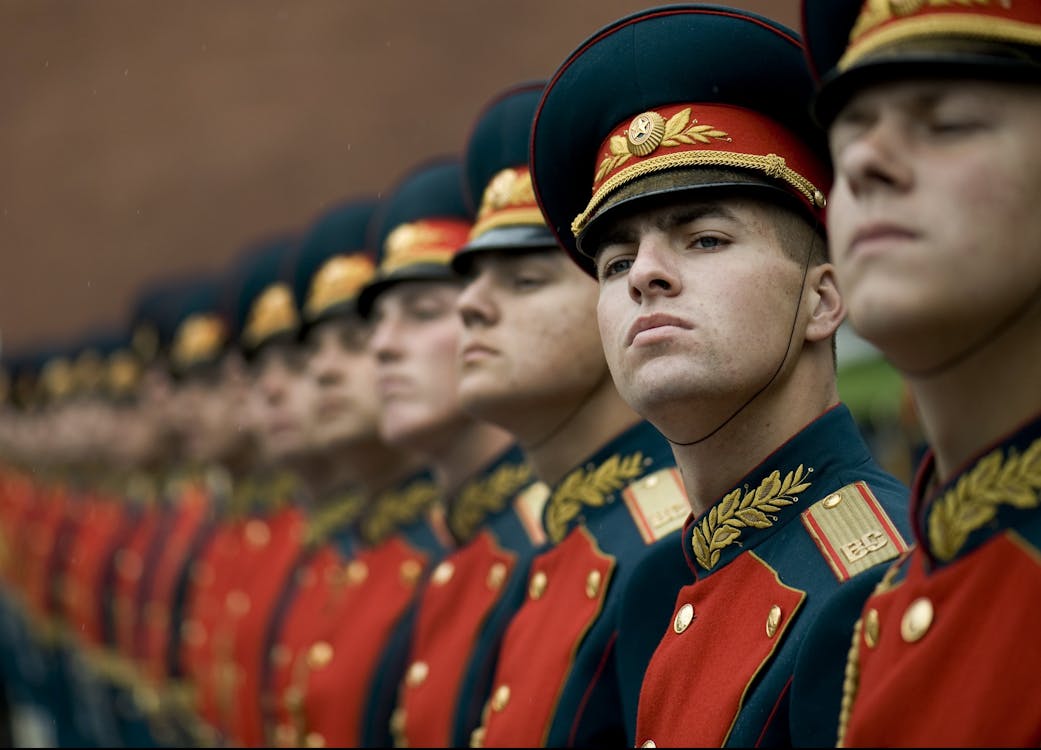
Russian soldiers from Pexels.com

From the display between the US and Soviet Russia, at best, we have a destabilized Middle East, a proliferation of nuclear weapons, and ongoing tensions. It could have been worse. The Cold War nearly got “hot” multiple times (Korean War, Sputnik, Vietnam War, Cuban Missile Crisis, any number of James Bond films), the consequences of which would have been the end of human civilization.

Why did we approach our own extinction? Competition. Capitalism vs. Communism. East vs. West. My army is bigger than your army.

So what do you do if faced with competition?

As mentioned, one must end it quickly by being absolutely overpowering by at least a magnitude (eg a competition of 1 requires you to be a 10). This can happen by letting other competitors go at it until you swoop in to take what’s left. However, whatever is being competed over will suffer (think of a football), leaving you with less, requires patience, and in no way guarantees success (there could be a magnitude 10 still left compared to your 1).

You can still win, though. When faced with competition, decline to compete.

Here’s a few ways how:

Kick Chess Piece Standing
Chess pieces from Pexels.com

Back Down, Rise Up

Backing down can be deemed as a weakness. This is only the pride of the moment getting in the way of any goal, or at the foundation, survival.

Say a person wants to take the lead on a project that you could also easily lead. You could use your skills or position already as a leader to squash their ambition. Or, you could let them take the lead so long as there’s no obvious threat to you. Do the latter.

With the other person as leader, they will do one of two things. First, they might prove themselves a fine and capable person, improving the situation for both yourself and others. If the first option fails, they will fail, taking the fall in your stead, no matter the reason. Should the second event come, it allows you to rise up to take charge again, hopefully also having a large amount of work done. Additionally, with a bit of compassion, you can improve the relationship with the person who tried and failed, but only because you didn’t butt heads in competition!

Secure Your Niches

It goes back to that “order of magnitude” thing. Leave where there is competition to secure where this is none (10 to 0!). That’s a niche.

Should you be so lucky as to be a first mover you gain momentum over any incoming competitors to your niche. It doesn’t prevent you from being displaced (there were Ubers before Uber), but it makes it a lot harder to be uprooted and still allows you to find more niches in the future.

On a global scale, a country could dominate any number of areas: tourism, ecology, education, shipping, infrastructure, computer science, production, military, diplomacy, art, writing, population, language, service, etc! The people of a country suffers when that country tries its best that’s only as good as some other country’s worst. Such is competition.

Grayscale Photography of Human Skull
Skull from Pexels.com

Takeaway

Competition is detrimental to you, others, and your goals. Even an order of magnitude advantage over other competitors only goes so far.

If something really must happen that involves competition, I encourage you to check your expectations.

Otherwise, consider letting others take the charge for you. Or better yet, compete against nothing after discovering your own niche.

History is full of competition. I’d like to see anything but the most dire cases not also causing suffering. From others’ examples, I’ll decline most all competition because “[…] doing the same thing over and over again and expecting different results” is for chumps.

Record Your Good Days

These kinds of days are rare, few and far between.

Today (Sunday, April 28th, 2019) has been a Good Day.

However, what makes it “good”? That can vary from person to person.

For me, it’s a sense more than contentment. Might it be happiness?

(Well, if so, that’s a let down to think a majority of days aren’t “happy”. But must we be bursting at the gills with unconstrained joy 24/7? Probably best not to be that jovial. Sounds tiring.)

Regardless of the sensation, I like it. I’m sure you’ve felt the same at some points in life. Maybe even this week!

So how do we get this good feeling to come calling again?

To do that, what makes up these “good days” ought to be looked at factually but in broad strokes. Let’s take my day today as an example:

  • 5:30 AM wake-up; protein powder and coconut-oil + baking-chocolate drink.
  • 7 AM arrival at event site; provide support + hang out with strangers and teammates for event.
  • Take pre-competition cocktail (beetroot and maca powder, whole wheat spaghetti w/ peanut butter and oil, vitamins)
  • 8:30 AM first-in-line competitors at event.
  • I excel / don’t fail at event; team doesn’t fail at event.
  • Casually hang out / watch other teams / work out.
  • Learn we (the team) have won event; get medals.
  • Casually post online.
  • Shower + eat pancakes.
  • 40 minutes editing a story.
  • 20 minutes laundry.
  • 15 minutes watching comedy (laughing).
  • 20 minutes meditation.
  • 1 hour of edits.
  • 15 minutes light exercise.
  • Another hour of edits.
  • Make mac’n’cheese + frozen peas + egg. (It’s binge day on the 6-on, 1-off schedule!)
  • 20 minutes of writing in the journal (summarize dice game idea and decide between writing this post and playing video games).
  • Writing this post! (17 minutes in by this bullet.)

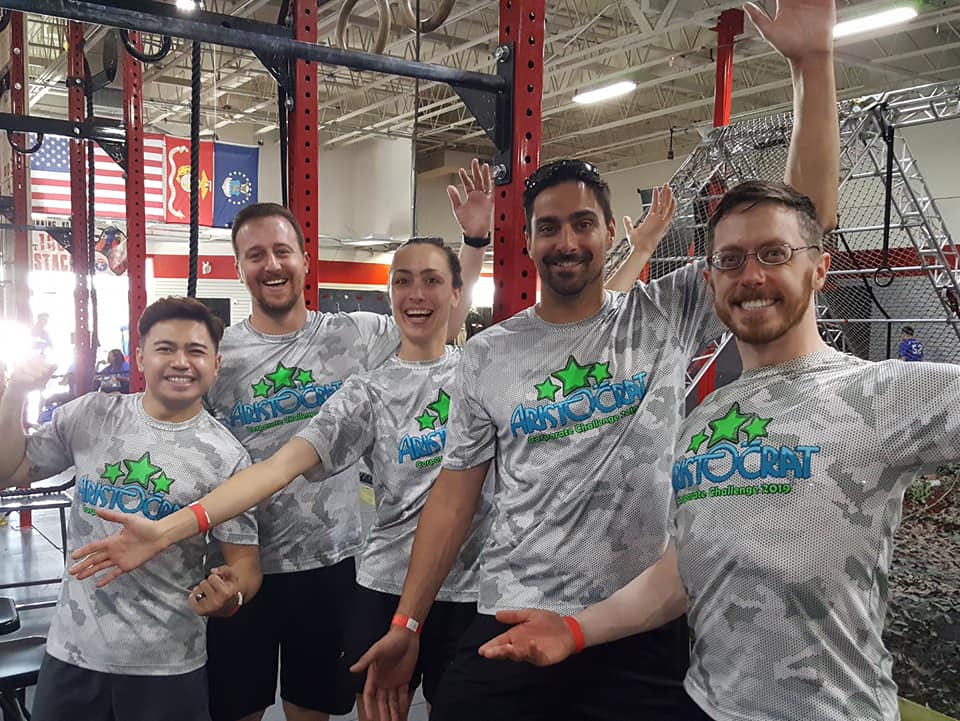
CorporateNinja2019
First-Place Ninjas of Las Vegas, B Division, 2019

My feelings are that I’ve done some cool stuff with cool people today while also saving time for myself for rest and accomplishment. That story is in good shape, I have a blog post incoming, and there is still time I might watch a cool movie or play a nifty video game!

Some generalities of today: Excellent weather (high of ~90 F, low wind), meeting people for a time, early-morning physical accomplishments, later-day personal project accomplishments, naps, and a touch of carb-rich foods.

What about other days?

Not all days have felt this good. Relatively few, in fact. The last time I recorded a really good day was April 13th. I’ve only thought to record a few similar times – these days still show some themes:

  • Great weather.
  • Physical accomplishment in the early morning w/ a team.
  • Casually watching people in a park do physical activity.
  • Socialize w/ strangers while also escaping to be on my own.
  • Casual physical activity.
  • Some generally-bad-for-you food w/ others.
  • Watch a good movie (Watchmen).
  • Laugh.

These are days to cherish. They don’t have the same specifics between them, nor do they need to. To get joy consistently / reliably is a work in progress.

A great outcome of taking note of these days and feelings is that I now have things to aim for, things to plan into my future. Certainly, this feeds into my analytical nature, these eyes for detail and pattern recognition.

If I plan on being happy, that comes with effort. It only could occur because 1) I’m aware and not afraid of my own feelings, 2) I wrote down and recognize what worked before, and 3) I forgave myself of backing off of various responsibilities (ie hanging out, video games, chores [this floor won’t vacuum itself…]).

Now I’m equipped for better days ahead. What to look for, what to say “yes” to, what to protect. If a record of the “good days” was absent, where would I be?

Without knowing the themes of your good feelings, where are you?