Making a Risk Map

  1. The Data Set
  2. The Equation
  3. The Calculations
  4. The Problem
  5. The Solution
  6. The Answer
  7. The Other Observations

Salutations ~

Part of last month’s goals were to make a Risk board game of the American Civil War.

The goal fell short due to the game not giving the right feel, but I sure-as-heck did the math to make the map 😁

For your reference, the game Risk has a map made of connected continents with various territories in each. If you control a continent, ie have a game piece in every territory, you get the continent bonus, which you usually spend for more game pieces.
The Data Set

It’s the continent bonus I calculated. To do so, I analyzed top-rated Risk games for the number of territories in each continent and how many connections every continent had with other continents. Here’s the list of games (pardon the formatting; yet to look into adding tables to WordPress):

  • Classic
  • Classic w/ a common community modification to connect the Australian continent and rebalance bonuses (ie “Connected”)
  • Star Wars Clone Wars
  • Starcraft
  • Halo (Ring, Forge, Hammer, and Anvil maps treated separately)
  • 2210
  • Mass Effect
  • Star Wars Original Trilogy

Online forums talking about Risk usually base the bonus on a continent’s connections (one territory in one continent connects to one territory in another continent). I feel we need to add territories to this calculation, however, as to control a larger continent requires the spending of more game pieces, thus larger continents are more expensive to get the bonus, regardless of connections (connections being a means for other players to disrupt your control of a continent).

The Equation

Because territories (required to get bonus) and connections (required to keep bonus) are so different in what they mean for a continent, I started my work with a linear equation for each continent for each game:

Nt * Ct + Nc * Cc = B
Nt = Number of territories
Ct = Territory constant for a bonus
Nc = Number of connections
Cc = Connection constant for a bonus
B = Continent bonus

We have Nt, Nc, and B for every continent. We need to solve for Ct and Cc, which we can do by combining the equations to eliminate those variables one at a time.

Note: Nc is the number of connections regardless of which territories are connected. 1 territory with 1 connection is 1 Nc; 1 territory with 4 connections is 4 Nc.

The Calculations

I assumed this would be straight forward for at least one of the Risk games. Spoiler: It was not 😑

Saving you some of the nitty-gritty calculations (you can do this yourself), let’s look at Risk Classic:

  • Continent – Territories – Connections
  • N. Amer.     9                       3
  • S. Amer.      4                       2
  • Europe        7                       8
  • Africa          6                       6
  • Asia             12                     8
  • Aust.            4                       1

This leads to getting multiple values for Ct and Cc, meaning how bonuses were calculated was a seemingly arbitrary affair 🤷‍♂️

OK! No problem! I’ll try the same thing on the other games…

The Problem

OK. We have a problem. They also churn out obviously tiered continents (some being better than others). For instance, the Connected modification to Classic Risk, while better, leaves us with 3 distinct groups:

  • Cc = 1.167 * Ct
  • Cc = Ct
  • Cc = 0.571 * Ct

To get around this, I tried averaging, normalizing, and a few other pen-and-paper solutions to make this work out.

Nothing worked out 🤦‍♂️

UNTIL I REMEMBERED:

~simplify~

The Solution

How does one simplify this sticky situation across multiple games? Some grossly off in their bonuses? (*ahem* Halo Risk 😐)

The solution is to combine territories and connections 🎉 Doing that, we get:

(Nt + Nc) * C = B
Nt = Number of territories
Nc = Number of connections
C = Constant for a bonus
B = Continent bonus

That equation allows for each game to get to C = B / (Nt + Nc), so a constant can appear. Here’s what I pulled out, also weighting each with BoardGameGeek  ratings:

  • Game – Constant – Weight
  • Classic                  .400             5.58
  • Connected           .411             6.00 (Classic rounded up)
  • SW CW                 .419             6.01
  • Starcraft               .389             6.37
  • Halo* (Ring)        .398             6.44
  • Halo (Forge)        .396             6.44
  • Halo (Hammer)  .407             6.44
  • Halo (Anvil)        .383             6.44
  • 2210                      .411             6.69
  • Mass Effect          .391             6.81
  • SW OT                   .391             6.84
  • * Halo needed extensive recalculation of its bonuses – they were incredibly low compared to any other Risk game. I may update BBG someday with a rules correction for improved and more consistent gameplay.

The Answer

We are left with two numbers: The weighted average (.399) and the median (.398). For simplicity’s sake, let’s call it .4 for:

(Nt + Nc) * .4 = B
Nt = Number of territories
Nc = Number of connections
B = Continent bonus

I adore when numbers come together ❤

TLDR; To get a fair continent bonus, add each territory and territory connection to another continent together, then multiply that by .4 to get the bonus for control of the continent. 

The Other Observations

Looking at a fair number of Risk games, I noticed some trends between the versions. (We will skip looking at copy-paste Risk games that only do a reskinning of the theme.)

  1. The bonus constant 40% (.4) can be ‘flexed’ down to 33% (.33) or up to 42% (.42) without skewing the fairness of the continent. Whatever percent is used, keep in mind that higher percentages are preferred (more reward for the ‘risk’ of controlling a continent).
  2. 6 continents is expected on a Risk map.
  3. Each continent has a minimum of 2 connections and 5 territories (4 territories is doable but extreme and should remain only thematic).
  4. Good design means connections are greater than 25% of the territories in a continent. (Bad design examples: Australia in Classic, North Atlantic in 2210.)
  5. Good design means there are more territories than connections in a continent. (Bad design examples: Africa, Europe, and Asia in Classic.)
  6. More game pieces means better player experience and faster play (long games is a common critique of Risk).
  7. Capping either the number of game rounds, putting in a score tracker, limiting the number of game pieces per territory, or all of these things and more also assist the slow play problem.

This was fun 😁 I may share later how I would “fix” each Risk game. Let me know if I should get on that sooner 😉 Cheers for now~

 

Investment Unicorns

Why, hello, there!

Jimmy here, with a short one (or at least, I’ll think it to be short) since I’ve more to figure out on this topic…

But! Maybe you’ll get some answers to investment questions on your mind or be able to answer some of the following 🙂

Definitions

When I say “investment”, I mean a stock or similar I’m going to hold for at least 5-to-10 years at least (my retirement horizon).

When I say “unicorn”, I mean what Warren Buffet does: Buy low when the business is quite expected to last long-term (ie decades). That ‘should’ be a rarity in this Bull Market.

What’s a “Bull Market”? It’s a time of elation and high emotion and high prices before a lot of sadness when the prices eventually go back down 😢 Simply, it’s a period of time in the stock market where prices for businesses go through the roof, whether or not the business is good at making money or has the capital to back up the asked-for price. In that, the price-per-earnings (P/E) ratio is typically high.

And lastly, “P/E” is an indicator on how much a company is being sold for vs. how much money it’s actually bringing in. 20 P/E is the rule of thumb for ‘fair price’ when the underlying company is expected to last a long time. 30 P/E is definitely considered high, while 40 or more is astronomical. 10 or less might be considered a steal, especially if the company has the long-term sustainability to flex profitability in the years to come.

Signs of Unicorns 🦄

So what do I look for that is an “investment” “unicorn” in a “Bull Market” (or any market)? A few things:

  1. A low P/E.
    1. For me, I have been foolish (we’ll look at that later here), buying company stock that did not have low P/E of at least sub-20. However, they’ve continued to grow in the longest Bull Market run in the last +120 years.
  2. A dividend.
    1. Having a dividend means the company will pay me periodically for owning it regardless of the stock price. To me, that sounds like passive income 💲
  3.  Brand.
    1. Is the name recognizable? Does the company do something very well? Do people talk about it in positive terms and use it on the regular?
  4. Longevity.
    1. This one’s a little tricky. Is the company earning money in a stable way for more than 5 or 10 years, is it expanded well into the market making it hard for newcomers, and does it have to reinvent product rarely?

To me, a unicorn has <10 P/E (a “-” or no P/E means the company has negative earnings), a dividend, is a popular brand, and has lasted and will last into the future. If so, I’m ready to dump 10% of my cash reserves into it pronto! (Another tip from Warren Buffet.)

Past Unicorns

I started investing in individual stocks back in November 2015, 4.5 years ago, well before I heard about Financial Independence or Paula Pant or ready up on investing vs gambling.

Buying into Activision, Sony, Microsoft, I was buying into companies that made or financed video games because that’s the world I knew 🤷‍♂️ The only other thing I kept in mind was to buy when the companies where going down more than 10%. But really, I had no idea 😶

In the last year or so, I bought into more things. More Microsoft, more Delta, more Exxon, more Google, more Tesla, etc. Some have gone up, some down. But I tended to buy willy-nilly just because the company seemed like it would be around forever (except for Tesla, which I thought was way too low a year ago when I saw Tesla cars parked in lines outside my office).

So how did all that perform?

Unicorns Jump

Let me show you how certain things have performed – we’ll forgo looking at individual stocks but at funds or markets as a whole (all from Vanguard, and investment leader [seriously, go read up on them]).

For the following references, I’ll post the 5 and 1 year gains (or losses!) as of July 15th 2020. I’ll also include the current P/E ratios if available.

  • My Investments
    • 5 yr: +30.01%
    • 1 yr: +26.87%
  • S&P 500
    • 5 yr: +51.72%
    • 1 yr: +7.41%
  • Vanguard S&P 500 ETF
    • 5 yr: +50.40%
    • 1 yr: +6.16%
    • PE: 31.50
  • Vanguard Total Stock Market ETF
    • 5 yr: +54.36%
    • 1 yr: +6.94%
    • PE: 26.15
  • Vanguard US REIT Fund
    • 5 yr: +1.00%
    • 1 yr: -12.26%
    • PE: 38.56
  • Vanguard Growth ETF
    • 5 yr: +94.97%
    • 1 yr: +25.25%
    • PE: 37.72
  • Vanguard International Dividend Appreciation ETF
    • 5 yr: +36.29%
    • 1 yr: +3.37%
    • PE: 22.31
  • Vanguard International High Dividend
    • 5 yr: +3.40%
    • 1 yr: -13.18%
    • PE: 11.86
  • Vanguard Total International Stock ETF
    • 5 yr: +2.31%
    • 1 yr: -2.36%
    • PE: 17.66

But what does it all mean???

It means I was dumb 5 years ago. As is the common suggestion, put currency into ETFs. (Seriously, do it.) With a heavy leaning to the US, we see the S&P and Total Market Vanguard funds even outperforming the S&P 500 itself. Growth companies have been ridiculous over the last half decade. My investments compare their measly 30% gains with the 50% realized elsewhere.

However, I haven’t done too bad in the last year. While the world has entered a pandemic, I’ve maintained well-above-standard earnings.

Now, I could let this outcome go to my head. “Why yes, I am that smart and can game the system! I gambled on Microsoft and Tesla, why not do the same again?”

Yeesh – May cooler heads prevail…

Unicorns Don’t Exist

I’ve had a good run, yet I’ve proven I perform worse than the market in the long-ish-term.

Now, as P/E ratios of major stock holdings race past 30, past 40, when a rocket-launching electric-car battery company is off the S&P but more valuable than any other business on it, when we near a massive US election in November, when we’re in the middle of a pandemic with millions out of work and hundreds of thousands dead… I am getting cold feet.

“No, Jimmy! Listen to Buffet! Buy stock for life! Don’t try to time the market!”

OK, fine. That’s a good point. Buy for life if buying stock. Act as an investor, not a speculator.

Then what do I do?

Well, even Buffet and his former mentor Benjamin Graham call out gross P/E ratios. When a business is overvalued to a silly extent (30-40+), it’s fine to sell if that money can go to a better leveraged investment.

There are a few companies that fit that bill in my portfolio (*cough* Tesla *cough*). Where the money (and any more I venture to stick into the market) can go to Vanguard funds. They consistently do well, have dividends, and some aren’t too icky with their P/E ratios.

If I do want to gamble (ie individual company stock), use another rule of thumb: no more than 10% of total cash in individuals. That, and have a defined exit strategy if I start to “make it big” or realize “I’ve made a mistake”. It’s like taking a little money to the casino and serves the same purpose of having fun 🙃

Your Unicorns?

I’ve covered that I’ve gotten lucky in the short-term, but have under performed in the long-term looking for my unicorns. In conclusion, I can say for me and most others seeking to invest, unicorns are very rare and far between, much like investors Graham and Buffet.

Going forward, I’ll put the time of searching for unicorns into rebalancing my portfolio into a Vanguard diversified ETF spread 👍

Have you found a unicorn before? Do you have one now? Why do you think you’re one? 🤔 Keep me posted – I’d like to hear your investment lessons if they’ve worked out for awhile 😉

Cheers ~

Cast 24 – Motivation Under Stress

Download for home. (4m 29s)

pencil-2878764_960_720
Image from Pixabay.com.

Times are tough. That’s true for millions if not more. It’s likely true for you.

Out of all of it, keep this in mind:

You got this. You are strong. You are resilient. Others have survived immense struggles. You have too. You will again.

You got this. And for all the work you’re putting into each day, each hour, that’s awesome. You are awesome. You are incredibly capable.

You got this. You overcome obstacles rather than cower. Even the smallest hurdle will stop those of lesser ability. You are much more than that.

I look forward to hearing of your feats, but it may be dangerous to go alone – take this toolbox to help stress and decision making. Hit me up to share your accomplishments – I want to know them, grow from them, for that being shared would be generous indeed.

Cast 22 – Fewer Goals

Download for home. (13m 53s)

checklist-2589418_960_720
Checklist from Pixabay.com.

I tried big goals! Itty bitty goals. And a few in between.

Failed a lot along the way, too.

But what’s worked best for me? Listen in to the system I use for defining goals, and therefore, my life.

If you’ve tips and tricks for setting and achieving goals, drop a comment – I’ll owe you one!

Cast 21 – Tools to Face Uncertainty

Download for home. (22m 22s)

This is a long one. Listen – it’ll be worth it.

Have an announcement I’m leaving in the cast. But to help you, below are abridged bullets my notes on dealing with stress and making decisions when things are uncertain.

(Most of these tips come from my mentors, both virtual and live, so if anything here helps you, they will be of greater utility!)

Dealing With Stress

pencil-2878764_960_720
Stress pencil from Pixabay.com
  1. Sleep.
  2. Eat (fats and proteins).
  3. Make lists.
  4. Meditate.
  5. Long walks.
  6. Visit nature.
  7. Intense exercise.
  8. Cut down the schedule.
  9. Remember and consume intense media.
  10. Discover minimally viable life.
  11. Days > years.
  12. Bonus not included in the cast: Cut down on stimulants. (Looking at you, coffee!) ☕

Making Decisions

away-4610699_960_720
Feet and arrows from Pixabay.com
  1. Doing > planning.
  2. What do I enjoy more?
  3. What is required for me to feel satisfied?
  4. Will I be better for having done it?
  5. Am I living my best life? How can I?
  6. What do other people want more?
  7. What would I need to do if I was to die in three months? Six?
  8. What would the decision look like if it were easy?
  9. Make the decisions / choices simpler.
  10. 90/10 Principle (upgrade from the 80/20 Principle).
  11. Say “no” if I can’t give it a “HELL YES!”
  12. Say “no” if there are no next steps or long term benefits.
  13. Say “no” if I am considering this because of guilt or obligation with no merit for myself.
  14. What’s the worst possible failure? How can we mitigate that?
  15. What would I do if not afraid?
  16. Will worry help the outcome?
  17. What do I fear that lacks unrecoverable risk? 💀
  18. Does it tell a white truth?
  19. How close is this to my sought-for legacy?

Tell me, what are your strategies for dealing with stress? Techniques for making decisions? Comment – I and others could learn a lot from you!

Cheers!

Cast 20 – Living Mentors

Download for home. (7m 20s)

Last week’s cast talked about those I’ve never met though consult on a daily basis.

This week I thank a few people I who’ve had unimaginable impacts on my life, true role models to emulate.

water-1828850_960_720
Water droplet impact from Pixabay.com

There are more of you out there, those that know not of this podcast, those that listen every week, more than I can count (or include in a <15 minute ‘cast!) – I adore you ❤ This is no slight to you, merely a recognition of the gifts others have made.

Such acts of gratitude are supposed to be cathartic, especially in times such as those we find ourselves in. I highly recommend you to try the same – come up with the role models in your life, living or dead, and listen to what they teach, watch what they do. They persevere – you will too 😊

Cheers ~

Cast 19 – Virtual Mentors

Download for home. (12m 53s)

I am a multitude. A legion. I am a bit over everyone and everything that I’ve experienced.

lego-1044891_960_720
Lego figurines from Pixabay.com

Their intelligence, insight, and inspiration have made my life objectively better 😊

This is about those people and things that I continue to learn from every day, things that you too could could add to your squad of virtual intimates.

Here’s a short list of the living mentors I go to for guidance on the daily:

  • Gary VeeCEO, writer, speaker, inspirational hustler with more drive than you can shake a stick at and aspire to live up to.
    • Redact February 16 2022: After being told I work too much and learning about workaholism, I am attempting to recover by “being chill.” Gary is all about the work, meaning I have had to abstain from this former mentor for a few years now.
  • Tim Ferriss (a chat with Gary Vee) –  Writer, self-experimenter, professional life- and work-hacker; a nice balance to Gary.
  • Jocko Willink – Former Navy SEAL commander, writer, leadership consultant, tea maker, jujitsu artist, and master of getting after it.
  • Jordan Peterson (a chat with Jocko) – At times controversial Canadian psychologist, writer, and current cultural phenomenon.
    • Redact February 16 2022: While taking personal responsibility to be useful to society and ourselves, Dr. Peterson has devolved over the years to not be someone to live up to. Look elsewhere for a mentor.
  • Paula Pant – Financially independent Afford Anything host, humorist, and charming voice for what we don’t talk about in enough detail: money.

(Be sure to listen in for books and historical figures!)

I also highly recommend these folks:

Who do you already follow from on this list? Who are you adding? 🤔 Let me know who your mentors are – I want to learn from them too!

Cheers through next week.

Cast 02 – RPG Systems

Download for the road. (11m 38s)

To follow-up on last week’s cast, here I am discussing the finer points of what I’ve learned about tabletop role playing games, and what I mean to do about it:

  • Faster prep
  • Faster play
  • Faster narrative escalation

I talk about “clocks” at one point. These are those:

Image of narrative clocks from Kevin Whitaker.


Saving Dice in Warhammer 40K

Because I’m a geek for the Warhammer 40000 universe fiction, I sometimes come across the Warhammer 40K tabletop game.

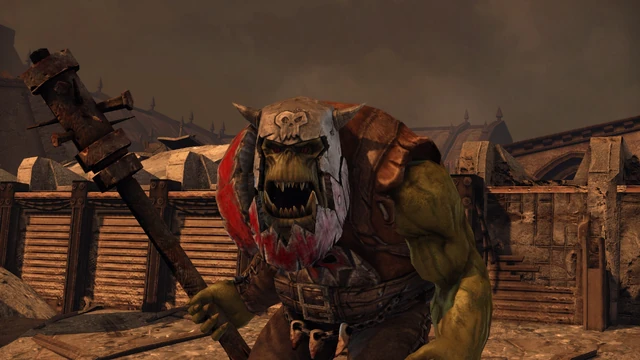
Now, this is a game of dice. Lots of dice. More dice than an Ork Nob can shake a bashin’-stick at.

File:Ork slugga nob.jpg
Ork Nob screenshot from Spacemarine.Fandom.com

And lots of dice-altering stats, too:

Stat sheet from Reddit.com

In the battles that take hours, dozens of dice are brought to bear. Me, a nerd, thought of only one thing:

What can we do to streamline the game?

Here’s what I found:

The Game Right Now

Stats

Warhammer 40K is a game of tiny model soldiers and monsters. A group of models is a “unit”, which is what acts on the battlefield.

A unit has these stats:

  • Name – easily distinguishes what you’re talking about.
  • Power – the level of the unit. Counts towards how large an army comprised of units may be.
  • Movement (M) – how far a unit may move on the board in a normal turn.
  • Weapon Skill (WS) – chance of hitting a target in melee combat. (Really, “Melee Skill”.)
  • Ballistic Skill (BS) – chance of hitting a target by shooting at it.
  • Strength (S) – how hard a unit hits in melee.
  • Toughness (T) – how difficult it is for an attack to do damage to the unit.
  • Wounds (W) – health points per model; 0 is the death of the model.
  • Attacks (A) – how many melee attacks the model may make.
  • Leadership (Ld) – how likely a unit is going to keep fighting after taking losses. (Losing models in a unit can cause the rest of the models to ‘flee’, AKA die.)
  • Save (Sv) – what a player must roll to not have their models die when attacked.

Units also have special abilities and weapons. While weapons have Range, Armor Piercing (makes it harder for a target to Save), Strength (in melee, use this or the unit’s Strength, whichever is higher), Damage, and a special effects, these are self-evident in what they might do.

Turns

A single player turn is defined by phases:

  • Movement – if a unit can move, it may do so.
  • Psychic – special to only certain units in the game. Like shooting, but with your mind.
  • Shooting – ranged units fire.
  • Charge – units can move again. If they do, they get shot at.
  • Fight – all units close enough to enemy units use their melee weapons.
  • Morale – for any unit that lost models in the turn, they roll against their Leadership. Failure here can collapse the rest of the unit. (Heard you liked taking losses, so here are some losses for your losses.)

Shooting and Fight are the dice-heavy portions of the game and will be our focus here.

Pile of White Dices on White Surface
Dice from Pexels.com

How It Works

Let’s look at the similarities of the Shooting and Fight in how they make models die.

Both phases start by using Ballistic and Weapon Skill (respectively) multiplied by the number of Attacks that can be made in the form of numbers of dice. A success here is when set A of dice roll equal to or greater than the Skill, becoming subset B.

Next, an attacking player must check the Strength of their attacks against the Toughness of the target. What subset B needs to be or greater to changes when Strength is the same or different to the Toughness. Subset B will become subset C.

Finally, the player owning the target units will roll for their Save. The number of dice in subset C is how many dice must be rolled, their face value needing to be equal to or greater than the Save of the target. The number of dice that fall below this value are the number of models to apply the Damage of the attack to the model’s Wound (or “taking a Wound”).

TLDR; An attacker must see if they hit, then see if they harm a target. The target gets a chance to save themselves. If not, models take Wounds.

Clear so far?

My Turn

Looks like we have some formulas to crunch, starting with combining the attacking player’s “did I hit” and “did I harm” rolls.

The Attacker

We’ll ignore the differences between Shooting and Fight phases, instead focusing on only the hit/harm cycle.

For that, the hit roll is determined by the chance of Skill passing a value roll times the number of Attacks.

To Hit = chance Skill * Attack

Easy.

To harm, it gets tricky. We ought to compare the Strength stat of the attacker to the Toughness of the target.

To Harm = (Variable, given Strength compared to Toughness)

This marriage of stats means we can’t have one nice roll for the attacker as it changes every time they pick a different target.

Let’s get a divorce.

If we only consider the Strength of the attacker, the Strength ought to also be considered as a chance roll. Say, for a five Strength, it’s two (five or greater, six) divided by six (six-sided die D6), or 33%.

We’ll need to do something with chance Strength. How about combining it to Skill and Attack?

For that, we can put the passing chance of Skill and Strength together, forming a percentage. This percentage will be low because we’re multiplying percentages, so take 100% minus the low chance we got, thereby betting   Let Attack be the number of dice to roll:

To Hit and Harm = 100% – (chance Skill * chance Strength), per #D6, # from Attack

We’re forgetting the Armor Piercing stat of some weapons. Originally, this would apply to the Save roll of the target. Since we’re trying to divorce the stats of two different units as much as possible, Armor Piercing should apply to the hit-and-harm combination roll:

Single Hit and Harm Roll = ((100% – (chance Skill * chance Strength)) * 6) + Armor Piercing

If a unit can roll dice greater than or equal to the value from the formula above, the attacker has successfully struck.

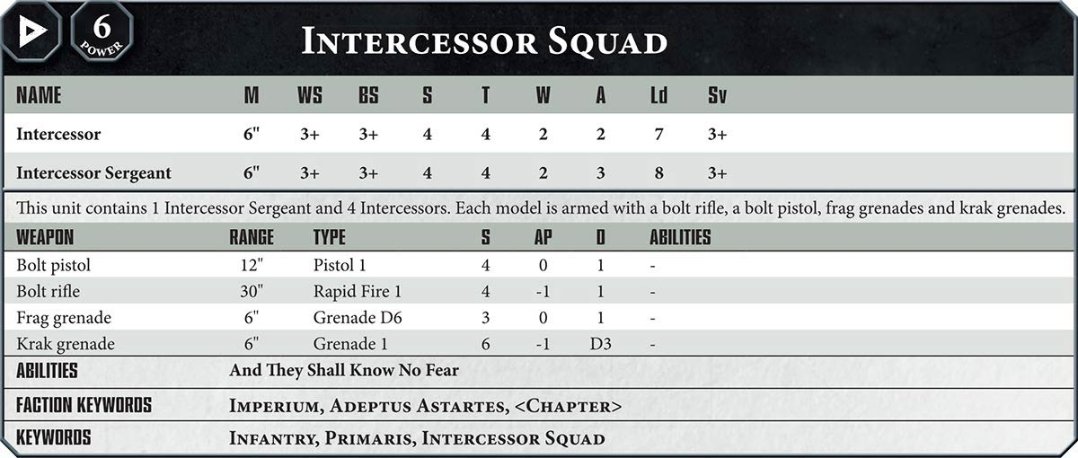
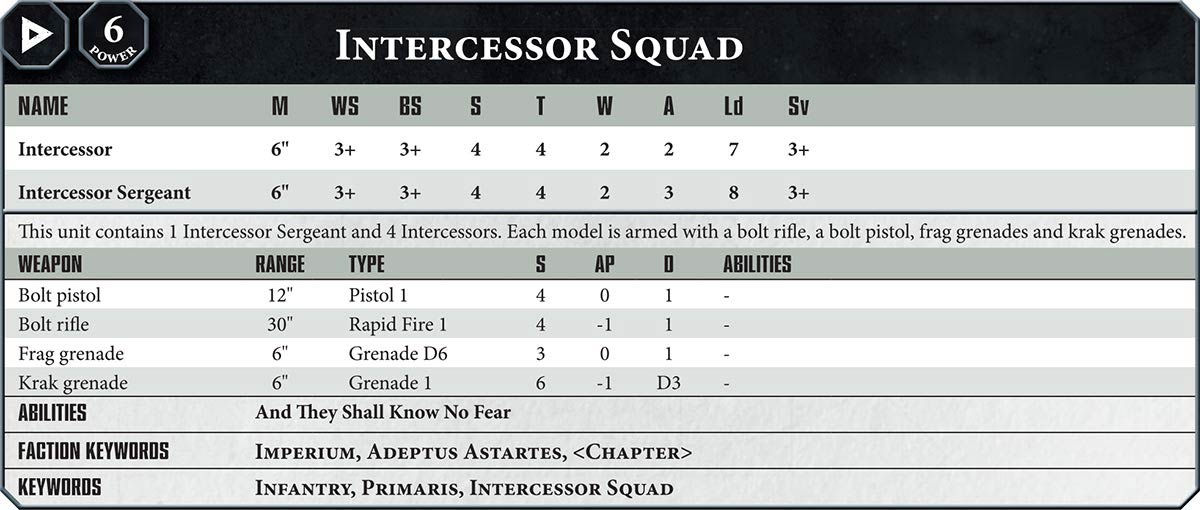
How does this work? Take an Intercessor Squad, armed with a Bolt Rifle, as example:

IntercessorSquad
Datasheet from BellOfLostSouls.com

One model in the unit is going to fire at a target. Thus, it’s chance of success for a single die (ignoring that it could make multiple attacks) is:

Success >= (6/6 – (4/6 * 3/6) * 6) – 1

>= (1 – (.333)) * 6) – 1

>= (.667 * 6) – 1

>= 4 – 1 >= 3

This example shows we have a 67% chance to succeed on any roll. People like succeeding, so this high chance is perfect for an attacker’s immersion when they get to keep dice on the table. No problem there!

We see how what would normally be multiple rolls of dice distills into a single roll per attack for either ranged or melee combat. Time savings, huzzah!

The Target

We have to keep our target from dying. From the previous section, Toughness is on its lonesome. We also took care of the Save vs. Armor Piercing. Thus, pairing Toughness with Save, we get something like:

Get to Live >= (100% – (chance Toughness * chance Save)) * 6, per successful attacker die

Any failure here will cost Wounds from the Damage of the attack.

Using the Intercessor Squad above and for a single successful die, we get:

Get to Live >= (6/6 – (3/6 * 4/6)) * 6

= (1 – (.333)) * 6

>= .667 * 6 >= 4

If we don’t get a four on our dice, our own Intercessors will die. Sad day 😥

Still a good day, though, since we can provide a base stat to our unit on what it must roll to survive being attacked!

So we’re looking at a 3+ to attack and a 4+ to live. The numbers boil down to a 33% chance of Wounding a model (66.7% chance of a successful attack roll multiplied by a 50% chance to fail a saving roll).

But again, only two rolls are needed to determine an outcome from end to end, compared to three previously, and with a lot less mental math of comparing attackers to targets.

So Where Do We Go From Here?

I have a confession…

I didn’t playtest this system.

It’s a shame, I know. You know. Playtesting would be the next step. This could be done with Excel simulations, seeing what the typical outcome of this system is compared to the actual game.

There’s a concern already that we aren’t removing enough models, the chance of Wounding being a little low. That, and how can we leverage the Power of a unit? Can it be added to rolls or the difference between attacker and target be applied? I don’t know yet. Merely, it wouldn’t make a lot of sense for a tiny bug (yes, these are in the game) to survive being stomped on by a giant robot.

Doing research for this post, I also found fun numbers and percentages when using a D20 (20-sided dice). The result made calculating roll value requirements a lot easier when different weapons were applied to different units. An article here could be forthcoming with a proper investigation.

Finally, consolidating the stats of a few units is in order. That’d allow for a few examples of simpler, streamlined play.

That’s it! What have you done to improve games in your life? I hope this mod is an inspiration to look at things through a lens of “how can this be made into something new, maybe better?” Cheers for now!

The Orc and the Pie Pt. 1 – A Breakdown of RPGs

Just the other day I was introduced to the role-playing game The Orc and the Pie. Written by Monte Cook of Dungeons & Dragons fame, it’s the world’s most popular and shortest-yet-technically-complete RPG adventure game. The only things a player knows is that:

You see an orc with a pie.

The room is 10 feet by 10 feet.

The rest is up to the imagination of the player with guidance from the Game Master (GM).

Pretty cool, eh? Simple, straight to the point, and offers creative freedom.

Let’s take that freedom and run. (Oh, and look at pie ~)

Baked Pie
Pie from Pexels.com

The World

Looking at The Orc and the Pie, we see the following elements of the game world:

  1. Potential Obstacle: The orc.
  2. Object: The pie.
  3. Context: The 10×10 room.

The Potential Obstacle is an implied conflict. There’s nothing in the scenario that indicates that the orc will do anything. Maybe it’s a coward, maybe it wants to sell the players the pie, maybe it’s minding its own business.

Our Object is also the implied goal. The players should want pie and acquire it in any way they deem fit.

The Context is merely a setting for the space. It could be a moon, the bottom of the ocean, or nowhere specific – everything ‘just is’.

Going Further

Ignoring the players for now, we can boil the game world down.

First, let’s toss out Context. A setting is interchangeable and largely only a consequence of how players might exist and act in relation to other characters / objects.

Next, I thought the RPG might be about the player, a goal (the Object), and some conflict (our orc) of getting that goal. However, the conflict between the player and a goal is merely a chance of failure of attaining the goal. The goal itself is a player want, whatever that ought to be.

Nixing Context and consolidating the Object and Potential, we’re left with:

  1. Want: Whatever the player seeks to objectively say they’ve succeeded.
  2. Chance: However likely the player gets what they want. The fairest chance is 50% to get it, 50% to not.

Gone Too Far

At this high-level view of The Orc and the Pie (and all RPGs for that matter [heck, even just games!]), we have the following synopsis:

Something is wanted.

The chance of getting what is wanted is 50%.

Our distillation of the game has been chopped up to a coin toss. “I want heads, which has a 50% chance of happening.”

Kinda lame.

Coming Back

It seems The Orc and the Pie has hit the formula of world creation pretty precisely. However, ‘world’ as environmental Context is not necessary. We can rely on players to develop their own Context.

But Potential Obstacle and Object? We need these. Chance and Want respectively are their ghosts, such that a chance to succeed in overcoming any Potential Obstacle exists and an Object can be implied to be the Want of the players.

Let’s keep our Potential Obstacle (orc) and Want (pie). How do players engage with these things?

The Players

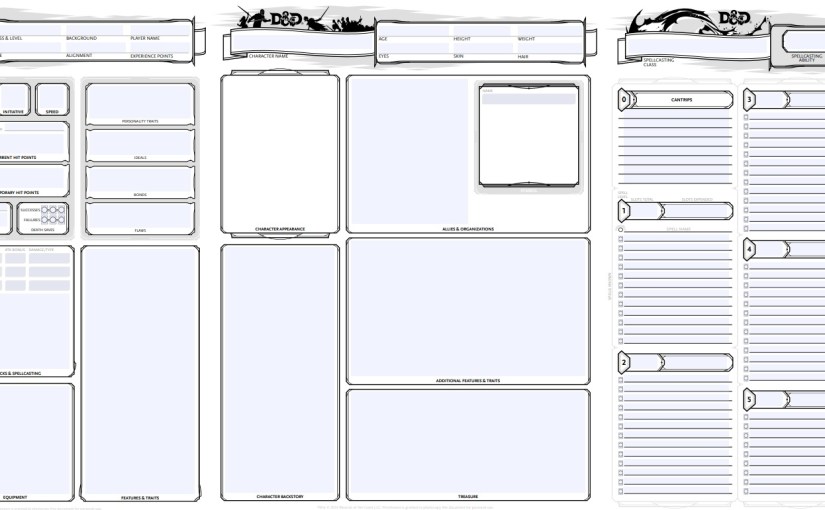
We’re missing our live-action cast for the role-play. In D&D for which The Orc and the Pie was made for, players sit in front of something like this:

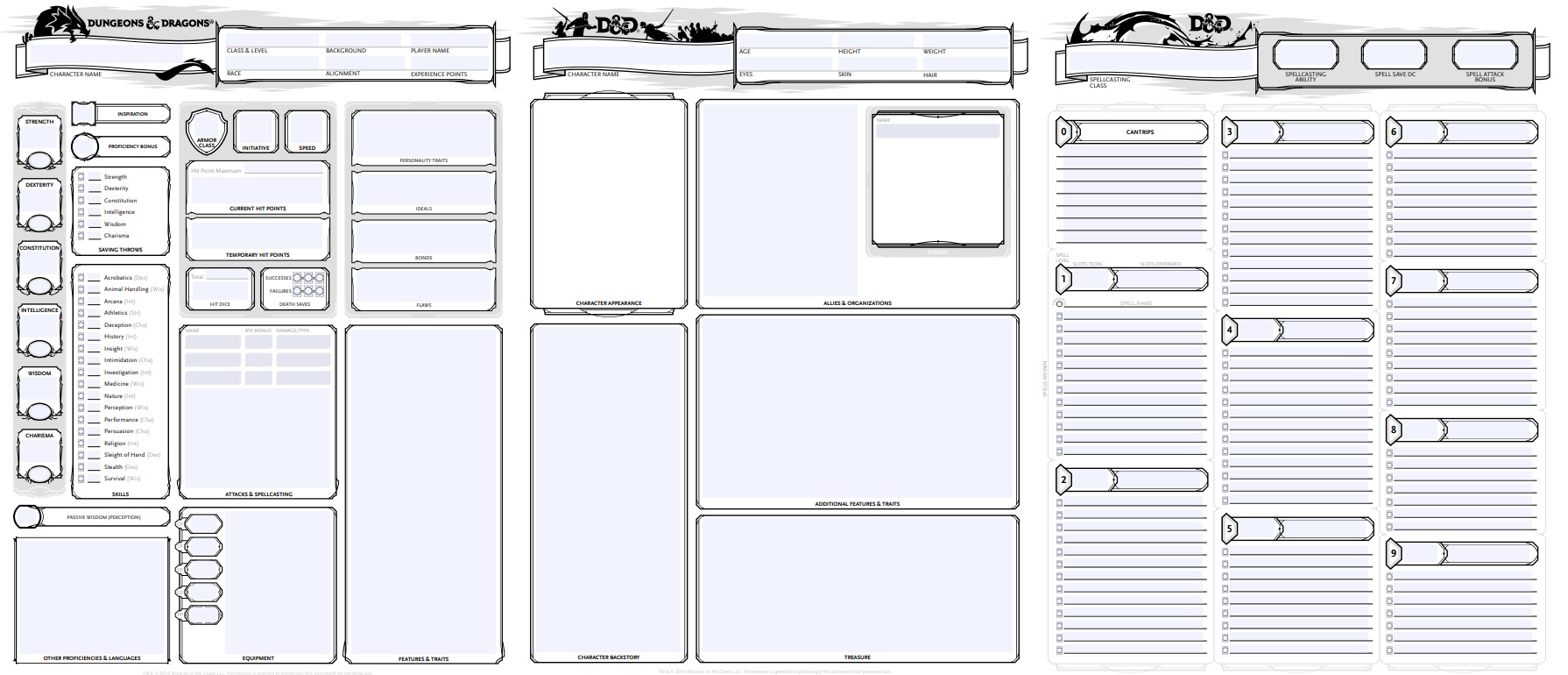
DnD_Character_Sheet.jpg
DnD character sheet from Wizards.com

Click the link above to see the full thing and spend a good 15 minutes just reading the section titles. We have, in no specific nor complete order: Class, Name, Alignment, Strength, Strength (again, but different), Ideals, Flaws, Equipment with “PP” (???), Wisdom, Wisdom again (passive this time), and a whole lot more.

That’s just from the first sheet of 3. And this isn’t the only kind of sheet there is! We have Adventure League, starters, D&D Beyond (not my character), and a metric boat-load of homebrew sheets for the myriad RPGs there are in existence.

But what in the world does all this have to do with pie and an orc?

Getting That Pie

Since simplicity is key, let’s get after as few things that’ll do as much as possible. Back to the burner to boil down the essence of player character…

Any character enacting on the physical world has physical attributes. We could divide this into something like Strength, Speed, and Sustainment (“constitution”, “endurance”, whatever; SSS seems like a cool acronym), but for simplicity’s sake, Brawn will be our trait for a brute-force approach to getting pie.

Since we’re not forgoing clever problem solving or thinking about how to get pie, Brain is our second trait. With book smarts and objective study of the world, Brain affects how a character can come up with a solution, notice things, or out-quiz an orc (or pie!) on trivia.

Lastly, Being. This is our health point / resource / whatever might get the players to care about failure. Maybe it’s ego. When a player character fails an action of Brain or Brawn, or when something succeeds against the player (with negative intention, like an attacking orc), their Being decreases. When a player character has no Being, they stop rolling dice or playing cards. They’re done (at least for awhile).

Three Red Dices
Dice from Pexels.com

Brawn. Brain. Being.

(Can’t say that B3 10x fast…)

A Step Too Far?

Shall we go farther? If we break B3 down, we have a single attribute, Chance, that dictates how likely a player is to accomplish whatever they attempt. The value of Chance would be how many coins need to be flipped to success to guarantee overall success.

Chance could have a spot in a very minimal setting. It serves as a nice tracker of ‘status’ (leveling, character health, etc.). The more a player succeeds, the higher Chance they have to continue to succeed! As they fail, those failures cascade into spectacular foibles great for storytelling.

Is Chance too simple? I’d say that depends. What kind of game is being played? If it’s aiming for a modicum of role-play, the B3 system is the way to go. Are you a fast, strong, dexterous character? Or more of the quick witted, perceptive variety?

Heck, Chance could be renamed to Luck where we’d be left with a handy modifier to B3 traits! A trait that doesn’t do anything on its own, existing only to improve the outcomes of others. (“Improve” because positive reinforcement is generally better received than punishment.)

I digress.

Where Are We Now?

The Orc and the Pie is a splendid basis for finding out what role-playing games are, what games can be on a fundamental level before they become too simplistic.

The game world of an RPG is easily set up. We have a (implied) want, chances to attain that want, character traits to alter those chances, and a clear end state for player and non-player characters, divorced from but ready to serve player goals.

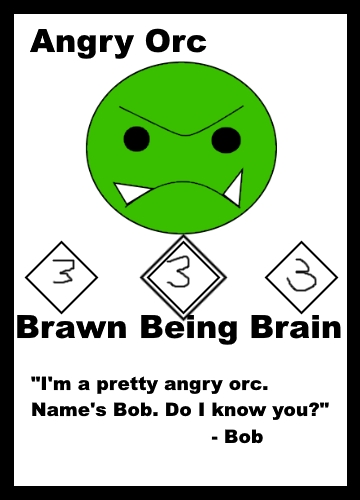
AngryOrc2.jpg
Bob, not so bad.
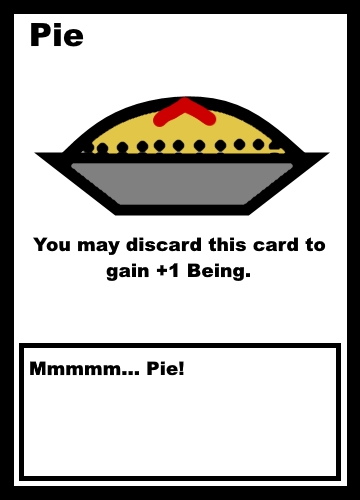
Pie.jpg
Your dreams and desires incarnate.

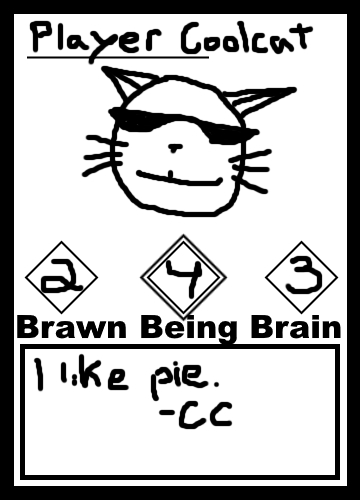
Speaking of players, with a D6, we can fill in our own player character:

PlayerCoolCat.jpg
Player #1

These numbers could be what a person has to role for success (a D6 roll greater than 8-# [“7” so a number of 6 would at least have a chance of failure with a roll of 1]), the number of dice to role to succeed (#D6), the number we have to roll under, or whatever. Lower numbers are bad.

An example of gameplay could end up being:

  1. Coolcat: “I shove Bob to get to the Pie.”
  2. Coolcat rolls a 1, failing the action for their Brawn, instead falling into Bob.
  3. Bob reacts, rolling a 5, a success for Bob’s Brawn.
  4. Bob pushes Coolcat away.
  5. Coolcat falls over, losing a point in Being.
  6. Bob: “What the heck. You’re getting me pretty angry.”
  7. Coolcat chooses to use their Brain to negotiate with Bob.
  8. Coolcat rolls a 6 off their Brain, a critical success!
  9. Coolcat: “Look, Bob, whose name I know because I read your card, I’m sorry. A tasty-looking Pie is over there. Want to share it?”
  10. Bob: “Ah, apologies accepted! Sorry about shoving you so hard. Why sure, let’s split this delicious Pie!”
  11. Bob and Coolcat both get Pie – Scenario complete!

Players are more difficult to cater to because they are people. People are difficult. However, with Brawn and Brain and Being, Potential Obstacles and implied Wants, playing RPGs doesn’t have to be.

The same goes for designing RPGs. In Part 2 of The Orc and the Pie, I’ll take a look at adding onto and into the game’s systems.