Character Sheet Essentials

Greetings again, there.

Been thinking and working a lot on tabletop roleplaying games (TTRPGs). In that work, I’ve needed to understand what’s necessary for making TTRPGs since my work concerns a universal simplification system that keeps the game’s original mechanical balance.

So, for your next dungeoneering adventure, you making your next great game, or if you only have a packet of note cards, keep five things in mind: You (your character), Seem (your external disposition), Story (your history), Stuff (your, ah, gear!), Status (your health, experience, etc).

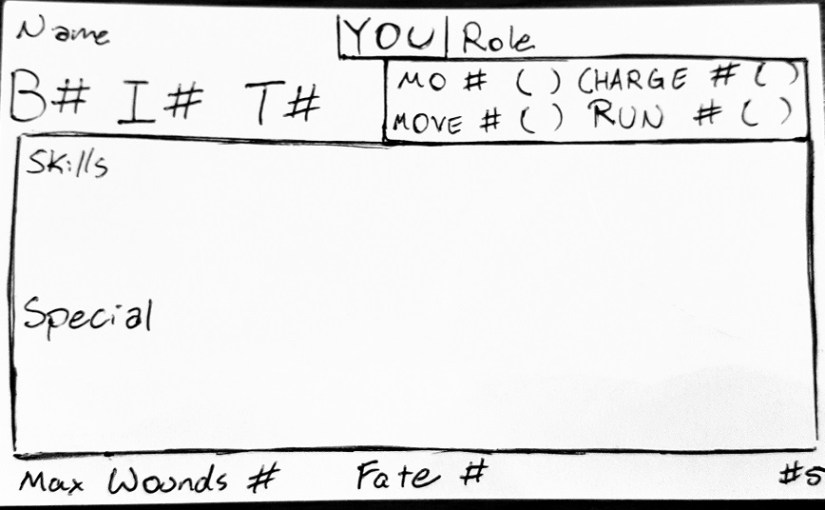
Going into those things in depth, keep in mind that all of the following can be recorded on one side of a 4×5 note card. I’ve pictures as examples, though these have been made game-specific for the Warhammer 40K Deathwatch TTRPG:

YOU

Your character and all the important things needed to keep in mind when interacting in the game. Name, stats, any special abilities, and some reminders of IP-specific values. This card shouldn’t change during play, and rarely between sessions of play.
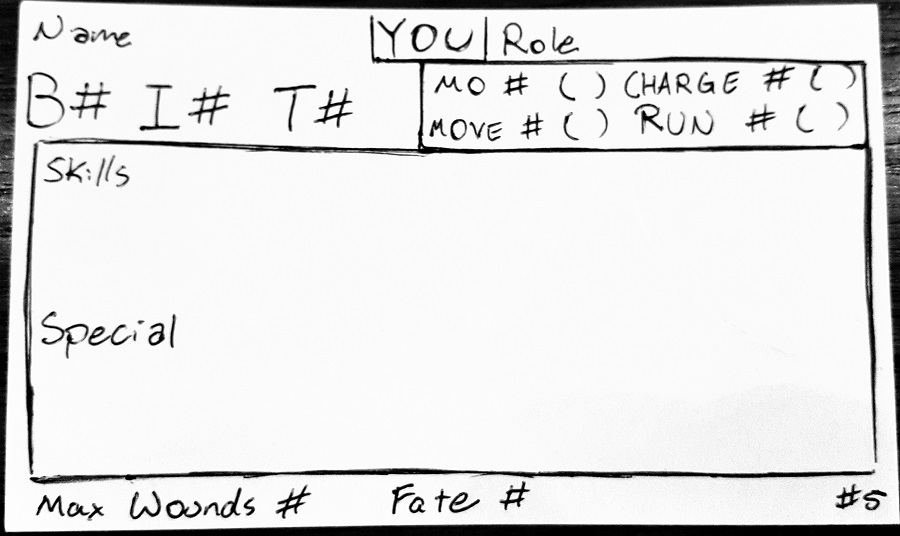
Sheet-You

Name
Yep.

Role
A reminder of your role in society or the game world.

BITS
The Body-Interaction-Thought values that are added to your rolls.

IP-Specific
In this case, Movement (half, full, charging, sprinting).

Skills
Anything you can do in particular.

Special
Special abilities or considerations in what you do.

Other IP-Specific
Anything else. In this case, max health and don’t-die points.

SEEM

Your character’s external appearance and behavior. This card also shouldn’t change much, unless a scar or some terrible incident has come about!

Sheet-Seem

Behavior
What’s your demeanor? Put that here.

Appearance
What do others see?

STORY

Your character has a past and a future. Here those goals and history get recorded. If the game IP warrants it, include the relationships the character has to people, places, and things. This card can change during play, especially if keeping a log of the character’s actions. (This may require additional cards / space!)

Sheet-Story

Future
Your goal(s), what you aim to do, how you’re driven to act.

Past
A log of everything you’ve done.

Relations
Optional as it’s IP-specific; how you and others relate to one another.

STUFF

It’s dangerous to go alone, so what are you taking along? Carrying and wearing, using and keeping, the gear goes on this changing card.

Sheet-Stuff

Armor #
How much protection what you’re wearing warrants.

Tools
A nicer word than than “Weapons”, but doesn’t alliterate 😑
Anything held or ready to be held.
Only ever carry 4 of these at a time; kept in the hands, on the body, or on the hips.
Since these can be changed often, best to keep the details of the tools on other cards.

Wear
Typically the suit worn, maybe your pack, and a few pieces of other gear.

Misc
A count of the miscellaneous items that you’ve packed.
Is abstracted to keep down bookkeeping.

Ammo (IP-Specific)
Sometimes ammunition kept in a magazine needs special attention.
Also is abstracted to save on bookkeeping.

Specifics
Any items carried along that you have a definite amount of.

STATUS

How your character is should be changing constantly throughout play if anything of worth is being done. Health, progression, and conditions are added and removed on the regular, possibly needing to replace this card multiple times during a single play session.
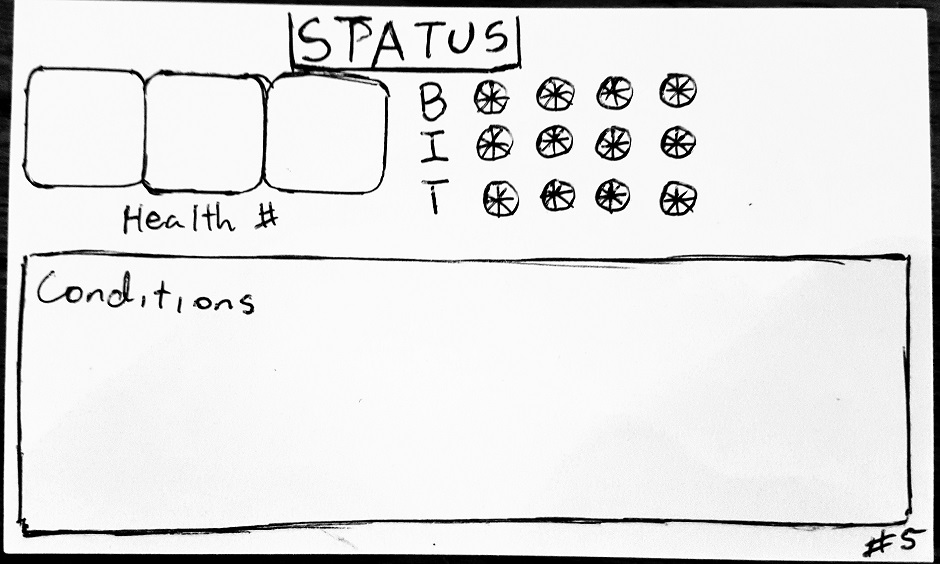
Sheet-Status

Health #
Health (thinking of renaming this to “Wounds” or “Harm”) followed by the total capacity for harm you have.

BITS Growth (ie Level Progression)
Add progression clocks or ticks (this latter is cleaner) to level up each of your attributes separately (or all at once if using an XP-pool system like D&D).

Conditions
Are you sick? Under the influence? Jot the name and a shorthand for effect here.

What’s missing? Drop a line – you’ll make for better games doing so 😁 Cheers!

#PaidMe

Hi, folks!

Guess who’s still in a strange land of finicky data? No matter! That doesn’t prevent writing a few things down 🙂

There’s been a few hashtags going around over the last few weeks. #TechPaidMe, #GameDevPaidMe, #PublishingPaidMe, #ComicsPaidMe, even just #PaidMe.

Think it’s about time I contributed to #TechPaidMe / #GameDevPaidMe. Why? Why not? Transparency in worker pay gives power to the worker. Gives power to you.

uncle-sam-29972_960_720
Uncle Sam from Pixabay.com

My history has been thoroughly and chronically underpaid for the value brought. After reading Chris Voss’s Never Split the Difference, I’ll never do such things again. After reading this post, maybe you won’t be underpaid either. Sound good?

I’ll save you some time by crunching the numbers with 2020’s income tax for take home pay (THP), then inflation (Inf; doesn’t count Roth 401K and IRA contributions), then normalized cost of living (CoL; to a US national 100%) so you can get some decently useful.

The Data

(Skipping pre-2013 dev work as I was preoccupied with other things at the same time.)

2013
#TechPaidMe
Software Developer
Base: $45,000
THP: $37,816
Inf: $41,620.54
CoL: $54,122.93
Secure Banking Solutions
Madison, SD

That means in 2020 dollars, adjusted for cost of living nationally, I took home about $54K. Let’s continue…

2014-2015
#TechPaidMe #HealthcarePaidMe
Technical Services Problem Solver (customer support + custom dev)
Base: $69,000 (I think? I actually can’t remember. I just know it was under folks hired some 3-6 months after!)
THP: $51,757
Inf: $55,988.32
CoL: $50,079
Epic Systems
Verona, WI (Outside Madison)

2015-2016
#GameDevPaidMe
SDET II Tools Developer
Base: $66,000
THP: $48,387
Inf: $51,690.73
CoL: $40,926.94
Microsoft
Tigard, OR (Outside Portland)

2016-2018
#TechPaidMe #GameDevPaidMe
Software Tools Developer
Base: $75,000 (not including bonus up to 15%)
THP: $59,588
Inf: $60,842.61
CoL: $54,518.47
Aristocrat Technologies
Las Vegas, NV

At this time, I read Never Split the Difference among other books and Reddit posts. Continuous learning evidently pays dividends:

2018-2020
#TechPaidMe #GameDevPaidMe
Senior Software Engineer
Base: $104,500 (not including bonus; had a raise for a few months before a promotion with a final raise here)
THP: $80,179
Inf: $-
CoL: $71,844.98
Aristocrat Technologies
Las Vegas, NV

2021+
Checkout the post.

Despite all of the lower-than-expected pay, despite coming late to the FIRE Movement, I am well on my way to financial independence. No debt, minimal other expenses, and investment performance is set to CoastFIRE me in less than 10 years, FatFIRE in less than 15. If we suffer a crash in the markets, independence will happen sooner with savings on hand that were meant for buying property 2 weeks before COVID-19 locked the US down. #BulletDodged

If you feel comfortable in sharing, what have been your numbers in tech and game dev? I used to be very sensitive over letting others know what I earn, so I understand if all you get is a reference point for your future salary negotiations 😉

Before we go, checkout these resources that have been such boons to me:

It’s dangerous to go alone. Take this, and ask for what you’re worth ❤ cheers ~

Cast 21 – Tools to Face Uncertainty

Download for home. (22m 22s)

This is a long one. Listen – it’ll be worth it.

Have an announcement I’m leaving in the cast. But to help you, below are abridged bullets my notes on dealing with stress and making decisions when things are uncertain.

(Most of these tips come from my mentors, both virtual and live, so if anything here helps you, they will be of greater utility!)

Dealing With Stress

pencil-2878764_960_720
Stress pencil from Pixabay.com
  1. Sleep.
  2. Eat (fats and proteins).
  3. Make lists.
  4. Meditate.
  5. Long walks.
  6. Visit nature.
  7. Intense exercise.
  8. Cut down the schedule.
  9. Remember and consume intense media.
  10. Discover minimally viable life.
  11. Days > years.
  12. Bonus not included in the cast: Cut down on stimulants. (Looking at you, coffee!) ☕

Making Decisions

away-4610699_960_720
Feet and arrows from Pixabay.com
  1. Doing > planning.
  2. What do I enjoy more?
  3. What is required for me to feel satisfied?
  4. Will I be better for having done it?
  5. Am I living my best life? How can I?
  6. What do other people want more?
  7. What would I need to do if I was to die in three months? Six?
  8. What would the decision look like if it were easy?
  9. Make the decisions / choices simpler.
  10. 90/10 Principle (upgrade from the 80/20 Principle).
  11. Say “no” if I can’t give it a “HELL YES!”
  12. Say “no” if there are no next steps or long term benefits.
  13. Say “no” if I am considering this because of guilt or obligation with no merit for myself.
  14. What’s the worst possible failure? How can we mitigate that?
  15. What would I do if not afraid?
  16. Will worry help the outcome?
  17. What do I fear that lacks unrecoverable risk? 💀
  18. Does it tell a white truth?
  19. How close is this to my sought-for legacy?

Tell me, what are your strategies for dealing with stress? Techniques for making decisions? Comment – I and others could learn a lot from you!

Cheers!

Lasers + Shields = Boom in Dune

Warning: There is going to be math later. (I’ll try to make this deduction as fun as possible!) To business –

Immovable, Unstoppable

In Frank Herbert’s Dune, there exists protection that cannot be penetrated in the form of shields. Shields are immovable, covering everything from people to planets. This led to the end of ranged warfare as we would know it in Dune‘s universe.

There also exists “lasers” (let’s call them “phasers” for now) when fighting at a distance is called for. Phasers can cut through anything and might be considered as an unstoppable force.

Assorted-color Laser Lights
Lasers from Pexels.com

When shields and phasers interact – that is, when the immovable meets the unstoppable – a huge explosion results:

A lasgun-shield explosion was a dangerous variable, could be more powerful than atomics […]
– Dune

Hearing this, I got to thinking. What kind of explosion are we talking about?

To find out, let’s first define our terms:

  1. Phaser – We’re going to consider this as equivalent to the Star Trek phaser. Those tools were also able to cut through anything and more, dissolving entire mountains in the early pistol-size variant.
  2. Shield – Here we assume that to stop any force, there must be an equal and opposite force. In the case of a phaser, we assume its disintegrating ray would be sent directly back along the line of the ray. Anything hitting the shield would disintegrate itself.
  3. Atomic – A nuclear weapon. For our purposes, assume 15 kilotons of explosive power (this was the power of the first atomic bomb in history).

Here comes the math…

So we shoot our phaser at a shield. At the speed of light, the shield deflects the beam back at us. Our ray hits and dissolves the matter in our phaser. All that matter has to go somewhere, right? With E=MC^2 (energy equals mass multiplied by the speed of light squared), we know that:

  • Energy (in Joules) = ?
  • C-speed of light squared = 9 x 10^16 meters^2 / seconds^2
  • Mass of a phaser = .340194 kilograms (assuming 12 ounces)

Therefore:

  • .340194 kilograms x 9 x 10^16 meters^2 / seconds^2
  • = 3.061746 x 10^16 Joules

A kiloton (measured in the mass of TNT-equivalent) is 4.18 x 10^12 Joules. We can cancel a few things out:

  • 3.061746 x 10^16 ÷ 4.18 x 10^12
  • = 3.061746 x 10^4 ÷ 4.18
  • = 30617.46 ÷ 4.18
  • = 7324.7512 kilotons

The energy held inside the matter of our handheld phaser is approximately 7324.7512 kilotons. To put that into perspective, that’s more that 488 atomic bombs.

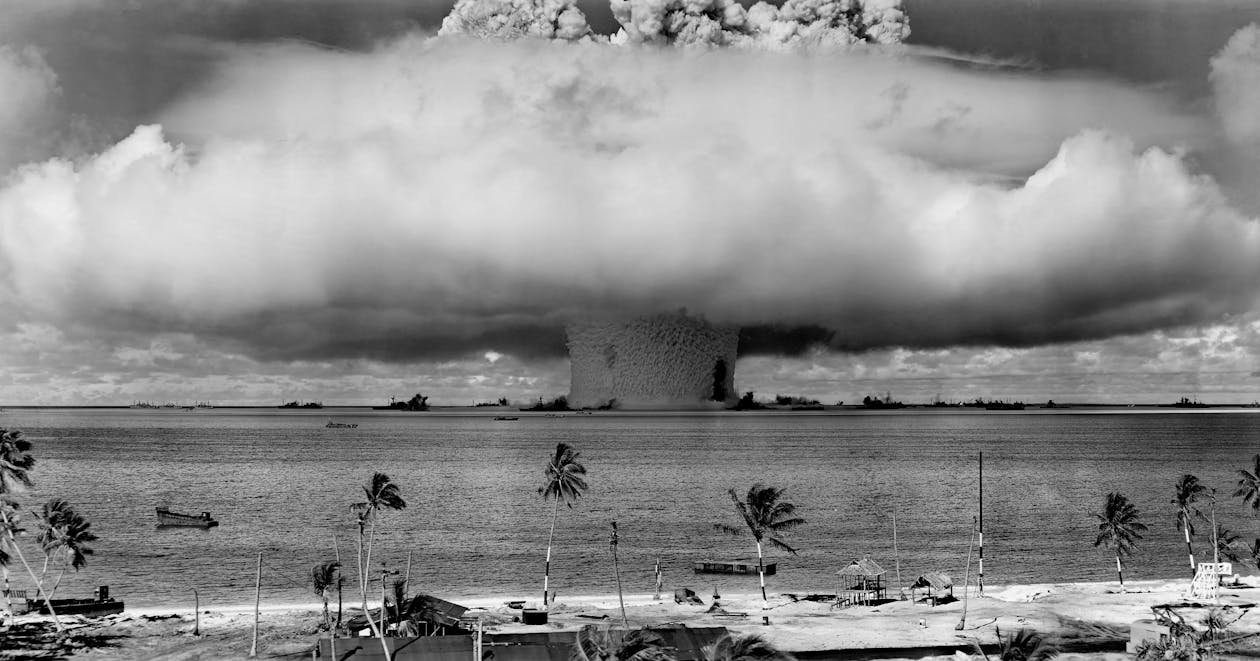
Grayscale Photo of Explosion on the Beach
Atomic explosion from Pexels.com

Let’s assume a 0.03% efficiency in converting mass into energy (equivalent to modern atomic weapons; not the most efficient conversion we can implement). That’s still some 15 atomic bombs going off. In your hand.

Little wonder the characters in Dune wouldn’t bring a gun to a knife fight.

Silver Butter Knife
Knife from Pexels.com