BITS – The Equipment

There’s been the intro, the core mechanic, and the GM guide to BITS. Let’s talk now about how players use tools to interact with the game!

Defining Terms

Equipment is anything the player’s character uses to aid their adventures. These things are just that: things (objects, items, stuff, etc.), each with a common set of properties that describe how the equipment helps with possibly additional explanation as to special, specific rules for the item.

The most common properties include a base damage or an armor value, a physical range of use, a weight or other abstract carrying value, a money value (which may be derived from other properties), and name that implies common use (we all know what a “shovel” is, right? 😶).

Lastly, after diligent study of what makes-up the tools in games, equipment falls into four categories:

    1. Wielded Equipment
    2. Worn Equipment
    3. Whatever
    4. Trinkets

About Equipment

Wielded equipment is anything held in one, two, or more hands depending on how the game means to accommodate weight or carry capacity. This type of equipment is what typically has the “base damage” (BD) property, which is the bare minimum of hurt the equipment will do to a target if successfully used. In the case of shields, though, the “armor value” property exists instead.

Armor value (AV) mostly stays on worn equipment which by its namesake stays on a character’s body. AV reduces any damage from damage passively should an action to hurt the wearer  get through successfully.

Both BD and AV may be reduced over time depending on the game experience intended. This then introduces repair (at a cost) and exchanging BD and AV values to negate or ensure actions. Thus, an economy of equipment is born!

But I digress…

“Whatever” is any equipment that is the miscellaneous, well, whatever that a character would be expected to bring with them on adventures. Fantasy examples include torches, bedrolls, rations, rope, and things specific to a character’s role or background, such as lockpicks for a thief or a war horn for a soldier.

Whatever is abstracted into a value of how much is brought along by a character. When the situation needs a tool, a character can take from that resource pool to get one of the item. Needless to say, this saves a lot when it comes to bookkeeping and tedious minutia when playing.

Trinkets are special things from a character’s past. These are equipment that take none of a character’s carrying capacity and are merely conversation starters that allow players to pursue different aspects of role-play with their characters. Mysterious rings, stained handkerchiefs, and even a ruddy deck of playing cards give the imagination a running head start. (And who knows? Players will always come up with more than the game designer, so a clever player may find a context to put their trinket to work!)

Ranges

Range is a finicky thing that changes based on how tactical or how abstract a game is meant to be. BITS gives tools to go either way.

A middle-ground example of the abstract and concrete is the approximation of distances like so (directly taken from the 201021 version of BITS):

Self – ~1 meter. Reach without a step.
Wagon – ~5 meters. Reach with one or two strides.
Room – ~10 meters. A road with two lanes and shoulders.
Half-line – ~50 meters. The height of a normal tower.
Field – ~100 meters. The length an arrow travels from a normal bow.
Peak – ~500 meters. When a hill becomes a mountain and a normal skyscraper height.
Horizon – ~1000 meters. Maximum visible length when on a road in wilderness.
League – ~5000 meters. Distance walked in an hour and maximum visibility on completely flat water.
Mountaintop – ~10000 meters. Mountains are not higher.

This is probably too specific – that’s why BITS is still a WIP 😂

Anywho, hand-to-hand encounters default to a wagon, or ~5 meters, away which is also the distance traveled in a single unit of movement. Therefore, positioning is preserved and other actions may roll directly into combat ⚔

There is a strict segregation between hand-to-hand and at-a-distance equipment (ie bows, crossbows, and slings). Equipment that may attack from afar first uses ammunition which is drawn from the character’s whatever, but only on critical failures. Balancing whether to keep shooting or to retreat comes because ranged equipment has disadvantage when there are opponents in hand-to-hand range while also being improvised equipment when dueling mono-a-mono.

Improvisation and Degrees of Success

Sometimes what you have is all you have to solve the problem in front of you. Thus, improvised equipment must be accommodated for.

Be it a suit made of rope acting as armor or a broken bottle in a bar, the reassigned devices work far less effectively than their purpose-built cousins. Armor value sits at 1 and is heavy while base damage is 0 (at most, 1) if using degrees of success.

Speaking of, degrees of success (DoS) offer a varying level of effectiveness with any action, and when it comes to equipment, that’s the damage caused.

DoS is how much higher a roll is than the roll needed to be. A pass of 7 but a roll of 10 has 3 DoS. This value gets added to the damage applied to the target, ensuring that an unarmored character with a shiv can still find a chink in a fully suited and shielded knight!

Other Stuff

There’s a lot to consider and accommodate for as it comes to equipment:

How do I throw my axe? Do I have a bonus or advantage if it’s a throwing axe?

So how does weight, or as you call it, “carry”, work?

Do spears also default to the same range as other HTH gear?

What about all this junk I want to bring along?

Ad infinitum…

These are important considerations which have been incorporated into the BITS designer’s guide. To really get into the meat of it all would require a whole new post for edge cases that rely primarily on the game experience sought by the designer.

However, if you have a specific question on your mind, of course it may be answered! 😃 Reach out (not with your longsword, please) to help shore up BITS, saving other designers the same wonder!

Next week will be how spells and magics apply to BITS! Stay tuned and stay healthy. Cheers ~
BITS – The Core Mechanic

This month (and last month) have fleshed out the BITS role-playing system. Today, I give you insight into how BITS resolves conflicts with its core dice mechanic.

The Dice

2d6 (or 2 6-sided dice) are all you need, easy enough to suffice the goal of BITS to be simple without being too simple.

6-sided dice are the most common dice a player’s likely to have in a sock drawer or at least any other game, so sticking with that fixes the issue many games have of having a museum of different many-sided dice.

As for having buckets of dice at any time, 2 is a great number. 2 breaks the linear drudgery of a single die, giving a lovely curving range which has double digits and makes even a minor change in a roll’s value possibly momentous. (The next section explains the latter part.)

No, BITS is not for the folks who bring a satchel of colorful dice to every gaming table. Yes, BITS is for the player who likes time spent on gaming vs. digging for dice. 🎲🎲

Use the Dice When…

There’s a chance that a game-character’s or -creature’s actions could hurt itself, hurt something else, draw unwanted attention, change how others act, cause the future actions not to be taken, or otherwise impact how the game will progress (or not) from the point of action forward.

You have to test for these, tests being times you roll the dice. The value of the dice (and any other values added to it) must meet or exceed a threat value for a given course of action. Threat may be the meanness of a monster, the narrowness of a cliff edge, or the reluctance of a princess to grant your wish.

When 1 or more tests are required to resolve conflict, those are trials, which come in 3 flavors: Combative (physical violence between creatures), Environmental (surviving dangerous conditions), and Social (convincing others to act). Each uses the BITS values for whatever action a player would like to take, which has made play faster and players more confident in their decisions.

The order of a trial (who rolls dice first, second, etc.) comes from an initiative order roll at the start of a trial. The highest value (with their highest BITS value added) goes first. If the value is odd, the order is clockwise (to the left), counterclockwise if even, each player (and the GM) taking tests for all the things they control at once. (Thus, BITS removes the need to keep track of a bouncing arrangement of who rolls dice when!)

Designer note: Categorizing and defining when to roll is an aim to remove ambiguity from the dice. In popular games, the numbers from a roll only matter concretely when a player is in combat, using subjective measures or a boat-load of skills or talents to resolve anything else (e.g. D&D). With BITS, dice roll for anything, removing subjectivity and increasing both the utility of the BITS values and player attention (people like to roll dice 🤷‍♂️).

The Math

A quick note that BITS relies on addition and only addition virtually always. This isn’t the case some times. However, when this principle breaks, it is for small-number subtraction (i.e. 4), which the next section covers.

‘Vantage and Criticals

Advantage and disadvantage are not unique principles in games. Your actions have some boon or bane to them that does something to the conflict resolution, either rerolling dice, adding values to the roll, subverting other effects, or similar.

BITS, since the system has only 2 dice and we don’t want players “remembering” a roll either mentally or needing extra paper to jot a roll value down, relies on simply increasing or decreasing a roll by 4 for advantage or disadvantage, respectively.

(Here’s that point of the need for subtraction, a rare accommodation for the game experience over the addition-only principle.)

Critical successes or failures (criticals) require a wee bit more attention. A critical happens when the dice show double digits, the same value on both dice. What happens next depends on whether the value is above or below the threat the value needed to be.

Over the value (never on, as difficulty is only ever odd), the roll automatically succeeds. Under automatically fails. No other values necessary. (As BITS does not involve rerolling dice, there’s no concern as to getting doubles on a reroll.)

That’s the core mechanic of BITS!  Roll 2d6 to see if your fiction happened the way you wanted it to, adding (and very rarely subtracting) values along the way.

Going to write up more on BITS in the coming weeks, going slowly to as BITS is actively undergoing edits and revisions 🙃 Stay safe! Have fun! Cheers ~

Game Health

Greetings, pandemic-quarantined people!

To give you a glimpse of what my brain thinks about at 3 AM when sleep alludes me, let’s talk about the different kinds of game health. You may add another tool to your belt as I have done to lend a lens towards your own game making 😁

Define Terms

Health in games is one thing: A resource that, when low or without, prevents the player from doing what they want with their character.

(For the purposes of this post, I’m including mechanics that “give you bad things” as health as well, where the absence of the “bad thing” is a measure of health.)

Usually, health is the most important resource to a player. Though it might come back or prevent it’s own loss, any less health is not what the player wants. If health is absent, some common “costs” for allowing the resource to be used up include:

  • Losing progress/time (restarting from a previous point in the game as if the player had done nothing, or requiring time away from accomplishing a goal)
  • Losing abilities (prevention of a few or all actions the player can take, or reducing the efficacy of actions)
  • Losing another resource (something valuable for other things or because it is rare is used up)

Since game designers have been creative over the years, that’s a short list. Whatever the case, something valuable is taken from the player and their efforts to play the game.

Here’s a longer list abbreviated of what “kinds” of health a game has:

  • Number of actors (units, currency, pieces, bits of a required resource, etc.)
  • Cardiovascular and muscular endurance
  • Flesh and blood
  • Metal or chitin armor plates
  • Energy or “shields”
  • Mental strength
  • Time to complete actions

Health is always abstract in its representation, yet always concrete in “if you cross line X, you will receive consequence Y that makes it harder to accomplish your goal”.

Health might be regained in a few ways or not at all. Allow me to skip the latter case to show a few ways health comes back:

  • Automatically with time
  • Using a game item or action
  • Not losing more health for a time

It is important to note that a game may have multiple kinds of health for the player, which may also be different between players.

OK! With those out of the way, I have a proposal:

Shields Armor Personal

The proposal is this: There are only 3 kinds of health in a game. I name these after games of conflict that have the most complexity as it comes to health implementation:

  • Shields
  • Armor
  •  Personal

Shields are a kind of health that automatically recovers over time. In the game, these can be depicted as recurring money income, generated energy, or other temporary-yet-perpetual health. This is the first health to be used. This health may be lost if not used, the game capping the amount being held at a time. The loss of shields isn’t a game-ender as shields will come back, but their loss may prevent other actions or allow more valuable health to be removed.

Armor (I was tempted to call this “plate”, but SAP is a nicer acronym 🙃) includes health that is impervious to a certain amount of reduction. If an action would remove 3 health but armor is at a 4, nothing happens, while a removal of 6 would be reduced to 2. Armor itself can be lessened, or be exchanged as the cost of preventing even more important health from being reduced.

Personal is the most important health. It does not come back on its own and is the direct measure of how poorly positioned a player is to keep playing the game as they have been. Without it, the player may not take actions towards their goal. It’s the last health to be taken from if Shields and Armor are present.

These kinds of health can be combined together or doubled-up with the same kind of health. Take Sanity from Call of Cthulhu as an example: Sanity pairs with Hit Points to balance mental and physical ability to act.

(If it will help your memory, replace SAP with the 3R’s of health: Regenerative, Reductive, Required.)

Why SAP Works

It comes back to the investigation of the definition of health: There is health that comes back or is temporary, there is health that reduces or resists reduction, and there is health that determines the actions available to the player. Plus, SAP is in order of application!

Further yet, be it the shield-armor-health of a Protoss warrior in the game Starcraft, properties and money in Monopoly, or the real-world APS-hull-crew of a tank or carapace-clothes-skin of people, SAP is repeated over and over again in systems dealing with a thing trying to do things.

Lastly, SAP balances player attention. Shields grow on their own so long as the player continues to play. Armor might be permanent and minor or major and replaceable. Personal gets better over time if left alone, but is the most critical to not let run out.

Therefore, SAP is a highly useful tool when considering health in a game and the order by which different kinds of health reduce. Further, it breaks out of abstract games into the real world, providing insight into the levels that protect the functioning of a thing.

What do you think? Share your insights and tools so better games and a more efficient way to look at the world can be unlocked! 👍🏻 Cheers~

BITS – An Introduction

You’ve seen me talk a lot about BITS, an original rule set for tabletop role-playing games (RPGs). It’s about time you got some more insight to it!

BITS, or Body-Interaction-Thought System, came about first when a colleague and knowledgeable friend mentioned how cumbersome the classic Dungeons and Dragons type of old-school RPG systems were.

I sat on this problem for awhile, pondering ways to automate and streamline the work of the world building, dice juggling, and stat monitoring. Nothing really “worked”…

Until I noticed that the universe of Warhammer 40K was made purely of the elements of Muscle, Machine, and Mind 🤯

Looking at other RPG systems, I saw the 3Ms everywhere. All game systems divide into physical ability and performance, manual dexterity and know-how, and mental strength and intelligence.

For reasons I care to let you read or listen about, the 3Ms became the 4Ms, “Maybe” joining the ranks and becoming a dump section for anything narrative in a game.

I tried 4Ms for a few more things, but I couldn’t get Maybe to always feel “correct”, but I sure as heck wasn’t going to give up Muscle, Machine, and Mind!

What resulted was BITS. Body relates better to physical performance, Interaction better for manual work and social charisma, and Mind handling magic and intelligence. And in these things, any attributes or stats in any game can be put 😎

Further, I discovered a common theme of ‘4’ showing up in games, where every number could be normalized on a 0 to 4 scale. Thus, any single BITS value is rated 0 to 4 on a linear growth curve (0 to 1 is short, 3 to 4 is long), meaning any fictional creature in a game has at maximum a total of 12 for their values, while any single value is at most 4. (Great for balancing and restricting the dreaded Power Creep!)

BITS uses 2 6-sided dice (2d6) for every roll to see if a fictional creature succeeds at what it wants to do. The expectation is to keep things simple – 2d6 are easy to add together, they are the most common dice type, and having everyone roll only 2 dice for everything is elegantly simple (checkout the probability curve that games such as the famous Powered by the Apocalypse system uses).

When rolling, the “additions” to the roll are kept in a very exclusive list:

  • Add a single BITS value (or none, in the case of pure Luck rolls), 0 to 4.
  • Add 1 for any other creature that spends valuable time helping your creature act.

“Maybe” hasn’t gone away completely, either. The current test-case conversion of D&D into BITS has “Luck”, a fallback for whenever a roll needs to happen that doesn’t seem to fit into the Body-Interaction-Thought set, or is an event that a player would have no chance to react to. It means no values are added to the roll.

But what does a person need to roll to succeed?

“Threat” is the WIP term for the success threshold. Every creature and environmental obstacle has a threat which corresponds with their total BITS value (if a creature) or difficulty (hazards). Any action against this creature or hazard must roll (with additions) at or over the threat. (Easy, ya?)

Scaling threat has been a major undertaking with BITS and may not be done yet, so it goes for now as follows:

  • Roll a 5 for easy actions.
  • 7 for moderate.
  • 9 for hard.
  • etc.

Players max out at 13 threat. Simple!

The rolls may be altered (rerolling for dis-/advantage) or may lead to automatic successes/failures (doubles over/under threat).

Regardless, how effective the action is deals with how much over threat a roll is. Using damage from a weapon as an example, weapons only have a low base damage X from 1 to 4. However, for every degree of success over threat, that’s extra damage to add! No extra rolling for damage, no variable dice for damage, and a counterbalance of using tools and picking fights!

If you take damage, you must have health! Or, as it is in BITS, “wounds”, which you add any damage to (reduced by an armor value). Once you reach your maximum number of wounds, well, 💀💀💀

I aim to have wounds traceable with 6-sided dice for easy counting, so maximum wounds have been necessarily low… I will need more playtesting later-/post-pandemic to understand the implications of that, but you get the drift – everything is to be easier, simpler, and more accessible 😉

When your creature acts is also streamlined. Everyone rolls, adding their highest BITS value. The highest final number goes first, but then if the result is even or odd, that changes the direction of the turn order (to the player’s left or right). If it’s the Game Moderator’s (GM) turn, they take a turn for every creature not controlled by a player.

The GM does more than moderate – they arbitrate, describe, listen, and help ensure the quality of the game. They’re also the player I aim to develop the most automation tools for 😁

Together, the GM and other players take on adventures meant to be self-contained missions that offer opportunities to pursue other adventures. The players gain XP for trying more difficult adventures, which increases their BITS values, which leads to getting more treasure in the adventure, which allows better equipment to be bought, which allows more difficult (and epic!) adventures to be undertaken, which gives more XP. #Cycles

And that’s a quick and dirty introduction to BITS! I have grand expectations for this theme-agnostic system, but am taking humble steps to make sure the foundations are solid before releasing the full set.

After reading all that, what are your thoughts? Any glaring holes in this design? How would you improve it?

Share your impressions and let me know if you’d like to be an alpha-reader. (Don’t worry – the system is split into short, topical guides.)

Take care of your own goals in September! Look forward to more design talk of BITS in the following weeks 😃 Cheers ~

Making a Risk Map

  1. The Data Set
  2. The Equation
  3. The Calculations
  4. The Problem
  5. The Solution
  6. The Answer
  7. The Other Observations

Salutations ~

Part of last month’s goals were to make a Risk board game of the American Civil War.

The goal fell short due to the game not giving the right feel, but I sure-as-heck did the math to make the map 😁

For your reference, the game Risk has a map made of connected continents with various territories in each. If you control a continent, ie have a game piece in every territory, you get the continent bonus, which you usually spend for more game pieces.

The Data Set

It’s the continent bonus I calculated. To do so, I analyzed top-rated Risk games for the number of territories in each continent and how many connections every continent had with other continents. Here’s the list of games (pardon the formatting; yet to look into adding tables to WordPress):

  • Classic
  • Classic w/ a common community modification to connect the Australian continent and rebalance bonuses (ie “Connected”)
  • Star Wars Clone Wars
  • Starcraft
  • Halo (Ring, Forge, Hammer, and Anvil maps treated separately)
  • 2210
  • Mass Effect
  • Star Wars Original Trilogy

Online forums talking about Risk usually base the bonus on a continent’s connections (one territory in one continent connects to one territory in another continent). I feel we need to add territories to this calculation, however, as to control a larger continent requires the spending of more game pieces, thus larger continents are more expensive to get the bonus, regardless of connections (connections being a means for other players to disrupt your control of a continent).

The Equation

Because territories (required to get bonus) and connections (required to keep bonus) are so different in what they mean for a continent, I started my work with a linear equation for each continent for each game:

Nt * Ct + Nc * Cc = B
Nt = Number of territories
Ct = Territory constant for a bonus
Nc = Number of connections
Cc = Connection constant for a bonus
B = Continent bonus

We have Nt, Nc, and B for every continent. We need to solve for Ct and Cc, which we can do by combining the equations to eliminate those variables one at a time.

Note: Nc is the number of connections regardless of which territories are connected. 1 territory with 1 connection is 1 Nc; 1 territory with 4 connections is 4 Nc.

The Calculations

I assumed this would be straight forward for at least one of the Risk games. Spoiler: It was not 😑

Saving you some of the nitty-gritty calculations (you can do this yourself), let’s look at Risk Classic:

  • Continent – Territories – Connections
  • N. Amer.     9                       3
  • S. Amer.      4                       2
  • Europe        7                       8
  • Africa          6                       6
  • Asia             12                     8
  • Aust.            4                       1

This leads to getting multiple values for Ct and Cc, meaning how bonuses were calculated was a seemingly arbitrary affair 🤷‍♂️

OK! No problem! I’ll try the same thing on the other games…

The Problem

OK. We have a problem. They also churn out obviously tiered continents (some being better than others). For instance, the Connected modification to Classic Risk, while better, leaves us with 3 distinct groups:

  • Cc = 1.167 * Ct
  • Cc = Ct
  • Cc = 0.571 * Ct

To get around this, I tried averaging, normalizing, and a few other pen-and-paper solutions to make this work out.

Nothing worked out 🤦‍♂️

UNTIL I REMEMBERED:

~simplify~

The Solution

How does one simplify this sticky situation across multiple games? Some grossly off in their bonuses? (*ahem* Halo Risk 😐)

The solution is to combine territories and connections 🎉 Doing that, we get:

(Nt + Nc) * C = B
Nt = Number of territories
Nc = Number of connections
C = Constant for a bonus
B = Continent bonus

That equation allows for each game to get to C = B / (Nt + Nc), so a constant can appear. Here’s what I pulled out, also weighting each with BoardGameGeek  ratings:

  • Game – Constant – Weight
  • Classic                  .400             5.58
  • Connected           .411             6.00 (Classic rounded up)
  • SW CW                 .419             6.01
  • Starcraft               .389             6.37
  • Halo* (Ring)        .398             6.44
  • Halo (Forge)        .396             6.44
  • Halo (Hammer)  .407             6.44
  • Halo (Anvil)        .383             6.44
  • 2210                      .411             6.69
  • Mass Effect          .391             6.81
  • SW OT                   .391             6.84
  • * Halo needed extensive recalculation of its bonuses – they were incredibly low compared to any other Risk game. I may update BBG someday with a rules correction for improved and more consistent gameplay.

The Answer

We are left with two numbers: The weighted average (.399) and the median (.398). For simplicity’s sake, let’s call it .4 for:

(Nt + Nc) * .4 = B
Nt = Number of territories
Nc = Number of connections
B = Continent bonus

I adore when numbers come together ❤

TLDR; To get a fair continent bonus, add each territory and territory connection to another continent together, then multiply that by .4 to get the bonus for control of the continent. 

The Other Observations

Looking at a fair number of Risk games, I noticed some trends between the versions. (We will skip looking at copy-paste Risk games that only do a reskinning of the theme.)

  1. The bonus constant 40% (.4) can be ‘flexed’ down to 33% (.33) or up to 42% (.42) without skewing the fairness of the continent. Whatever percent is used, keep in mind that higher percentages are preferred (more reward for the ‘risk’ of controlling a continent).
  2. 6 continents is expected on a Risk map.
  3. Each continent has a minimum of 2 connections and 5 territories (4 territories is doable but extreme and should remain only thematic).
  4. Good design means connections are greater than 25% of the territories in a continent. (Bad design examples: Australia in Classic, North Atlantic in 2210.)
  5. Good design means there are more territories than connections in a continent. (Bad design examples: Africa, Europe, and Asia in Classic.)
  6. More game pieces means better player experience and faster play (long games is a common critique of Risk).
  7. Capping either the number of game rounds, putting in a score tracker, limiting the number of game pieces per territory, or all of these things and more also assist the slow play problem.

This was fun 😁 I may share later how I would “fix” each Risk game. Let me know if I should get on that sooner 😉 Cheers for now~


Pawn Prince v1.2

Salutations, reader! Welcome!

After community feedback, my piece mod to Chess has received an update! First in 5 years!

Version 1.2 is being approved by Board Game Geek now – you can find the full file shortly on BBG, which I highly recommend you to. (There are pictures in the PDF!)

To give you a preview, here’s the rules text in this little mod:

The Pawn Prince (Prince) replaces the Pawns in the A and H columns.  The piece cannot be captured by a piece moving into it from the 3 tiles immediately between it and the opposite color’s side*.  No other Pawn can become a Prince, as Prince’s cannot be upgraded themselves.

The Prince piece gains the base movement behaviour of any piece – same color or not – left or right to the Prince before it moves.  For example, if a Bishop is on the left, and a Rook directly ahead, the Prince only has the moves of a Bishop for that turn.  If a Prince is on a Prince’s flank, the Prince cannot move, since the other Prince’s base movement is no movement.  If no piece is to the Prince’s left or right, it cannot move!

For the special move cases of Castling, En Passant, Jumping, and Pawn Promotion,  these rules do not apply to the Prince even if the Prince is next to a Rook, King, Pawn, or Knight for which the special move cases apply. In the case of En Passant, the other player may not use En Passant on a Prince piece.

If a move leaves only a Prince and a King unit for a color on the board, the game ends in a stalemate unless the move results in a checkmate.

If the Queen of a color is captured, all Princes gain the permanent movement of Kings, but still cannot be captured by the forward facing tiles and may use the movement of any piece on their sides.

* A Knight’s capture path to a Prince is determined by the controlling player. That is, a Knight must move 2 tiles along an axis, 1 tile along the other axis.

I’m very excited that folks are still viewing and playing the content I’ve put together. It gives me a push to continue on my newest works (BITS being a great example).

It’s my pleasure to share this simple mod to a complex game with you! When you give it a play, let me know your experience – it’ll be invaluable!

Stay well! Cheers for now ♟

Improvised Role-playing Game

It follows this month’s goals that I invest in both making games and in family. This week, I did both!

This post has lessons for being a Game Moderator, or GM (referred to in the massively popular role-playing game Dungeons & Dragons as DM) and impromptu game-playing. However, I want make special note of just how much fun my sister, her partner, and I had with nothing more than two dice, a prompt, and our imaginations 😁

Try the following yourself sometime and have a great day! 👍

Mechanics

2d6. Or, two six-sided dice, are what’s rolled. Only the GM rolls dice when the outcome is uncertain or the attempt could be dangerous.

3-5-7-9-11 difficulty. Difficulty starts at 3 for very easy (this should hardly, ie never, be used; the player should just be able to do it), 5 for easy, 7 for moderate (the default if no difficulty specified), 9 for hard, and 11 for very hard. The GM bases the difficulty off of the game’s context, the player’s ability, and the action or actions trying to be done.

Roll at or above to succeed. Meet or above the difficulty to do the things intended.

Critically succeed or fail. When the 2d6 both have the same face value (eg 2-2, 5-5), consider that a critical. It’s a success or failure if the total value of the 2d6 is above or below the difficulty, having especially positive or especially negative consequences.

Have the option to reroll the lowest die for great context. If in the game story a player does something unexpected, has the high ground, or takes advantage in the game’s story in any other way, give that player the option to reroll the lowest die.

Playing

Two to six players, one being GM. You need a handful of players (two to six-ish), one being the GM. Players work together to clarify and act in the game’s story. The GM describes the environment and outcomes, rolls dice, presents obstacles, answers other players’ questions, and asks what the players are doing (this buys the players time to think of their next actions).

Non-GM players are themselves in the game. To judge how well they might do something, the players are asked about their past experiences and current abilities when such things might help them accomplish what they want.

Let the details reveal themselves. Whether defining a player’s character or the game world, let the specifics be asked for when they’re needed. This saves time and trivia. Want to know where the exits in a room are? Ask if there are any. Need to know if a player is strong enough to lift something? Ask for their experience and past examples of doing similar.

Let the very likely happen. If something is very easy, or if it involves nothing but the character themselves, those in the game story do it without needing to roll the dice. This goes for having certain items and being knowledgeable about certain things that the player would very likely have or know.

Talk it out. Again, as a player, ask for details and talk among yourselves. If unsure what intentions are, what something looks like, where things are, or how actions would be carried out, ask and talk it out. As a GM, you also don’t need to describe absolutely everything, either; ask players for how they commit their successes, where they were before, and what they’ve done previously.

Give a prompt. The GM can start the game off with the famous The Orc and the Pie game prompt from Monte Cook: “You see an orc with a pie. The room is 10 feet by 10 feet” and “what are you doing?” Regardless of prompt, it should have implicit or explicit obstacles to get around and goals to attain in a place.

Optional

Players roll their own dice. This though seems to slow things down. One person rolling (the GM) and reviewing the values is faster, especially since the GM determines the difficulty and any additions or advantage the players have. (That, and you need more dice!)

Players are someone else. Depending on the game wanting to be played, players can be lousy pirates 🦜 superior ninjas 🐱‍👤 bug squashing space marines 👾 or anything in between, original or taken from a popular story world. Being generic as possible helps here, but the bare minimum is that all players are familiar with trope.

Add or subtract from rolls. A roll may be given +1, +2, or -1, -2 for the abilities of the player in the context of the game world, such as being weak (usually a negative) or comparatively large (usually a positive). This was tried for awhile, but arithmetic usually slowed things down, it being better to give harder or easier difficulty instead.

Roll for who goes first. This is commonly called “initiative”, which determines which characters act first. When playing, I did this for the first conflict, yet that was over very quickly. As the game went on, we skipped initiative, instead giving each player and fictional character near-enough equal time in the spotlight to try something, moving on to other characters once they were done.

Have you done something similar? I want to know! The improvised game played was something I want to do again. Heck, I may (after the current pandemic passes) carry dice with me at all times just for the possible opportunities 😃

Character Sheet Essentials

Greetings again, there.

Been thinking and working a lot on tabletop roleplaying games (TTRPGs). In that work, I’ve needed to understand what’s necessary for making TTRPGs since my work concerns a universal simplification system that keeps the game’s original mechanical balance.

So, for your next dungeoneering adventure, you making your next great game, or if you only have a packet of note cards, keep five things in mind: You (your character), Seem (your external disposition), Story (your history), Stuff (your, ah, gear!), Status (your health, experience, etc).

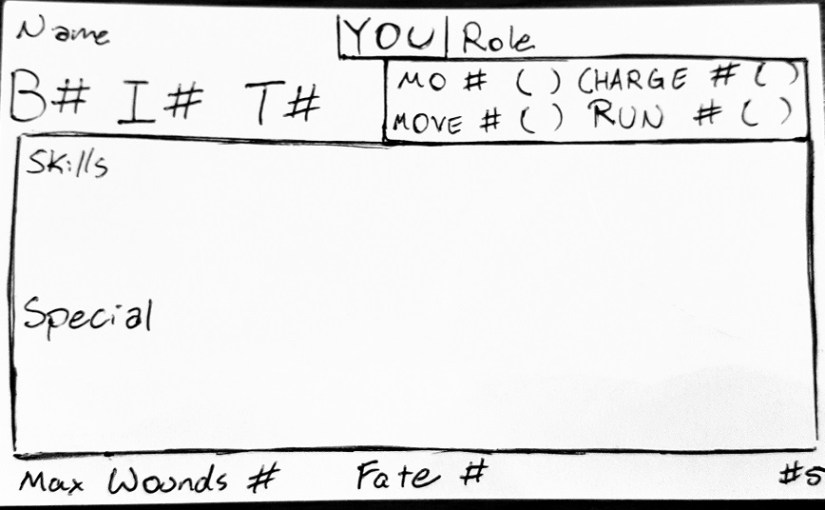
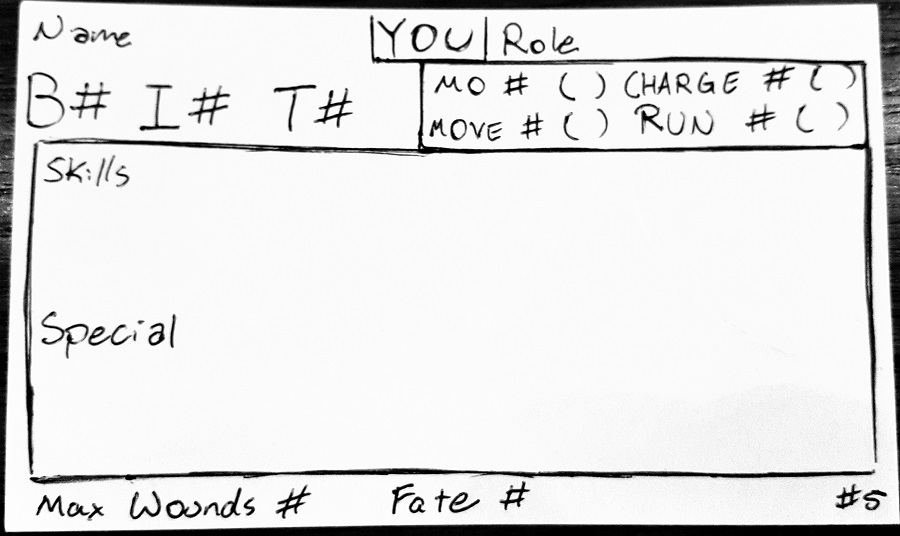
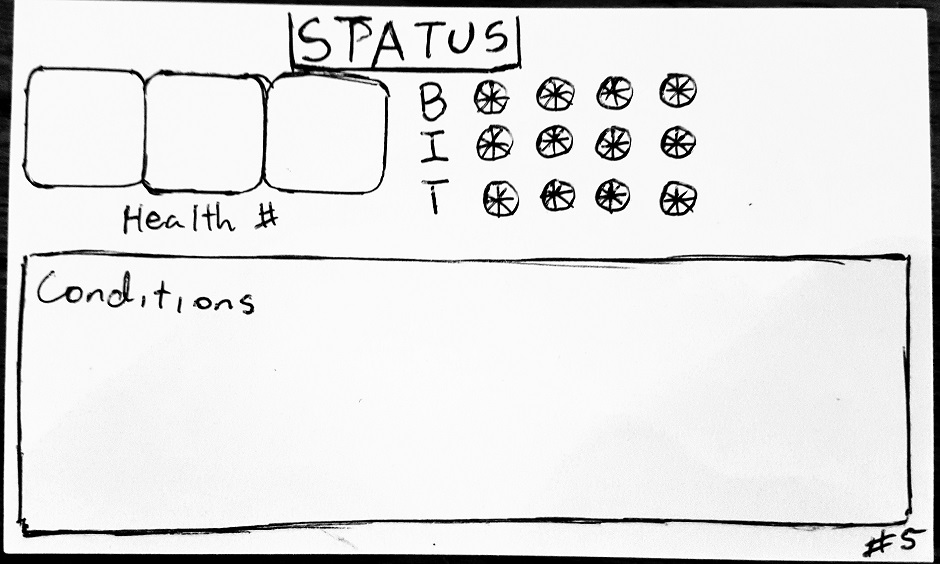
Going into those things in depth, keep in mind that all of the following can be recorded on one side of a 4×5 note card. I’ve pictures as examples, though these have been made game-specific for the Warhammer 40K Deathwatch TTRPG:

YOU

Your character and all the important things needed to keep in mind when interacting in the game. Name, stats, any special abilities, and some reminders of IP-specific values. This card shouldn’t change during play, and rarely between sessions of play.

Sheet-You

Name
Yep.

Role
A reminder of your role in society or the game world.

BITS
The Body-Interaction-Thought values that are added to your rolls.

IP-Specific
In this case, Movement (half, full, charging, sprinting).

Skills
Anything you can do in particular.

Special
Special abilities or considerations in what you do.

Other IP-Specific
Anything else. In this case, max health and don’t-die points.

SEEM

Your character’s external appearance and behavior. This card also shouldn’t change much, unless a scar or some terrible incident has come about!

Sheet-Seem

Behavior
What’s your demeanor? Put that here.

Appearance
What do others see?

STORY

Your character has a past and a future. Here those goals and history get recorded. If the game IP warrants it, include the relationships the character has to people, places, and things. This card can change during play, especially if keeping a log of the character’s actions. (This may require additional cards / space!)

Sheet-Story

Future
Your goal(s), what you aim to do, how you’re driven to act.

Past
A log of everything you’ve done.

Relations
Optional as it’s IP-specific; how you and others relate to one another.

STUFF

It’s dangerous to go alone, so what are you taking along? Carrying and wearing, using and keeping, the gear goes on this changing card.

Sheet-Stuff

Armor #
How much protection what you’re wearing warrants.

Tools
A nicer word than than “Weapons”, but doesn’t alliterate 😑
Anything held or ready to be held.
Only ever carry 4 of these at a time; kept in the hands, on the body, or on the hips.
Since these can be changed often, best to keep the details of the tools on other cards.

Wear
Typically the suit worn, maybe your pack, and a few pieces of other gear.

Misc
A count of the miscellaneous items that you’ve packed.
Is abstracted to keep down bookkeeping.

Ammo (IP-Specific)
Sometimes ammunition kept in a magazine needs special attention.
Also is abstracted to save on bookkeeping.

Specifics
Any items carried along that you have a definite amount of.

STATUS

How your character is should be changing constantly throughout play if anything of worth is being done. Health, progression, and conditions are added and removed on the regular, possibly needing to replace this card multiple times during a single play session.

Sheet-Status

Health #
Health (thinking of renaming this to “Wounds” or “Harm”) followed by the total capacity for harm you have.

BITS Growth (ie Level Progression)
Add progression clocks or ticks (this latter is cleaner) to level up each of your attributes separately (or all at once if using an XP-pool system like D&D).

Conditions
Are you sick? Under the influence? Jot the name and a shorthand for effect here.

What’s missing? Drop a line – you’ll make for better games doing so 😁 Cheers!

Cast 13 – Quick Table Top Role Playing Game – 2

Download for the road. (15m 13s)

Coming hot off last week’s post, here is the second half of the Quick TTRPG (name pending; any suggestions?).

Today we’re getting after the role of the Game Moderator, some general rules for everyone, and background to the system.

Download the action-oriented sheet here.

And here’s the roleplay sheet.

The sheets will be appearing soon! In the meantime, let me know if these suckers print properly – not all printers were created the same 😑

Lots happening towards this month’s goals – looking forward to sharing more news with you in future posts 😁 Enjoy the game! Cheers.


Cast 12 – Quick Table Top Role Playing Game – 1

Download for the road. (15m 2s)

When’s the last time you played a tabletop role playing game? A TTRPG? 🤔

How much time did it take to play? How much time did it take to prepare? Do you know? What did the dungeon master do to start the game? Did you feel left out? Did you feel it was slow?

When did you pull out your phone? 🤳🏻

Games can take awhile. long while. 😱

After listening to the concerns of my friends who regularly play and hundreds of hours studying what makes role playing games both fun and terrible, I’ve come up with something quick, simple:

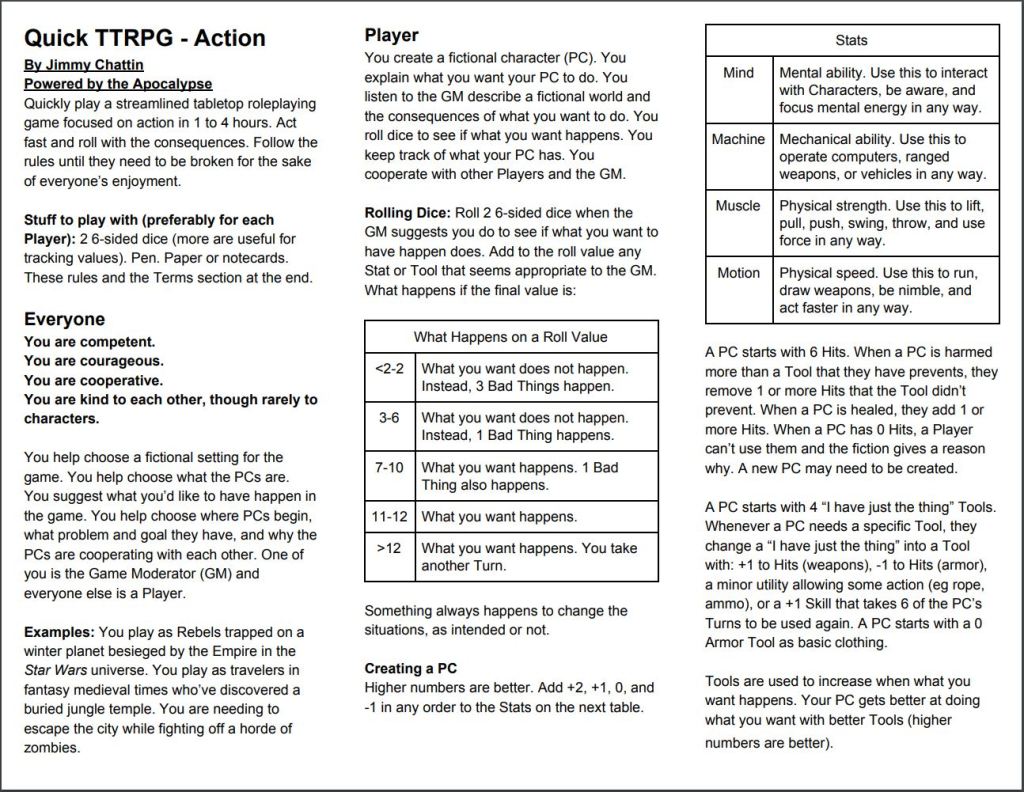
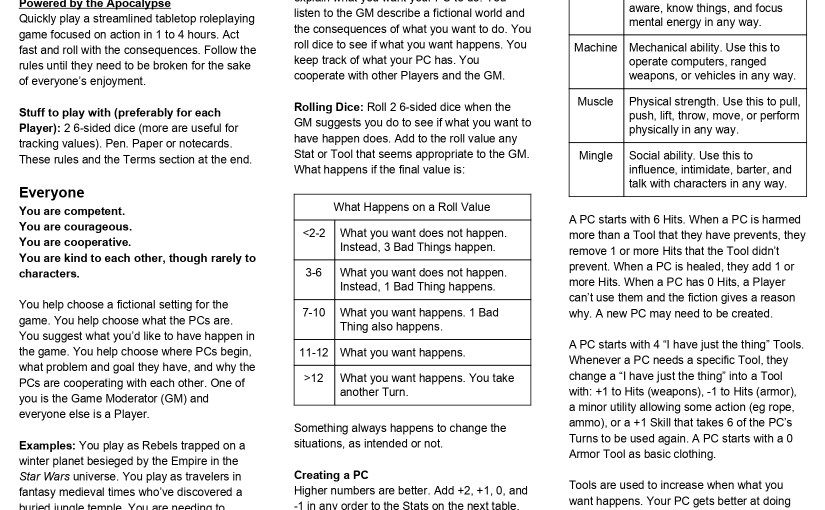
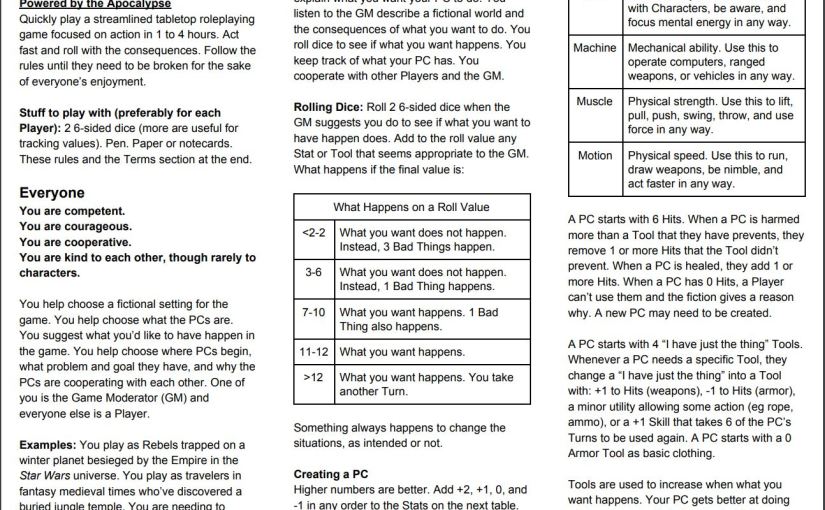
QuickTTRPGPreview
Preview of the Quick TTRPG ruleset.

Meant to be printed front to back on a single page, the Quick TTRPG means to accommodate for two styles of play (Action, Role Play), the roles of every participant (Player, Game Moderator), dice rules (two six-sided), stats (4M System), and the tools used in a game.

Further resources include random tables for both game setup, character creation, treasure, missions, and the Bad Things that happen.

And now, the second half of the review is up! Check it out for some freebies.

I look forward to your thoughts  – please give the casts a listen and the ruleset a glance. Send me your comments to assist in making better games 🙂