This is my attempt to boil down characters to the essentials of what needs to be known. A character sheet still needs the four sections “Self, Seem, Story, and Stuff,” but there’s more wiggle room, especially on “Self,” on what a given game IP ought to include.
(Note card-sized sections are pictured for reference.)
My joy of a game system, BITS delivers a faster pace of gameplay, simpler arithmetic, but a thorough set of possible outcomes for any action. Here I talk of the dice, the math, and other factors in resolving conflict in the system.
Back when I could upload podcasts, I outline twelve actions that remove stress and improve decision making. These are points that are recommended by the best performers and thinkers in our society which I have also tried out personally to great success 😁
I’ve come a long way in terms of knowledge and technique for making games (specifically TTRPGs), yet this first system has a special place in my heart ♥
There are a lot of disgusting, dangerous things being said to downplay or misinform about the current global pandemic.
One hit me so hard on social media it took me days to get over the audacity of it. Then I wrote a blog post in response 😉
One thing I’d add to this post: You can’t give someone lung cancer from your lung cancer condition. You can give COVID-19 to another without even knowing you have it. Therefore, this is another point that comparing COVID to other diseases as a means to render mute the concerns (and lives lost) of the pandemic is not just infantile and uninformed, it is dangerous.
I fled Las Vegas to the wilds and eventually the East Coast in May. What’s written retells my journal entries for the trip, including a very eye-opening understanding of poverty in the forgotten, decaying rural sections of America.
I wish I had this guide when I started in the professional sphere.
What’s inside is a step-by-step formula to calculating what you ought to be paid along with surefire ranges you must ask for when negotiating pay.
It’s dangerous to go about with ignorance when it comes to money. Take this insight along for the ride.
–
If you’ve missed out on these crowd-pleasers, it’s not too late! I also recommend checking out the other posts – you’ve plenty of content to gleam from.
What has been your favorite post? Which articles would you recommend I read? Let me know! Cheers to your 2020 wrap-up ~
I’ve gotten around to watching the shows Avatar: The Last Airbender (ATLA) and Avatar: The Legend of Korra (great shows, btw). Along the way, I’ve taken notes on recurring themes and opportunities to bring ATLA to the tabletop.
This post is less than a full game – for those, try out Avatar-inspired titles like Legend of the Elements (Powered by the Apocalypse narrative game) and The Last of the Lacers (D&D game). The following are the elements (see what I did there? 😁) I’m concerned with for making ATLA into a streamlined RPG.
Themes
ATLA is consistent with a set of ‘rules for the world’ which make it ‘kid friendly’, though these can begin to be stripped away for a harsher feel depending on game genre.
No one kills another. (It’s only an option for the biggest, baddest evil villain.)
People live for over a hundred years.
Gravity is really low, so falls, jumps, and throws are very impressive.
Injuries reduce capability until a person is unconscious, not dead.
There is the Spirit World and the Material World.
There are four Elements (Air☁, Water🌊, Earth🌎, Fire🔥) with a subset and super-power each.
A person is either born able to Bend (magically control) one of the four Elements or not. (Cataclysmic events or powers can give or remove Bending ability.)
Animals are intelligent and a companion is common.
Got it? Cool! Onto mechanics…
Mechanics
Very similar to BITS, two six-sided dice (2d6) roll at or above a target number, that number representing the threat of an individual or otherwise the difficulty of enacting a character’s will on the world.
To aid rolls, the applicable stat number gets added to the value.
Stats
A simple set of stats represent the collective ability of any action a character may take.
Martial
For fighting and physical exertion, getting your way manually. This includes the name of a preferred weapon that, when used, gives a bonus to the action or outcome.
Influence
For leading and convincing others, getting your way without violence. This includes the name(s) of a companion, human or animal, that gives a bonus when they are also interacting in a social situation.
Training
For when doing a life’s work. This uses a specific name of a specialty which in turn has lists of actions that could be taken for a bonus.
Training may be Bending, Soldiering, Crafting, Performing, Wandering, Administrating, or other professions a character could spend their time at. However, if not choosing Bending, other boons are given to the character, eg another weapon they are practiced with.
Other stats keep a character in the game and add color to their life:
Nation
Where the character comes from. This is also the default Element the character may Bend, though for role-play another Element may be Bent if it’s specified that a parent is from another Nation.
Endurance
How much more the character can take. Any detriment to Stress adds conditions that impede the character’s actions before they are ultimately rendered unconscious or otherwise lost.
Confidences
The things the character is proud of. Some advantage may apply when doing such things.
Failings
The things a character should be ashamed of. Some disadvantage may apply when doing such things.
Goals
Stat advancements are the first goal since they improve the odds of accomplishing other things in the game.
The goals in fiction are ultimately up to the type of game being played. The primary goal must be shared by all players, but each player may have additional goals for themselves that give reward such as stat advancement or other mechanical boon.
Some group goal ideas:
Stop the Fire Lord from conquering the world.
Resurrect the Avatar.
Unite the Material and Spirit worlds.
Find an item of power to bring balance to the Nations.
Bending
The “magic” of the game offers great robustness in how diverse a character may become as they Train. Whether used as a utility, brought to bear in offense, or as a matter of healing, Bending can do about all. Each Element also has a magical Elemental animal.
Air
Earth
Fire
Water
Examples
Softening falls, pushing objects away, flying.
Raising the ground, throwing rocks, carving stone.
Creating fire, throwing fireballs, immolating.
Freezing, spraying, using water to manipulate objects.
Subgroup Bending
Cloud Bending
Sand Bending
Light Bending
Swamp Bending
Advanced Bending
Gravity Bending
Metal or Lava Bending
Lightning Bending
Blood Bending
Healing Power
Sickness
Bones
Bleeding
Flesh
Animal
Sky Bison
Badger Moles
Dragons
(none)
No matter the Bending Element, a true master-level character may Bend with only their minds. Hands-free magic!
The god-tier forms of Bending usually lie with the Avatar, the incarnation and agent of the cosmos to keep balance in all things. Walking the Spirit world, telepresence, removing Bending ability, using all Elements at once, achieving a temporary state of extreme ability, and transforming into a hulking colossus of energy are a few examples.
Non-Bending
Not to be outdone by Benders, normal folks have their own gifts too. In advanced Trainings, a non-Bender has access to a lot:
Acrobatics to dodge attacks, run on water and walls, and scale heights.
Chi blocking or assassination to immediately disable the limbs or whole body of an opponent.
Medicine to care for any ill or injury.
Weapon skills to duel with and defend against any foe.
Engineering to create machines and tools matching or exceeding a Bender’s ability.
Brilliance to outthink any situation and foretell things to come.
Bending gives a natural edge that some non-Benders have overcome with study and dedication.
Closing
As a world, ATLA is rich with potential. Keeping things simple, the above outline establishes a solid way to create a purely ATLA game experience. Surprised this wasn’t a post about BITS?
I may come back here someday to create a game from this, though if you beat me to it, let me know 😉 Cheers for now!
Part of last month’s goals were to make a Risk board game of the American Civil War.
The goal fell short due to the game not giving the right feel, but I sure-as-heck did the math to make the map 😁
For your reference, the game Risk has a map made of connected continents with various territories in each. If you control a continent, ie have a game piece in every territory, you get the continent bonus, which you usually spend for more game pieces.
The Data Set
It’s the continent bonus I calculated. To do so, I analyzed top-rated Risk games for the number of territories in each continent and how many connections every continent had with other continents. Here’s the list of games (pardon the formatting; yet to look into adding tables to WordPress):
Classic
Classic w/ a common community modification to connect the Australian continent and rebalance bonuses (ie “Connected”)
Star Wars Clone Wars
Starcraft
Halo (Ring, Forge, Hammer, and Anvil maps treated separately)
2210
Mass Effect
Star Wars Original Trilogy
Online forums talking about Risk usually base the bonus on a continent’s connections (one territory in one continent connects to one territory in another continent). I feel we need to add territories to this calculation, however, as to control a larger continent requires the spending of more game pieces, thus larger continents are more expensive to get the bonus, regardless of connections (connections being a means for other players to disrupt your control of a continent).
The Equation
Because territories (required to get bonus) and connections (required to keep bonus) are so different in what they mean for a continent, I started my work with a linear equation for each continent for each game:
Nt * Ct + Nc * Cc = B Nt = Number of territories Ct = Territory constant for a bonus Nc = Number of connections Cc = Connection constant for a bonus B = Continent bonus
We have Nt, Nc, and B for every continent. We need to solve for Ct and Cc, which we can do by combining the equations to eliminate those variables one at a time.
Note: Nc is the number of connections regardless of which territories are connected. 1 territory with 1 connection is 1 Nc; 1 territory with 4 connections is 4 Nc.
The Calculations
I assumed this would be straight forward for at least one of the Risk games. Spoiler:It was not 😑
Saving you some of the nitty-gritty calculations (you can do this yourself), let’s look at Risk Classic:
Continent – Territories – Connections
N. Amer. 9 3
S. Amer. 4 2
Europe 7 8
Africa 6 6
Asia 12 8
Aust. 4 1
This leads to getting multiple values for Ct and Cc, meaning how bonuses were calculated was a seemingly arbitrary affair 🤷♂️
OK! No problem! I’ll try the same thing on the other games…
The Problem
OK. We have a problem. They also churn out obviously tiered continents (some being better than others). For instance, the Connected modification to Classic Risk, while better, leaves us with 3 distinct groups:
Cc = 1.167 * Ct
Cc = Ct
Cc = 0.571 * Ct
To get around this, I tried averaging, normalizing, and a few other pen-and-paper solutions to make this work out.
Nothing worked out 🤦♂️
UNTIL I REMEMBERED:
~simplify~
The Solution
How does one simplify this sticky situation across multiple games? Some grossly off in their bonuses? (*ahem* Halo Risk 😐)
The solution is to combine territories and connections 🎉 Doing that, we get:
(Nt + Nc) * C = B Nt = Number of territories Nc = Number of connections C = Constant for a bonus B = Continent bonus
That equation allows for each game to get to C = B / (Nt + Nc), so a constant can appear. Here’s what I pulled out, also weighting each with BoardGameGeek ratings:
Game – Constant – Weight
Classic .400 5.58
Connected .411 6.00 (Classic rounded up)
SW CW .419 6.01
Starcraft .389 6.37
Halo* (Ring) .398 6.44
Halo (Forge) .396 6.44
Halo (Hammer) .407 6.44
Halo (Anvil) .383 6.44
2210 .411 6.69
Mass Effect .391 6.81
SW OT .391 6.84
* Halo needed extensive recalculation of its bonuses – they were incredibly low compared to any other Risk game. I may update BBG someday with a rules correction for improved and more consistent gameplay.
The Answer
We are left with two numbers: The weighted average (.399) and the median (.398). For simplicity’s sake, let’s call it .4 for:
(Nt + Nc) * .4 = B Nt = Number of territories Nc = Number of connections B = Continent bonus
I adore when numbers come together ❤
TLDR; To get a fair continent bonus, add each territory and territory connection to another continent together, then multiply that by .4 to get the bonus for control of the continent.
The Other Observations
Looking at a fair number of Risk games, I noticed some trends between the versions. (We will skip looking at copy-paste Risk games that only do a reskinning of the theme.)
The bonus constant 40% (.4) can be ‘flexed’ down to 33% (.33) or up to 42% (.42) without skewing the fairness of the continent. Whatever percent is used, keep in mind that higher percentages are preferred (more reward for the ‘risk’ of controlling a continent).
6 continents is expected on a Risk map.
Each continent has a minimum of 2 connections and 5 territories (4 territories is doable but extreme and should remain only thematic).
Good design means connections are greater than 25% of the territories in a continent. (Bad design examples: Australia in Classic, North Atlantic in 2210.)
Good design means there are more territories than connections in a continent. (Bad design examples: Africa, Europe, and Asia in Classic.)
More game pieces means better player experience and faster play (long games is a common critique of Risk).
Capping either the number of game rounds, putting in a score tracker, limiting the number of game pieces per territory, or all of these things and more also assist the slow play problem.
–
This was fun 😁 I may share later how I would “fix” each Risk game. Let me know if I should get on that sooner 😉 Cheers for now~
It follows this month’s goals that I invest in both making games and in family. This week, I did both!
This post has lessons for being a Game Moderator, or GM (referred to in the massively popular role-playing game Dungeons &Dragons as DM) and impromptu game-playing. However, I want make special note of just how much fun my sister, her partner, and I had with nothing more than two dice, a prompt, and our imaginations 😁
Try the following yourself sometime and have a great day! 👍
Mechanics
2d6. Or, two six-sided dice, are what’s rolled. Only the GM rolls dice when the outcome is uncertain or the attempt could be dangerous.
3-5-7-9-11 difficulty. Difficulty starts at 3 for very easy (this should hardly, ie never, be used; the player should just be able to do it), 5 for easy, 7 for moderate (the default if no difficulty specified), 9 for hard, and 11 for very hard. The GM bases the difficulty off of the game’s context, the player’s ability, and the action or actions trying to be done.
Roll at or above to succeed. Meet or above the difficulty to do the things intended.
Critically succeed or fail. When the 2d6 both have the same face value (eg 2-2, 5-5), consider that a critical. It’s a success or failure if the total value of the 2d6 is above or below the difficulty, having especially positive or especially negative consequences.
Have the option to reroll the lowest die for great context. If in the game story a player does something unexpected, has the high ground, or takes advantage in the game’s story in any other way, give that player the option to reroll the lowest die.
Playing
Two to six players, one being GM. You need a handful of players (two to six-ish), one being the GM. Players work together to clarify and act in the game’s story. The GM describes the environment and outcomes, rolls dice, presents obstacles, answers other players’ questions, and asks what the players are doing (this buys the players time to think of their next actions).
Non-GM players are themselves in the game. To judge how well they might do something, the players are asked about their past experiences and current abilities when such things might help them accomplish what they want.
Let the details reveal themselves. Whether defining a player’s character or the game world, let the specifics be asked for when they’re needed. This saves time and trivia. Want to know where the exits in a room are? Ask if there are any. Need to know if a player is strong enough to lift something? Ask for their experience and past examples of doing similar.
Let the very likely happen. If something is very easy, or if it involves nothing but the character themselves, those in the game story do it without needing to roll the dice. This goes for having certain items and being knowledgeable about certain things that the player would very likely have or know.
Talk it out. Again, as a player, ask for details and talk among yourselves. If unsure what intentions are, what something looks like, where things are, or how actions would be carried out, ask and talk it out. As a GM, you also don’t need to describe absolutely everything, either; ask players for how they commit their successes, where they were before, and what they’ve done previously.
Give a prompt. The GM can start the game off with the famous The Orc and the Pie game prompt from Monte Cook: “You see an orc with a pie. The room is 10 feet by 10 feet” and “what are you doing?” Regardless of prompt, it should have implicit or explicit obstacles to get around and goals to attain in a place.
Optional
Players roll their own dice. This though seems to slow things down. One person rolling (the GM) and reviewing the values is faster, especially since the GM determines the difficulty and any additions or advantage the players have. (That, and you need more dice!)
Players are someone else. Depending on the game wanting to be played, players can be lousy pirates 🦜 superior ninjas 🐱👤 bug squashing space marines 👾 or anything in between, original or taken from a popular story world. Being generic as possible helps here, but the bare minimum is that all players are familiar with trope.
Add or subtract from rolls. A roll may be given +1, +2, or -1, -2 for the abilities of the player in the context of the game world, such as being weak (usually a negative) or comparatively large (usually a positive). This was tried for awhile, but arithmetic usually slowed things down, it being better to give harder or easier difficulty instead.
Roll for who goes first. This is commonly called “initiative”, which determines which characters act first. When playing, I did this for the first conflict, yet that was over very quickly. As the game went on, we skipped initiative, instead giving each player and fictional character near-enough equal time in the spotlight to try something, moving on to other characters once they were done.
–
Have you done something similar? I want to know! The improvised game played was something I want to do again. Heck, I may (after the current pandemic passes) carry dice with me at all times just for the possible opportunities 😃
Yes, there are more excellent games out there than any of us have a lifetime to play, so we get what we get.
For me, there are a few board / card games that have redefined how I view design problems where it comes to pleasing “Game Feel“. Having many hours behind me with these titles, I am who I am:
When’s the last time you played a tabletop role playing game? A TTRPG? 🤔
How much time did it take to play? How much time did it take to prepare? Do you know? What did the dungeon master do to start the game? Did you feel left out? Did you feel it was slow?
After listening to the concerns of my friends who regularly play and hundreds of hours studying what makes role playing games both fun and terrible, I’ve come up with something quick, simple:
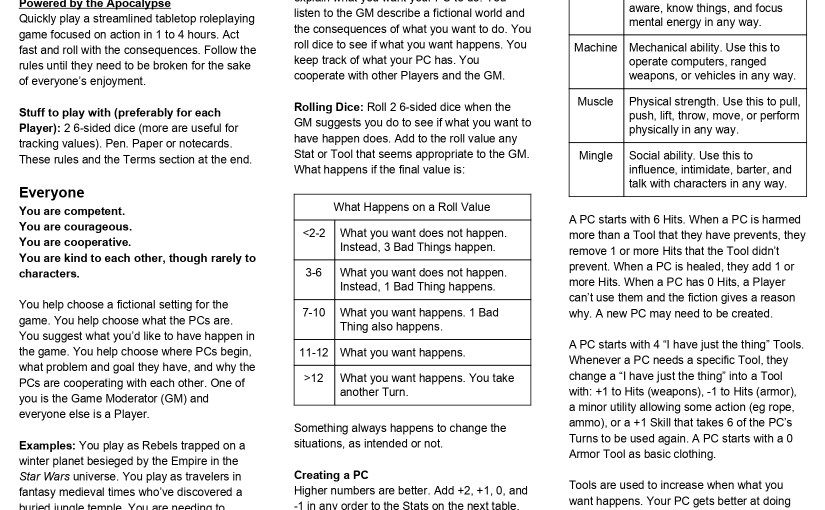
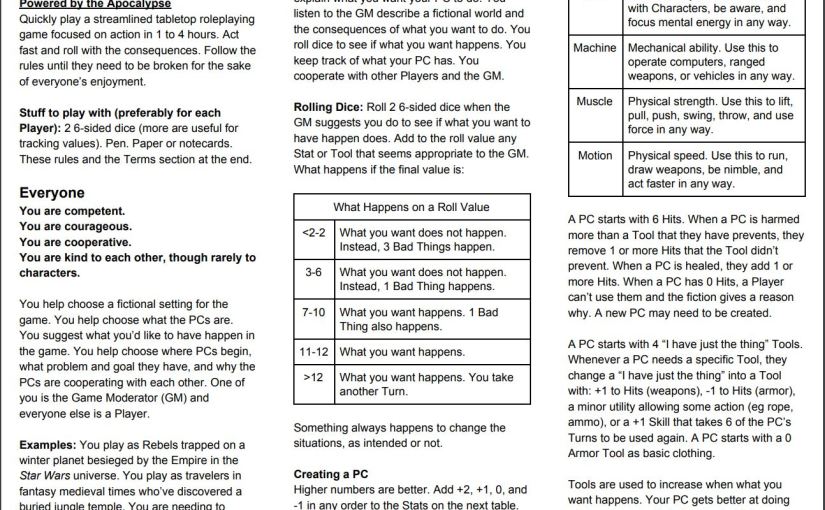
Preview of the Quick TTRPG ruleset.
Meant to be printed front to back on a single page, the Quick TTRPG means to accommodate for two styles of play (Action, Role Play), the roles of every participant (Player, Game Moderator), dice rules (two six-sided), stats (4M System), and the tools used in a game.
Further resources include random tables for both game setup, character creation, treasure, missions, and the Bad Things that happen.
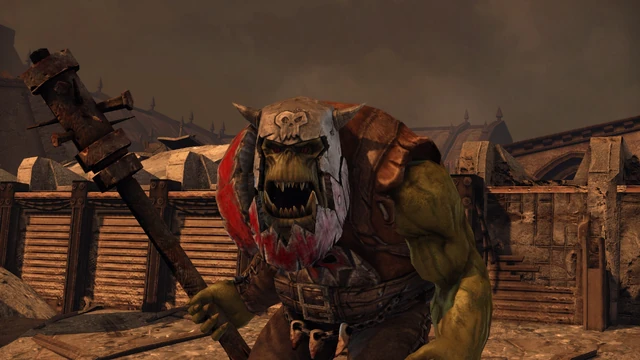
In the battles that take hours, dozens of dice are brought to bear. Me, a nerd, thought of only one thing:
What can we do to streamline the game?
Here’s what I found:
The Game Right Now
Stats
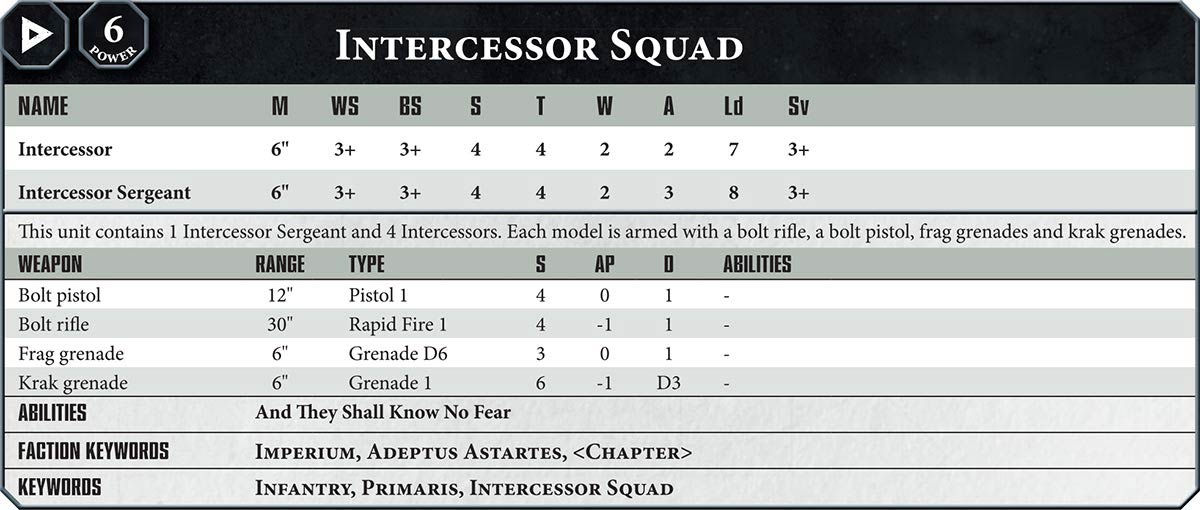
Warhammer 40K is a game of tiny model soldiers and monsters. A group of models is a “unit”, which is what acts on the battlefield.
A unit has these stats:
Name – easily distinguishes what you’re talking about.
Power – the level of the unit. Counts towards how large an army comprised of units may be.
Movement (M) – how far a unit may move on the board in a normal turn.
Weapon Skill (WS) – chance of hitting a target in melee combat. (Really, “Melee Skill”.)
Ballistic Skill (BS) – chance of hitting a target by shooting at it.
Strength (S) – how hard a unit hits in melee.
Toughness (T) – how difficult it is for an attack to do damage to the unit.
Wounds – health points per model; 0 is the death of the model.
Attacks (A) – how many melee attacks the model may make.
Leadership (Ld) – how likely a unit is going to keep fighting after taking losses. (Losing models in a unit can cause the rest of the models to ‘flee’, AKA die.)
Save (Sv) – what a player must roll to not have their models die when attacked.
Units also have special abilities and weapons. While weapons have Range, Armor Piercing (makes it harder for a target to Save), Strength (in melee, use this or the unit’s Strength, whichever is higher), Damage, and a special effects, these are self-evident in what they might do.
Turns
A single player turn is defined by phases:
Movement – if a unit can move, it may do so.
Psychic – special to only certain units in the game. Like shooting, but with your mind.
Shooting – ranged units fire.
Charge – units can move again. If they do, they get shot at.
Fight – all units close enough to enemy units use their melee weapons.
Morale – for any unit that lost models in the turn, they roll against their Leadership. Failure here can collapse the rest of the unit. (Heard you liked taking losses, so here are some losses for your losses.)
Shooting and Fight are the dice-heavy portions of the game and will be our focus here.
Let’s look at the similarities of the Shooting and Fight in how they make models die.
Both phases start by using Ballistic and Weapon Skill (respectively) multiplied by the number of Attacks that can be made in the form of numbers of dice. A success here is when set A of dice roll equal to or greater than the Skill, becoming subset B.
Next, an attacking player must check the Strength of their attacks against the Toughness of the target. What subset B needs to be or greater to changes when Strength is the same or different to the Toughness. Subset B will become subset C.
Finally, the player owning the target units will roll for their Save. The number of dice in subset C is how many dice must be rolled, their face value needing to be equal to or greater than the Save of the target. The number of dice that fall below this value are the number of models to apply the Damage of the attack to the model’s Wound (or “taking a Wound”).
TLDR; An attacker must see if they hit, then see if they harm a target. The target gets a chance to save themselves. If not, models take Wounds.
Clear so far?
My Turn
Looks like we have some formulas to crunch, starting with combining the attacking player’s “did I hit” and “did I harm” rolls.
The Attacker
We’ll ignore the differences between Shooting and Fight phases, instead focusing on only the hit/harm cycle.
For that, the hit roll is determined by the chance of Skill passing a value roll times the number of Attacks.
To Hit = chance Skill * Attack
Easy.
To harm, it gets tricky. We ought to compare the Strength stat of the attacker to the Toughness of the target.
To Harm = (Variable, given Strength compared to Toughness)
This marriage of stats means we can’t have one nice roll for the attacker as it changes every time they pick a different target.
Let’s get a divorce.
If we only consider the Strength of the attacker, the Strength ought to also be considered as a chance roll. Say, for a five Strength, it’s two (five or greater, six) divided by six (six-sided die D6), or 33%.
We’ll need to do something with chance Strength. How about combining it to Skill and Attack?
For that, we can put the passing chance of Skill and Strength together, forming a percentage. This percentage will be low because we’re multiplying percentages, so take 100% minus the low chance we got, thereby betting Let Attack be the number of dice to roll:
To Hit and Harm = 100% – (chance Skill * chance Strength), per #D6, # from Attack
We’re forgetting the Armor Piercing stat of some weapons. Originally, this would apply to the Save roll of the target. Since we’re trying to divorce the stats of two different units as much as possible, Armor Piercing should apply to the hit-and-harm combination roll:
Single Hit and Harm Roll = ((100% – (chance Skill * chance Strength)) * 6) + Armor Piercing
If a unit can roll dice greater than or equal to the value from the formula above, the attacker has successfully struck.
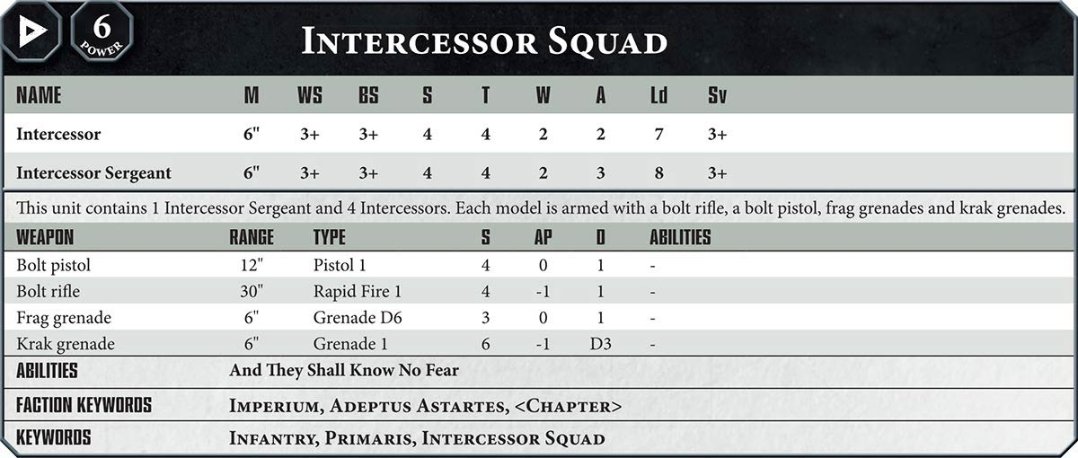
How does this work? Take an Intercessor Squad, armed with a Bolt Rifle, as example:
One model in the unit is going to fire at a target. Thus, it’s chance of success for a single die (ignoring that it could make multiple attacks) is:
Success >= (6/6 – (4/6 * 3/6) * 6) – 1
>= (1 – (.333)) * 6) – 1
>= (.667 * 6) – 1
>= 4 – 1 >= 3
This example shows we have a 67% chance to succeed on any roll. People like succeeding, so this high chance is perfect for an attacker’s immersion when they get to keep dice on the table. No problem there!
We see how what would normally be multiple rolls of dice distills into a single roll per attack for either ranged or melee combat. Time savings, huzzah!
The Target
We have to keep our target from dying. From the previous section, Toughness is on its lonesome. We also took care of the Save vs. Armor Piercing. Thus, pairing Toughness with Save, we get something like:
Get to Live >= (100% – (chance Toughness * chance Save)) * 6, per successful attacker die
Any failure here will cost Wounds from the Damage of the attack.
Using the Intercessor Squad above and for a single successful die, we get:
Get to Live >= (6/6 – (3/6 * 4/6)) * 6
= (1 – (.333)) * 6
>= .667 * 6 >= 4
If we don’t get a four on our dice, our own Intercessors will die. Sad day 😥
Still a good day, though, since we can provide a base stat to our unit on what it must roll to survive being attacked!
So we’re looking at a 3+ to attack and a 4+ to live. The numbers boil down to a 33% chance of Wounding a model (66.7% chance of a successful attack roll multiplied by a 50% chance to fail a saving roll).
But again, only two rolls are needed to determine an outcome from end to end, compared to three previously, and with a lot less mental math of comparing attackers to targets.
So Where Do We Go From Here?
I have a confession…
I didn’t playtest this system.
It’s a shame, I know. You know. Playtesting would be the next step. This could be done with Excel simulations, seeing what the typical outcome of this system is compared to the actual game.
There’s a concern already that we aren’t removing enough models, the chance of Wounding being a little low. That, and how can we leverage the Power of a unit? Can it be added to rolls or the difference between attacker and target be applied? I don’t know yet. Merely, it wouldn’t make a lot of sense for a tiny bug (yes, these are in the game) to survive being stomped on by a giant robot.
Doing research for this post, I also found fun numbers and percentages when using a D20 (20-sided dice). The result made calculating roll value requirements a lot easier when different weapons were applied to different units. An article here could be forthcoming with a proper investigation.
Finally, consolidating the stats of a few units is in order. That’d allow for a few examples of simpler, streamlined play.
That’s it! What have you done to improve games in your life? I hope this mod is an inspiration to look at things through a lens of “how can this be made into something new, maybe better?” Cheers for now!






 – health points per model; 0 is the death of the model.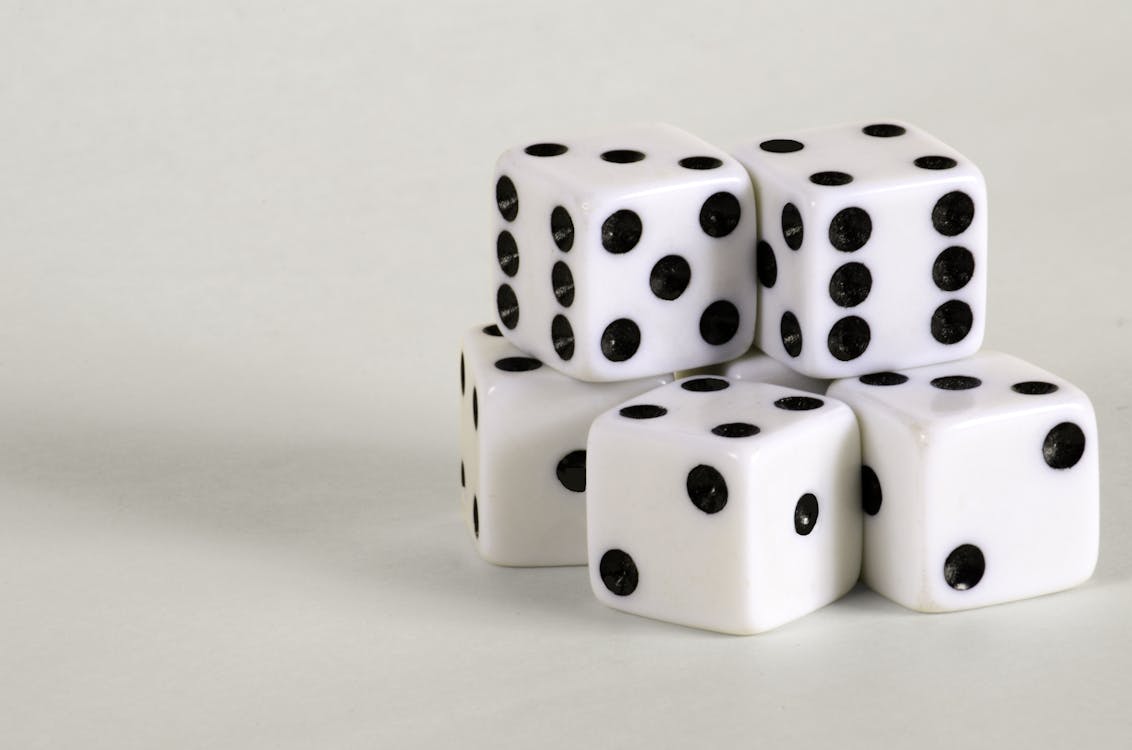
 Jimmy Chattin